



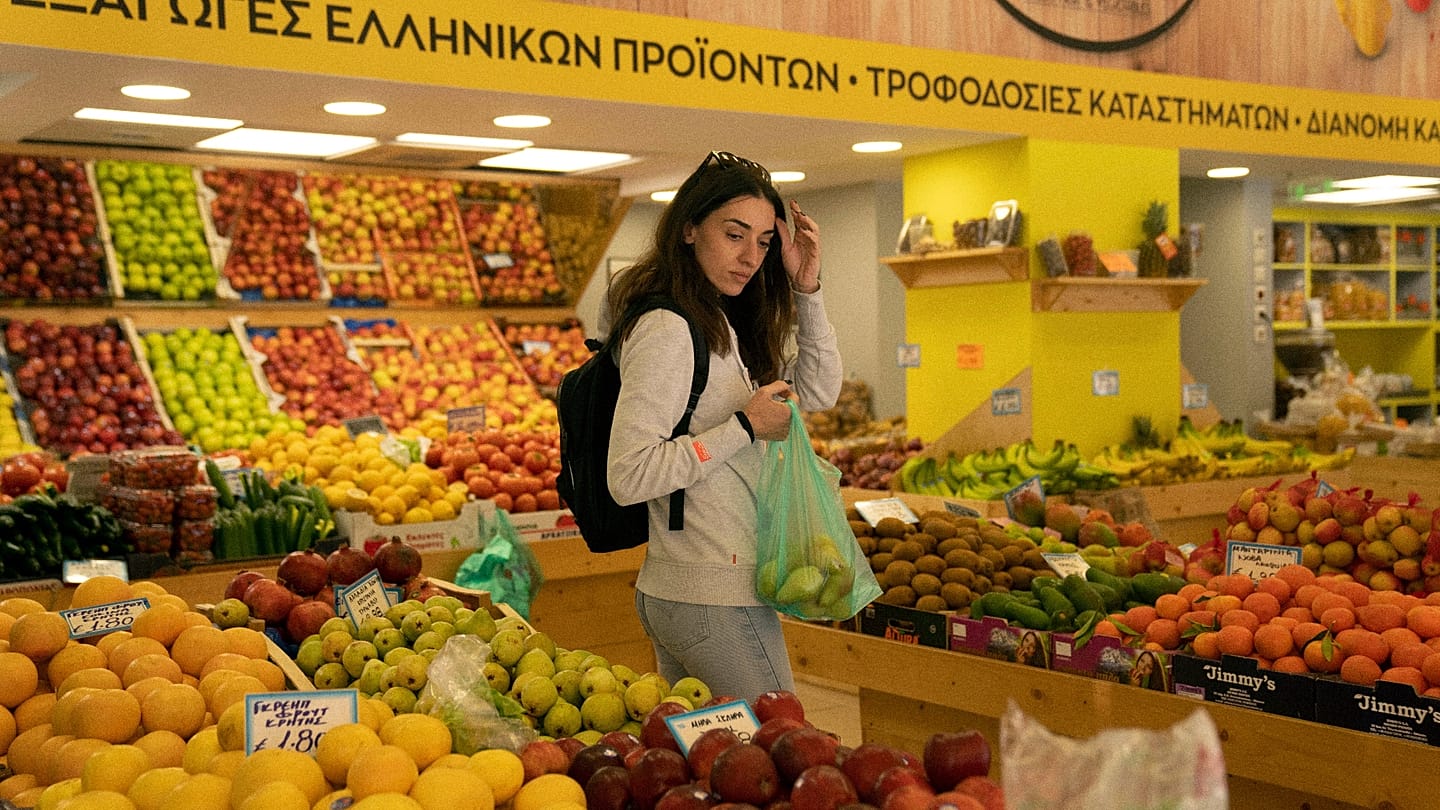
Grocery prices vary widely across Europe. Bread can cost more than three times as much in one country as in another. Euronews Business takes a closer look at the differences and what drives them.
Food takes a sizeable share of household budgets across Europe, but the cost of filling a shopping basket varies widely from country to country. In the EU, food and non-alcoholic beverages account for 13.6% of household spending, compared with 23.6% for housing and utility bills
Which countries are the most expensive for groceries, and what drives these differences?
According to mid-2026 data from Numbeo, a crowdsourced cost-of-living database, the grocery index ranges from 57.2 in Moldova to 189.2 in Switzerland, with the EU average set at 100. This means groceries are 89.2% more expensive than the EU average in Switzerland, while they are 42.8% cheaper in Moldova.
To illustrate the gap, a basket costing €100 at average EU prices would cost €189.20 in Switzerland and €57.20 in Moldova, based on the index.
Numbeo’s index takes New York as the base at 100. Euronews Business converted the index to use the EU average as 100.
Which are the most expensive countries?
Three of the five most expensive countries are Nordic. Iceland (183.6) ranks second, followed by Norway (154.4), Luxembourg (134.9) and Denmark (128.4). The other Nordic countries are also above the EU average: Finland (119.7) and Sweden (116.6).
Among five of Europe’s major economies, France is the most expensive for groceries, at 27.5% above the EU average. Spain (89.7) is the only one below the average. The UK (111.9), Germany (111.6) and Italy (110.2) are above it, with similar price levels.
Austria (124.5), Ireland (122), Belgium (117.6) and the Netherlands (116.4) are also among the more expensive countries, all above the EU average.
Cheapest EU country: Groceries in Romania cost a third less
Within the EU, Romania (66.7) is the cheapest country for groceries, with prices 33.3% below the EU average.
More broadly, groceries are cheaper in Eastern European and Balkan countries, including EU candidates. For example, the index is 59.8 in North Macedonia, 67.9 in Bosnia and Herzegovina and 68.8 in Serbia.
Turkey (82.1) is more expensive than several EU members, although it remains below the EU average. Turkey also has the highest food inflation in Europe.
Lower prices do not mean greater affordability
Ilaria Benedetti, an associate professor at the University of Tuscia, pointed out that while food prices are lower than the EU average in some countries, households spend a larger share of their budget on food. For example, groceries are cheaper in Romania, but households spend 23.1% of their budgets on food and non-alcoholic drinks. This share is also above 20% in Bulgaria.
“Lower prices do not necessarily mean greater affordability,” Prof. Jeremiás Máté Balogh from Corvinus University told Euronews Business.
Pointing to differences in wages and purchasing power, he emphasised that groceries can be cheaper in absolute terms but less affordable relative to what people earn after tax.
An 18-item grocery basket costs €69.84 in the EU
Numbeo lists 19 items in its “Markets” category. Euronews Business collected the prices of these items in October 2026. Adding together the listed prices of 18 items, with each counted once rather than weighted, gives an average EU basket cost of €69.84.
Cigarettes are excluded from the Euronews calculation because prices vary substantially and the share of smokers differs across countries.
As with the index, the grocery basket is most expensive in Switzerland at €137.90, while Moldova is the cheapest at €41.10.
The basket also costs more than €100 in Norway (€116.10). Other expensive countries include Luxembourg (€99), Austria (€88.10) and Denmark (€87.70).
France is still the most expensive among the five major economies compared. The basket costs €87.40 in France, compared with just €63 in Spain. These groceries cost €80 in Italy, €75.20 in Germany and €69.10 in the UK.
The 18 grocery items can be bought for less than €50 in North Macedonia (€43.90), Kosovo (€45.50), Romania (€45.90), Georgia (€46.90), Poland (€49.60), Serbia (€49.70), Montenegro (€49.80) and Bosnia and Herzegovina (€49.80).
However, these rankings are based on nominal prices. When purchasing power is taken into account, the gap narrows. The rankings may also change slightly when the basket is weighted.
The role of energy prices and labour costs
“Labour costs have likely become one of the most persistent drivers of grocery prices across Europe, but energy costs remain an important factor,” Balogh said. He noted that higher energy, fuel, and transportation costs continue to affect agricultural production, food processing, and distribution.
Benedetti said that energy is the main driver of recent rises in food prices, particularly fuel this time. She added that, since the strikes on Iran at the end of February, the average price of diesel in the EU had risen from €1.59 per litreon 23 February to €2.24 on 28 September, the highest level since records began in 2005.
“Diesel moves the whole food chain, from tractors to the lorries that supply supermarkets,” she told Euronews Business.
She also pointed out that when inflation slows, prices do not necessarily fall. If inflation remains positive, they keep rising, only more slowly, from a higher level.
Why does bread cost more than three times as much in Denmark as in Bulgaria?
“The price of food in a shop is only partly the cost of the food itself,” Benedetti said.
“It also includes wages, energy, rents, transport and taxes, which are much higher in richer countries.”
She noted that a 500g loaf of fresh white bread costs €3.18 in Denmark and €1.02 in Bulgaria — more than three times as much a more standardised product, costs €4.52 in Denmark and €2.69 in Estonia, less than twice as much
Balogh explained that differences in grocery prices across European countries reflect a combination of factors, including wages, land and labour costs, retail market structure, taxation, exchange rates, logistics and transportation costs, agricultural productivity and consumer preferences.
Source: www.euronews.com

3 Comments
Pingback: Startups don't need to go viral to win customers - Warsaw.Today
Pingback: Expert says electric flights are closer than we think - Warsaw.Today
Pingback: Anchorage: A City Within the Wild - Warsaw.Today