



Aeroplane manufacturers should be forced to pivot to electric as car companies have, says influential Dutch researcher Maarten Steinbuch.
The Netherlands is pushing the world towards electric flight faster than most European countries.
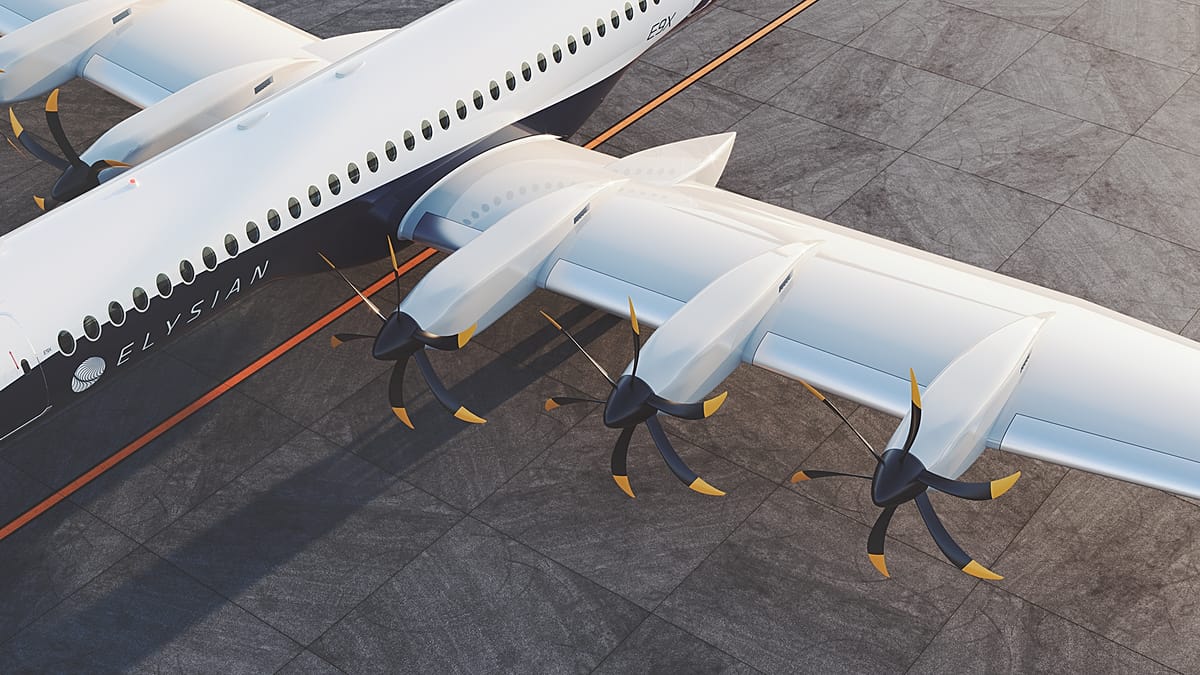
One of the world’s first battery-powered passenger planes is being built by Dutch start-up Elysian Aircraft. Development is well underway: “There will be six engines. And we have folding wingtips, so that we fit into the current gates’ infrastructure of the airports, because the wings are very large,” explains co-founder Daniel Jacobson.
Cutting fossil fuel emissions is the most pressing challenge facing the world, and aviation is a big contributor. “By being able to transport 90 passengers for initially 800 kilometres and eventually 1,000 kilometres you can reduce emissions to zero, from half the world’s flights,” Jacobson says. “That is a very large amount of flight activity in the world. And you reduce total emissions from aerospace by 20 per cent.”
Should the European Union be backing electric air travel? What can e-planes learn from EVs? When will ordinary passengers be able to fly in an electric plane?
Euronews Earth sat down with Maarten Steinbuch, a renowned Professor of Mechanical Engineering at Eindhoven University of Technology, to get his expert view of the future of electric flight.
We can’t leave it to the airlines to cut their own emissions
Aviation contributes six per cent to global heating, when CO2 as well as other emissions are taken into account. In wealthy countries, aviation is responsible for a much larger share, according to data seen by campaign group Stay Grounded.
The aviation industry is, of course, aware of its impact and has made promises to cut emissions. The International Civil Aviation Organization (ICAO), the UN agency responsible for regulating international aviation, adopted the goal of “carbon neutral growth from 2020”. However, CO2 emissions from international aviation have increased since 2020, as the goal focuses on offsetting the sector’s CO2 emissions rather than committing to real emissions reductions.
Climate Action Tracker rates the ICAO’s goal of carbon neutral growth from 2020 levels as “Highly insufficient”.
The European Commission, Professor Steinbuch says, is focused on helping “current aviation” to “become as sustainable as possible”. But rather than helping current planes to reduce the emissions they create, the Commission should be supporting a pivot to zero emissions planes – electric ones. “There is not enough attention yet to have a revolution in airspace electrification. So, it’s more an evolution and not yet a revolution.”
Could electric planes become as common as EVs?
Electric vehicles have been adopted across Europe, faster than many people predicted. Sales grew year-on-year from 2020 to 2025, with one in four cars sold worldwide in 2025 being electric, according to the International Energy Agency. As a result, about five per cent of the global car stock is now electrified, displacing 1.2 million barrels of oil per day in 2025.
This shift did not happen by magic but because car companies were put under pressure through government policy. “I have seen, in the electrification of passenger cars, that being strict on dates when manufacturers of cars effectively should have a sufficient number of models of electric cars available really helped,” says Professor Steinbuch.
He believes that if similar requirements were made of aeroplane manufacturers, we could see real change. “We need legislation saying that part of a fleet could be electrified in this or that year. Push that also with legislation.”
The European Commission also needs to speed up how quickly new aeroplane designs are certified. Safety must be the “first, second and third” priority, of course, but “it could help if the European Commission would put a little bit more effort in, so that those processes could be accelerated and giving space for scale-ups to build up both on the infrastructure for electrification of airflights, but also for the manufacturing and the startups who make new planes.”
When will electric flights be available to us all?
Seeing the owners of low-cost airlines become influential millionaires, it can be difficult to imagine aviation losing its grip on the market.
But Professor Steinbuch says there are plenty of reasons to be optimistic that electric flights will be common in the not too distant future – and there’s one key component.
“It’s not a dream, it is very real and the most important part of development is the batteries. Batteries are the key thing. All over the world billions of euros and dollars are spent in development. Why? Because everybody knows that batteries are the Holy Grail for the transition both in mobility as well as in energy.”
Batteries are so crucial because they power electric planes, and how long they last determines how far they can fly. “If solid-state batteries with double the capacity – up to 500 watt-hours per kilogram – come onto the market, electric flying will attract the interest of far more people. And this point will come soon.”
How soon? “I think in 2032 or so, within six years, we might see the first 500 km range airplanes for cargo and for passengers, at five seats, so that’s a very small scale – but still it will be a start for specialised purposes.” Three years later, in 2035, “we could see nine-seaters, maybe 20-seaters, flying with a range of 500 kilometres. 80- or 90-seaters will be more close to 2040, even maybe beyond.”
Source: www.euronews.com
