



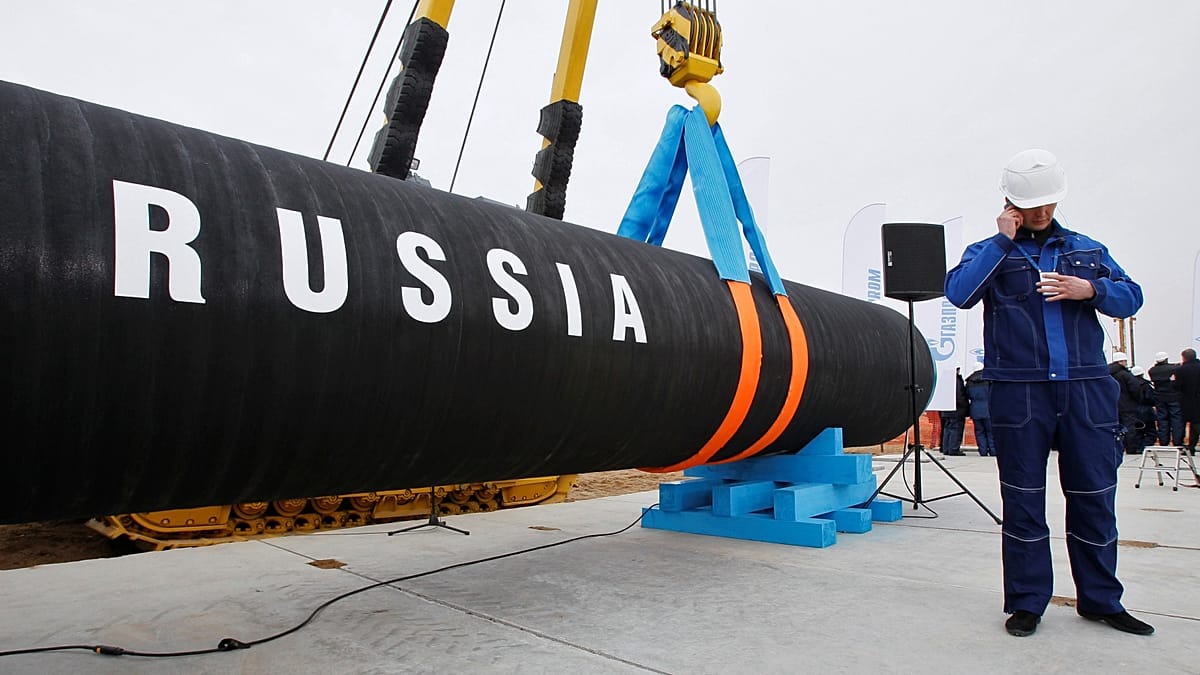
Brussels insists Nord Stream will remain shut after the war in Ukraine ends, countering a joint push by the US and Russia to restart the pipeline.
The Nord Stream pipeline will not bring Russian gas into Europe after the war in Ukraine comes to an end, the European Commission has said, pushing back against a joint attempt by Washington and Moscow to revive the controversial project.
The underwater pipeline, which links Germany to Russia across over 1,200 kilometres, is under EU sanctions. Nord Stream 1 has been inoperable since an explosion in mid 2022, while Nord Stream 2 never received certification from the German government.
“We know far too well the hidden costs of being dependent on Russia for the purchase of fossil fuels,” Paula Pinho, the Commission’s chief spokesperson, said on Wednesday in reply to a Euronews question.
“They have been weaponised and we have been paying the price, so we do not forget that,” she added.
Pinho cited a speech by Commission President Ursula von der Leyen, who last week told MEPs that sanctions on Russian energy would remain “until Russia stops the war”.
Von der Leyen voiced the same view earlier this month during a summit of EU leaders attended by Ukrainian President Volodymyr Zelenskyy.
Her words were a rebuke to the diesel supply deal struck by US President Donald Trump and Russian President Vladimir Putin, which enraged Europeans.
Pressed on whether the thinking would also apply to the post-war scenario, the Commission pointed to the legislation that member states approved to phase out all imports of Russian gas by the end of 2027.
Short-term LNG contracts have already been phased out, while long-term LNG contracts will cease by January 2027. The final step concerns pipeline gas contracts, such as those previously associated with Nord Stream, which will be phased out by September 2027.
“The legislation in force is not tied to sanctions or any geopolitical events either,” Anna-Kaisa Itkonen, the Commission’s energy spokesperson, said.
“So regardless of what happens, we are phasing out Russian gas and LNG from the European market. The last shipments should be finished by the end of next year.”
Pinho added: “It’s a good occasion to remind ourselves who has cut the supplies in the first place. It was Russia, in case this is being forgotten in the meantime.”
A dark legacy
Nord Stream has become a symbol of Europe’s prolonged reliance on Russian energy, a dependency that proved costly after Moscow’s full-scale invasion of Ukraine triggered a surge in energy prices, driving bills to record highs.
In response, the bloc adopted a phase-out strategy that brought the share of Russia’s pipeline gas from around 40% in 2021 to around 6% in 2025. The switch came with a hefty price tag, as countries turn heavily to the more expensive American LNG.
Now, as peace talks to end the war intensify, the US and Russia have reportedly floated a plan to restart gas flows to Europe, including through Nord Stream with an US investor.
The two sides are said to be discussing others deals involving the Lukoil assets, nuclear technology and Arctic LNG. This fits with Washington’s strategy of dangling economic benefits to entice Russia into meaningful negotiations.
Europeans contend the approach is fundamentally flawed because it ignores Putin’s fixation with territorial conquest, the core reason why he launched the invasion. No deal, however lucrative, can replace Ukraine’s annihilation in Putin’s mind, they say.
In fact, Moscow is yet to offer a single concession in return.
But the contentious strategy also has European supporters.
Alice Weidel, the leader of the far-right Alternative for Germany (AfD), has vowed to end sanctions and restart Nord Stream if she ever reaches power, arguing cheap Russian gas was the “secret” of Germany’s past economic success.
“We want natural gas and crude oil from Russia to relieve German consumers and German businesses,” Weidel recently told the German parliament.
Chancellor Friedrich Merz has accused Weidel of taking Russia’s side and insisted the country’s energy supply can be safeguarded only with renewable sources.
Abolishing or amending the EU legislation that phases out Russian gas would require a new proposal by the Commission and a qualified majority among member states.
The majority of countries remain of the opinion that buying from Moscow comes with unacceptable costs for the common security.
Source: www.euronews.com
