



The Federal Reserve kept interest rates unchanged on Wednesday, six days before the midterms, but two officials, including Governor Lisa Cook, whom US President Donald Trump is trying to fire, voted for a hike, with inflation at 3.7% and investors still braced for a rise in December.
The Federal Reserve held its benchmark interest rate at 3.75% to 4% on Wednesday, pausing after raising borrowing costs in September for the first time in three years.
However, policymakers were split 10-2, with Fed Governor Lisa Cook, whom US President Donald Trump is trying to remove, and Cleveland Fed President Beth Hammack both voting for another quarter-point hike.
The decision came less than a week before Americans vote in the midterms, and with inflation at 3.7% and energy prices elevated, markets still expect the central bank to raise rates again in December.
The split marks a break from September, when the Fed’s rate-setting committee voted unanimously for a hike.
Dallas Fed President Lorie Logan, who had also been tipped to vote for higher rates, backed the decision. Some economists had argued that dissents could even help Fed Chair Kevin Warsh by showing that there was still support on the committee for tighter monetary policy.
In its statement, the Fed said that “inflation remains elevated”, adding that gathering more information would help it decide on the policy stance needed “to ensure a timely return of inflation” to its 2% target, and repeated that it “will deliver price stability”.
The wording keeps the Fed’s options open. In September, it said its hike would support a “timelier” return to its target.
The Fed also upgraded its view of the economy, saying activity was “expanding at a strong pace”, compared with a “solid pace” in September, while uncertainty remained elevated “owing, in part, to geopolitical developments”.
In June and July, the first two meetings Warsh chaired, it had pointed instead to “the conflict in the Middle East”, and blamed above-target inflation partly on supply shocks in sectors “including energy”.
Since September, it has dropped both references, becoming less specific about the Iran war in the statements.
As of the last hike, several senior officials have played down the urgency of moving again. Vice Chair Philip Jefferson pointed to a sharp rise in longer-term borrowing costs, while New York Fed President John Williams said there was “no need for urgency”.
Cook’s dissenting vote comes as US President Donald Trump presses ahead with his efforts to remove her over mortgage fraud allegations she denies. He has set up a three-person committee to recommend whether he has cause to fire Cook, who was appointed by former US President Joe Biden, and she is expected to appear before it next week.
In June, the Supreme Court halted a previous bid to oust her.
Inflation keeps the pressure on
The case for tighter policy has not gone away.
US consumer prices rose 3.7% in September from a year earlier, while core inflation, which strips out food and energy, climbed to 2.6%.
Petrol, which has cost more than $4 a gallon for the past three months, drove over half of September’s price increase, and diesel hit a record $6.53 a gallon in late September.
Brent crude, the global oil benchmark, fell more than 6% on Monday as diplomacy over the Iran war gathered pace, and traded at around 111.75$ a barrel late on Wednesday, still far above the roughly $72 it fetched before the conflict began in late February.
Higher borrowing costs are already biting, with the average 30-year US mortgage rate hitting a three-year peak of 7.4% in early October.
Hiring has also slowed sharply, with employers adding just 29,000 jobs in September and unemployment rising to 4.2%, though the Fed said job gains had “kept pace with the workforce”.
Yet the economy has held up.
It grew at an annualised 2.2% in the second quarter, and the Atlanta Fed’s GDPNow tracker points to 3.5% for the third.
What Warsh said
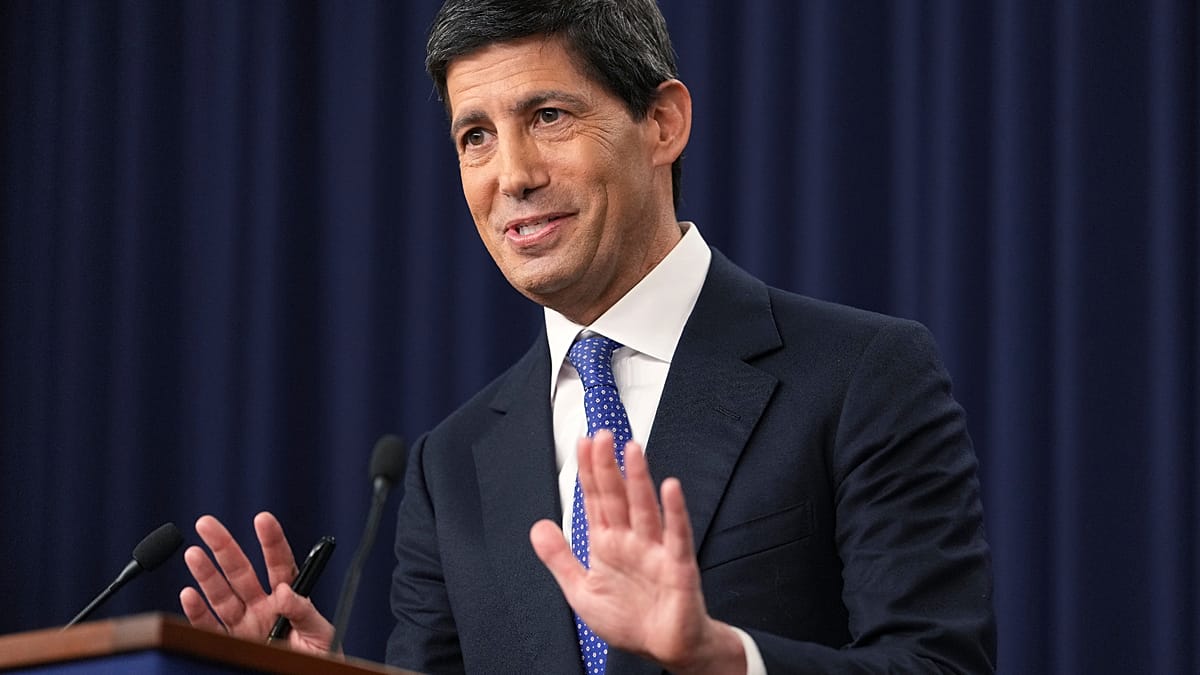
Speaking to reporters after the decision, Warsh largely repeated the Fed’s statement, saying that “domestic spending has been resilient, productivity growth is strong and capital investment robust”, but that “inflation remains elevated”.
He said more information would help the committee decide on the policy stance needed “to ensure a timely return of inflation to the 2% goal”, adding that “the committee will deliver price stability.”
Warsh has long opposed forward guidance, the practice of signalling future moves to the markets. Speaking in Bangkok earlier this month, he said “I don’t prejudge meetings.”
He also announced a shake-up of the calendar of the Federal Open Market Committee (FOMC), which sets US interest rates. The committee will keep meeting eight times a year, but from next autumn, some of those meetings will be dedicated to discussing strategy instead of setting rates.
“We believe eight meetings per year is the right number for the FOMC, but in 2027 one meeting will focus exclusively on broad monetary policy strategy, with neither a vote on the federal funds rate nor a policy statement anticipated,” Warsh said.
He added that he expected “in 2028 we will have two meetings dedicated to discussions of strategy and six for setting policy”, meaning the Fed will decide on rates seven times in 2027 and only six times in 2028, down from eight now.
After the decision, markets priced an 87.5% chance of a quarter-point hike at the Fed’s 8-9 December meeting, up from 73% on Tuesday, according to CME Group’s FedWatch tool, which tracks interest rate futures.
Investors will also not have to wait long for their next clues.
On Thursday at 13:30 CET, the US publishes its first estimate of third-quarter growth and September data for the Fed’s preferred inflation gauge, the personal consumption expenditures (PCE) price index.
Attention then turns to Europe.
The European Central Bank announces its own decision on Thursday and is widely expected to hold its deposit rate at 2.5%, with France’s bond market turmoil taking centre stage.
Source: www.euronews.com

2 Comments
Pingback: Hacker stole personnel data about thousands of Homeland Security employees, including CBP and ICE agents - Warsaw.Today
Pingback: US ambassador suggests Trump could blame Canada if midterms don’t go his way - Warsaw.Today