



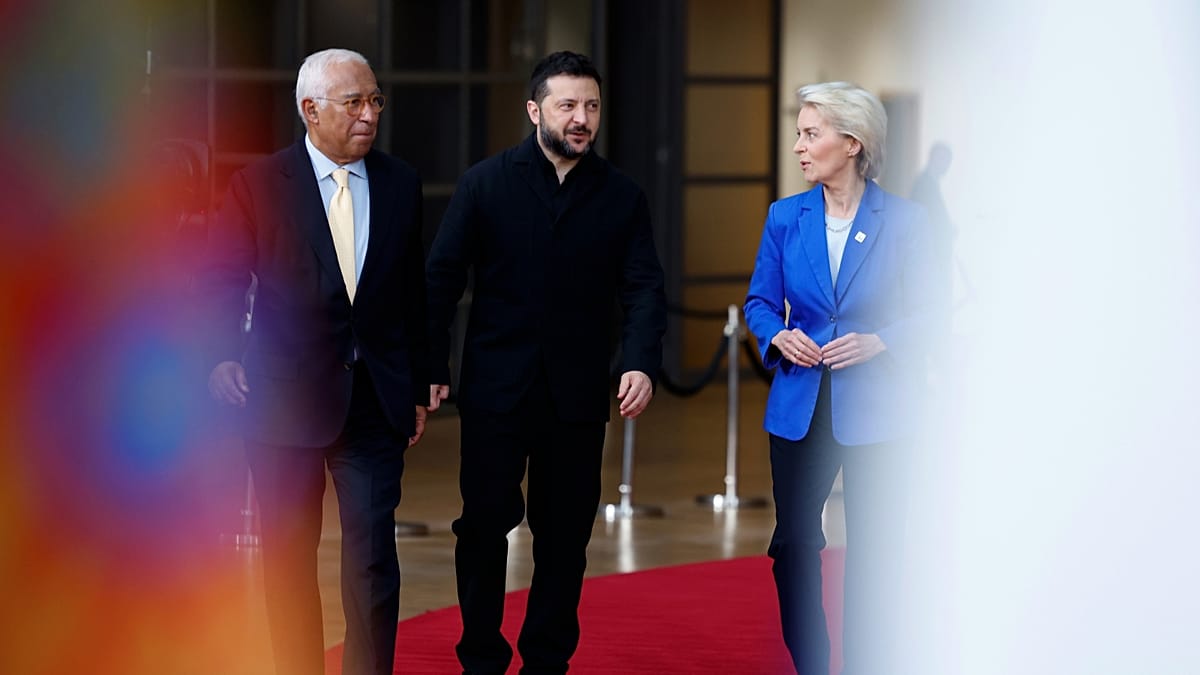
Brussels wants to turn the next round of trilateral peace talks betwen Ukraine, Russia and the US into a multilateral format with European representation.
The European Union is seeking a greater role in peace talks to end Russia’s war on Ukraine, potentially including direct contact with Moscow.
The United States wants to resume trilateral talks at the technical level in November, after its midterm elections. Ukraine says it welcomes any format at any time, while Russia has said it is “ready in principle”.
The peace process stalled in February after the US launched its war on Iran, shifting much of its diplomatic focus to the Middle East.
Brussels sees a possible resumption of talks as an opportunity to move from a trilateral to a multilateral format, bringing European representatives to the table and giving the EU a chance to influence Washington’s thinking, which has recently shifted sharply in Moscow’s favour, setting off alarm bells.
Europeans, however, have a track record of being blindsided, dismissed and even ignored by their American counterparts, so there is no guarantee of success.
“Now, there is an expectation that there will be a multilateral-level discussion with representatives at senior official level, and the EU will be present at these talks,” European Commission deputy chief spokesperson Arianna Podestà said on Friday.
“We have always worked to have Ukraine in a position of strength, and we have always worked for a just and lasting peace for Ukraine. We’re doing so on every occasion.”
Podestà said the EU should be represented jointly by the European Commission, the bloc’s executive arm, and the European Council, which represents member states.
Asked whether this could involve European officials meeting Russian representatives face to face, she left the door open.
“At this stage, I wouldn’t have further details to provide. The expectation is that there would be a joint Commission-Council representation that would attend the meetings,” she said. “Beyond that, I don’t have other elements to share.”
Kremlin spokesperson Dmitry Peskov did not immediately oppose European participation, as Moscow has done in the past, but stressed that the next round of talks under preparation would remain trilateral.
“Nothing can be ruled out a priori,” Peskov said.
“But these talks we are discussing, which are scheduled for the first half of November in Abu Dhabi, will take place in a trilateral format.”
A seat for two?
It remains unclear whether both EU institutions will have a place at the table.
The last rounds of talks involving Ukraine, Europe and the US, first in Miami and later in Oslo, included only Bjoern Seibert, Commission President Ursula von der Leyen’s powerful chief of cabinet.
Pedro Lourtie, chief of cabinet to European Council President António Costa, was not invited.
National security advisers from Germany, France and the UK — the so-called E3 — and NATO attended the Miami talks. In Oslo, Italy took France’s place.
Discussions focused on security guarantees for Ukraine, sanctions against Russia and post-war recovery. After the Oslo talks, US special envoy Steve Witkoff met Russian President Vladimir Putin in Saint Petersburg for nearly three hours.
The Kremlin later dismissed Witkoff’s proposals as offering “little of real value” towards ending the war, while signalling its readiness to resume technical-level talks.
EU officials and diplomats say Moscow has yet to show signs of abandoning its maximalist demands or engaging meaningfully in the peace process. But with the stakes so high, they argue, Europe cannot afford to sit on the sidelines.
US President Donald Trump’s decision to strike a diesel supply deal with Putin and ease long-standing sanctions on Russia has alarmed European capitals, reinforcing their view that the EU’s presence at the table is essential as a counterweight to Washington.
Ukrainian President Volodymyr Zelenskyy, whom Trump has repeatedly criticised, has urged European leaders to establish their own diplomatic channel with Moscow.
Earlier this year, Costa quietly opened a line of communication with Russia, but the initiative failed to yield results and was put on hold.
The idea of appointing a special envoy was discussed again by EU leaders at last week’s summit. No consensus candidate emerged, but Finnish President Alexander Stubb has returned to the conversation after co-hosting the latest round of talks in Oslo.
Moscow later said it could accept Stubb as an intermediary, provided he did not “parrot” the European position — a condition unlikely to sit well with the Finnish president, a staunch supporter of Ukraine.
Source: www.euronews.com
