


Close Menu
Warsaw.Today
    What's Hot

    How Sudan’s shift to drone warfare is fuelling a civilian crisis

    October 22, 2026

    What’s next for hospitality in Qatar?

    October 22, 2026

    Forget “Malaise 2.0,” GM says it’s still all-in on EVs and autonomy

    October 22, 2026
    Facebook X (Twitter) Instagram
    Trending
    • How Sudan’s shift to drone warfare is fuelling a civilian crisis
    • What’s next for hospitality in Qatar?
    • Forget “Malaise 2.0,” GM says it’s still all-in on EVs and autonomy
    • Gdyby w “Matkach pingwinów” pokazali całą prawdę, trudno byłoby w to uwierzyć
    • United Gateway Card review: MileagePlus miles without the frills
    • Almost every shallow-water coral reef on the planet faces ecosystem collapse by 2075, UN advisors say
    • Gulf nations brace for possible return to all-out war
    • ‘Nunchucks’ wielded by agitated man in Hannah Beazley’s office may have been drumsticks, court told
    Facebook X (Twitter) Instagram
    Warsaw.TodayWarsaw.Today
    Demo
    • Home
    • News
    • World
    • Sports
    • Business
    • Culture
    • Politics
    • Travel
    • Technology
    Warsaw.Today
    Home»World»Almost every shallow-water coral reef on the planet faces ecosystem collapse by 2075, UN advisors say
    World

    Almost every shallow-water coral reef on the planet faces ecosystem collapse by 2075, UN advisors say

    Peter NovakBy Peter NovakOctober 22, 2026No Comments0 Views
    Facebook Twitter Pinterest LinkedIn WhatsApp Reddit Tumblr Email
    Share
    Facebook Twitter LinkedIn Pinterest Email

    Assessment finds global heating is endangering 96% of coral reefs across 80 countries – a figure scientists say should serve as a ‘wake-up call’

    Almost every shallow-water coral reef on the planet, including Australia’s Great Barrier Reef, faces a high risk of ecosystem collapse before 2075 because of global heating, according to an assessment by United Nations nature advisers.

    About 24% of the planet’s reefs across more than 80 countries are already critically endangered, the assessment said, but when the expected impacts of global heating were added this rose to 96%.

    Coral reefs are known as the rainforests of the sea. A quarter of all known marine species are found in and around them and they support hundreds of millions of people with food, as well as protecting shorelines and supporting tourism.

    Overfishing, pollution, coastal development and global heating have already caused declines in the ecosystems over the past 50 years, measured by the loss of live coral as well as changes in fish populations, the assessment said.

    But the scientists said while the prognosis was dire, the findings should serve as a “wake-up call” because reefs could survive with rapid cuts to fossil fuel use and strong conservation action at local levels.

    “The risk is real and very concerning,” said Dr Mishal Gudka, research director at CORDIO (Coral Reef Degradation in the Indian Ocean) East Africa and the scientific lead for the assessment.

    “We stand to lose one of the most valuable ecosystems we have – the impacts of which will affect millions of people around the world.”

    The assessment analysed the current status and future threat levels of 127 coral reef regions and was coordinated by the International Union for Conservation of Nature (IUCN), an international group that advises the United Nations.

    The assessment assumed greenhouse gas emissions – mainly from burning fossil fuels – would follow a “middle-of-the-road” pathway, causing about 2.7C of global heating by the end of the century when compared with temperatures before the Industrial Revolution.

    Current climate policies and targets adopted by countries around the world are likely to cause about 2.6C of global heating, one assessment finds.

    The share of coral eco-regions considered critically endangered would likely be even higher, the IUCN said, but four regions did not have enough data to assess them and the coral reefs of the western Galápagos had already collapsed.
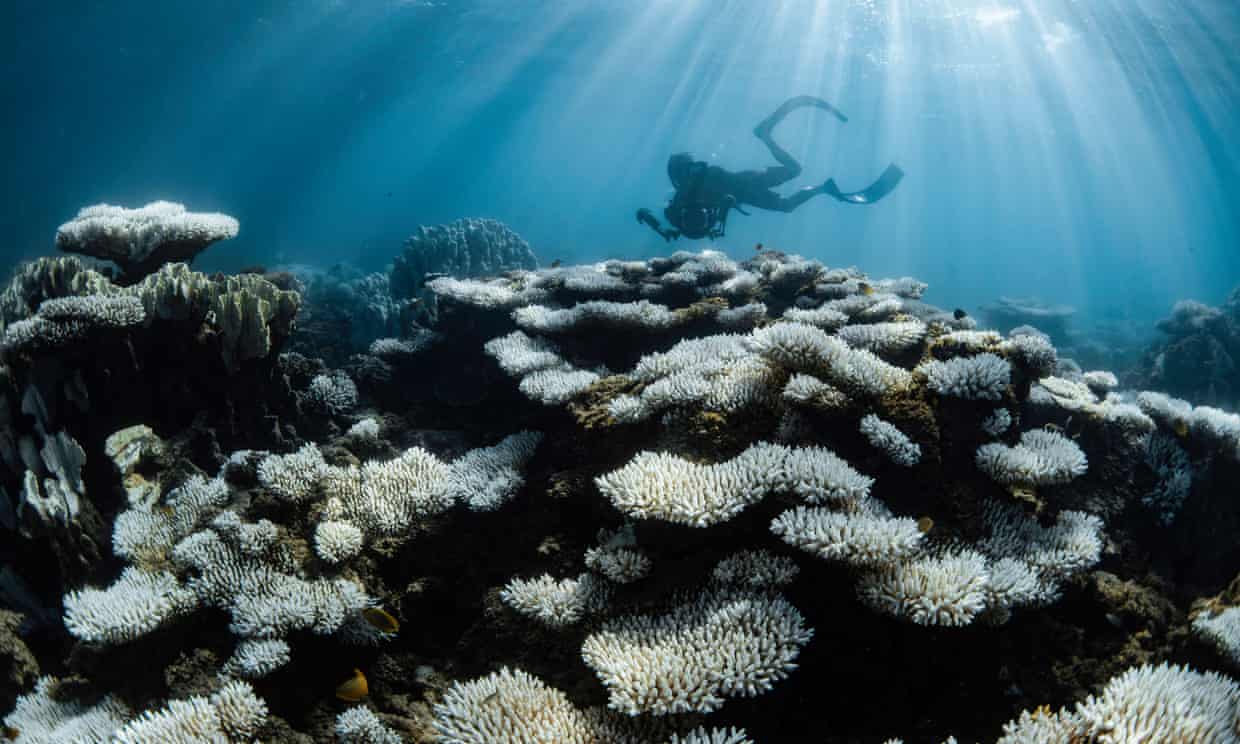
    A diver among bleached coral
    Extensive coral bleaching occurred at the Ningaloo Reef, WA, in February 2025. Photograph: Brooke Pyke

    The critically endangered classification meant an “extremely high risk” of ecosystem collapse before 2075.

    The group considers a coral reef ecosystem to have collapsed if the reef could not maintain itself because of a near or complete loss of living reef-building corals.

    The assessment did not fully account for the impacts of the fourth global mass bleaching event from early 2023 to mid-2025 – the most widespread global mass bleaching event on record, the US government’s Coral Reef Watch has confirmed.

    That global event was bookended by the worst mass bleaching event on record for reefs in Western Australia where a heatwave killed corals across 1,500 kilometres (930 miles).

    Marine heatwaves can cause corals to separate from the symbiotic algae that provides them with colour and nutrient. While not always deadly, bleaching can weaken corals and make them more susceptible to disease.

    Gudka said the results were a “wake-up call” and were “alarming, but certainly not hopeless”.

    He said: “They should be seen as a call to action – an early warning sign before the worst outcomes eventuate.”

    Dr Grethel Aguilar, the director general of the IUCN, said: “It is not too late to give coral reefs a chance to recover, but it requires decisive action to tackle climate change and halt further ocean warming.

    “We know what is needed: ambitious emissions reductions, stronger protection and restoration efforts, and sustained investment in resilient coastal ecosystems and the communities that depend on them.”

    Four of Australia’s 17 reef regions were considered critically endangered. Five were endangered and five more were classed as vulnerable.

    But all 17 regions, including the Great Barrier Reef, were critically endangered once the expected impacts of climate change were accounted for.

    Dr Ben Fitzpatrick of the University of Western Australia Oceans Institute led the Australian assessment. He said even after accounting for the ability of some corals to adapt to warmer water, the rising heat “overwhelmed everything”.

    “Reefs are like Picasso paintings underwater,” he said. “They have all these wonderful inhabitants in their millions. You can spend a lifetime trying to understand how all these weird critters go about their daily lives.

    “To think we might lose that is devastating. There’s one message. We have to stop burning fossil fuels.”

    Explore more on these topicsReuse this content

    Source: www.theguardian.com

    Australia news Climate crisis Coral Environment Great Barrier Reef Marine life Oceans Wildlife
    Share. Facebook Twitter Pinterest LinkedIn Tumblr Telegram Email
    Peter Novak
    • Website

    Related Posts

    How Sudan’s shift to drone warfare is fuelling a civilian crisis

    October 22, 2026

    ‘Nunchucks’ wielded by agitated man in Hannah Beazley’s office may have been drumsticks, court told

    October 22, 2026

    Is Neha Bora, India’s new red star, Modi’s real Gen Z threat?

    October 22, 2026
    Leave A Reply Cancel Reply

    WARSAW WEATHER
    Economy News
    World

    How Sudan’s shift to drone warfare is fuelling a civilian crisis

    By Peter NovakOctober 22, 20260

    In the Imtidad Nasser neighbourhood east of Sudan’s capital Khartoum, residents are grappling with a terrifying new reality of skies filled with drones.

    What’s next for hospitality in Qatar?

    October 22, 2026

    Forget “Malaise 2.0,” GM says it’s still all-in on EVs and autonomy

    October 22, 2026
    Top Trending
    World

    Switzerland’s neutrality vote is asking the wrong question

    By Peter NovakSeptember 25, 20260

    On September 27, Switzerland votes on whether to lock a stricter definition of neutrality into its constitution. The initiative would bar Switzerland from cooperating with a military alliance unless it were under military attack or such an attack were being prepared, and prevent it from imposing sanctions on a belligerent state unless those sanctions were…

    Technology

    Apple’s hyper-pricey M5 Ultra Mac Studio made me into a vibe coder

    By Peter NovakSeptember 25, 20260

    When Apple was using Intel processors and AMD GPUs, the idea of an expandable and upgradeable tower made sense. But Apple Silicon chips bring the CPU, GPU, and memory interface all under one roof in a way that makes that sort of upgradeability not just superfluous but impossible. At least not without breaking some of…

    News

    What is working and what is holding them back

    By Peter NovakSeptember 25, 20260

    This article was authored by Jens Teutrine, DACH representative (Germany, Austria and Switzerland) at the Consumer Choice Center, and a former Member of Germany’s Federal Parliament. The views expressed in this article are those of the author and do not necessarily reflect the official policy or positions of EU Tech Loop or Euronews.

    Subscribe to News

    Subscribe to receive the latest breaking news, local updates, and top stories from Warsaw delivered to your inbox.

    Warsaw.Today is your trusted source for breaking news, local updates, business, politics, technology, sports, culture, and events from Warsaw, Poland—all in one place.

    Facebook X (Twitter) Instagram Pinterest YouTube

    How Sudan’s shift to drone warfare is fuelling a civilian crisis

    October 22, 2026

    What’s next for hospitality in Qatar?

    October 22, 2026

    Forget “Malaise 2.0,” GM says it’s still all-in on EVs and autonomy

    October 22, 2026

    Subscribe to Updates

    Subscribe to receive the latest breaking news, local updates, and top stories from Warsaw delivered to your inbox.

    © 2026 ThemeSphere. Designed by ThemeSphere.
    • About Us
    • Get In Touch
    • Disclaimer
    • Privacy Policy
    • Terms and Conditions

    Type above and press Enter to search. Press Esc to cancel.