

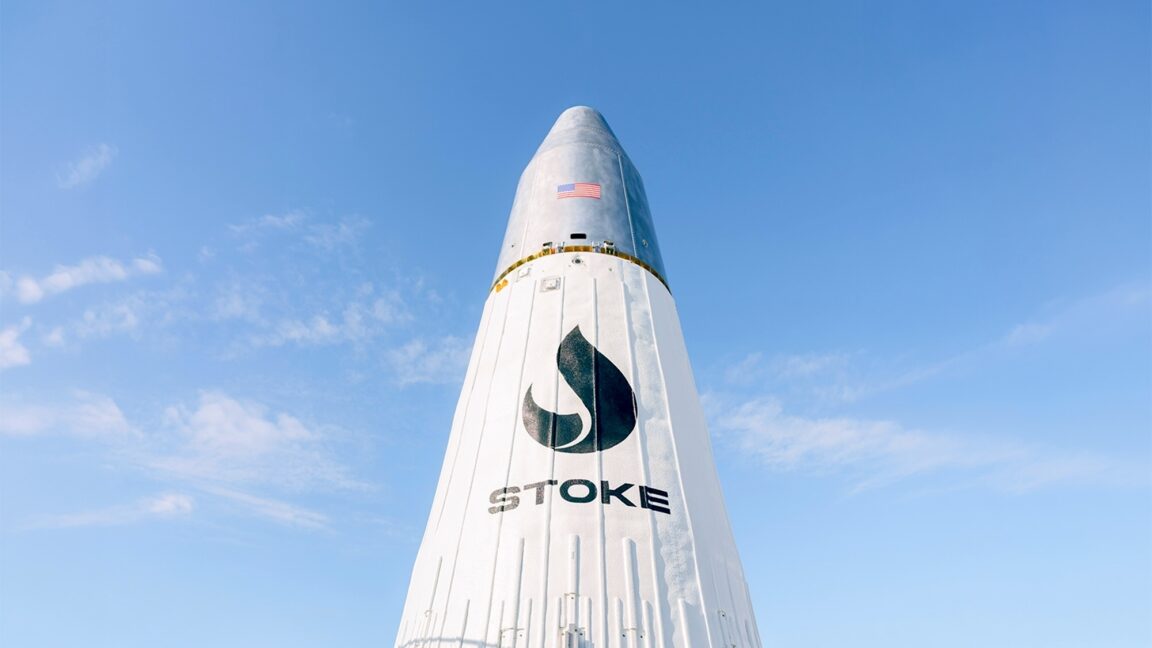
Stoke Space announced Tuesday that it has raised another significant round of funding, $1 billion, as it makes a final push toward its debut launch next year. The Washington-based launch company also revealed plans for a larger medium-lift vehicle.
With the Series E funding round, co-led by Point72 Ventures and Spark Capital, Stoke Space brought its total amount of capital raised to $2.3 billion, a staggering amount for a company that has yet to attempt an orbital launch.
The quantity of new funding will enable the company to accelerate work on a larger “Block 2” version of the Nova rocket, capable of lifting 15 metric tons to low-Earth orbit in a fully reusable configuration, said Stoke co-founder and Chief Executive Andy Lapsa.
“We have already started development on a larger vehicle, and we felt like now is the time to pour gas on that fire and really start full-force development of the larger vehicle, and so that’s the reason for the timing,” Lapsa said in an interview.
First up, Nova “Pathfinder”
The initial version of Nova is planned to have a lift capacity of 3 metric tons in fully reusable mode and up to 7 tons in a fully expendable configuration. The rocket’s first stage is powered by seven Zenith engines, with a combined thrust of 700,000 pounds. The novel upper stage features a ring of 24 thrusters that surround a regeneratively cooled heat shield to protect the rocket during reentry into Earth’s atmosphere.
After completing an extensive set of structural tests earlier this summer on the first stage, Lapsa said Stoke will ship this stage “pretty soon” to the company’s launch site at Cape Canaveral, Florida. After additional testing there, the vehicle will undergo a static fire test before being mated with the upper stage.
As for the upper stage, it will soon be shipped to Stoke’s test site at Moses Lake, Washington, for its own set of structural tests, followed by a hot fire test. Then the upper stage will also be shipped to Florida.
For the first time since Stoke was founded in 2020, Lapsa publicly put out a target launch date for Nova, saying the company is aiming for “early” 2027 to launch. Of course, he is fully aware that problems can, and often do, occur during stage testing and final integration of the vehicles.
“Ifeelgoodaboutthatlaunchdate,” he said. “Ithinkthat’sprettyrealistic. But asyouknow,inourindustry,we’llgowhenwe’reready.”
During an Ars site visit to the company’s factory in Kent, Washington, last fall, it was clear that the company is in advanced stages of assembly of flight hardware and has additional vehicles in flow. The Nova rocket is real and represents a bold effort to build a small, fully reusable vehicle. The industry will be watching closely, especially now that Stoke has raised so much funding.
Block 2 is new
The Nova Pathfinder vehicle has a diameter of about 12.5 feet, slightly larger than SpaceX’s Falcon 9 vehicle, although it is considerably shorter. The Block 2 version of Nova is intended to have a 15-foot diameter, Lapsa said.
Like Pathfinder, the Block 2 version of the Nova rocket will use the methane-liquid-oxygen-fueled Zenith engines—although there will be more of them. The upper stage will similarly use hydrogen-liquid oxygen for propellant.
“Probably the biggest change on the whole vehicle is that we will have a cylindrical second stage,” he said. “That’s an area where, inside our walls for years, we’ve been wrestling with how do we delete the taper on Pathfinder’s upper stage, and I think we’ve got a pretty slick approach to doing that.”
Pathfinder’s upper stage has a more conical shape, constraining the volume of the payload fairing. Stoke is targeting 2029 for the debut launch of Block 2.
As Ars recently reported, satellite operators are presently in ‘panic mode’ when it comes to launch availability. Stoke can address some of these issues with Nova Pathfinder, but to play a major role in constellations, it will need the larger Block 2 vehicle to compete with SpaceX’s reusable rockets, as well as Blue Origin’s New Glenn, Relativity Space’s Terran R, and Rocket Lab’s Neutron vehicle. Lapsa said he believes there is demand for all of the above.
“The space economy will grow exactly as fast as we can launch rockets,” he said. “It will not grow faster. It cannot grow faster. And there is a lot of pent-up demand for rockets flying. The mismatch between supply of launch and demand is enormous.”

Eric BergerSenior Space Editor
Eric BergerSenior Space Editor
Eric Berger is the senior space editor at Ars Technica, covering everything from astronomy to private space to NASA policy, and author of two books: Liftoff, about the rise of SpaceX; and Reentry, on the development of the Falcon 9 rocket and Dragon. A certified meteorologist, Eric lives in Houston.
Source: arstechnica.com
