


Close Menu
Warsaw.Today
    What's Hot

    The world is $365 trillion in debt, and the interest bill is climbing

    October 22, 2026

    Video. French police union sues French government over recent violence

    October 22, 2026

    Man United’s Carrick not worried about his job despite ‘unacceptable’ loss

    October 22, 2026
    Facebook X (Twitter) Instagram
    Trending
    • The world is $365 trillion in debt, and the interest bill is climbing
    • Video. French police union sues French government over recent violence
    • Man United’s Carrick not worried about his job despite ‘unacceptable’ loss
    • Overnight attacks resume between Russia and Ukraine
    • Airbnb guests freed from chores involving ‘significant effort’ under new global rules
    • France on edge as Macron faces backlash, Putin signals peace talks
    • Regular tea drinking linked to lower risk of stroke and heart disease
    • Canadian publisher Boréal ends relationship with novelist Thélyson Orélien over alleged use of AI
    Facebook X (Twitter) Instagram
    Warsaw.TodayWarsaw.Today
    Demo
    • Home
    • News
    • World
    • Sports
    • Business
    • Culture
    • Politics
    • Travel
    • Technology
    Warsaw.Today
    Home»Technology»US military ends long-running program to spot nuclear missile launches
    Technology

    US military ends long-running program to spot nuclear missile launches

    Peter NovakBy Peter NovakOctober 2, 20261 Comment0 Views
    Facebook Twitter Pinterest LinkedIn WhatsApp Reddit Tumblr Email
    US military ends long-running program to spot nuclear missile launches
    Share
    Facebook Twitter LinkedIn Pinterest Email

    In late 1970, a Titan IIIC rocket launched from Space Launch Complex 40 at what was then called Cape Canaveral Air Force Station. It carried a top-secret payload for the US military.

    Much has changed in spaceflight since then. The Titan IIIC would bow out in 1982 after dozens of launches. Various Titans continued launching from Space Launch Complex 40 until 2005, at which point the US Air Force—in a competitive process hotly opposed by United Launch Alliance—turned the pad over to a small, largely unknown startup called SpaceX. And Cape Canaveral is now a “Space Force” station.

    But those unspecified payloads? Until last month, some of them were still flying operationally.

    They were looking for missile launches

    The US <a href="https://warsaw.today/spanish-lawmakers-reject-government-housing-measure-amid-protests/” title=”Spanish lawmakers reject government housing measure amid protests”>government would later disclose that the top-secret payload that launched in November 1970 was a “Defense Support Program” satellite. The initial block of these satellites, launched from 1970 to 1973, had a mass of about 1 metric ton, and each carried about 2,000 infrared detectors. They were essentially very sensitive telescopes, and each satellite was launched into geosynchronous orbit.

    For a time, these were among the most important satellites flown by the US, as they served to detect the launch of a nuclear warhead at the country. As a result, the Defense Support Program would become one of the primary elements of American military space power during the Cold War.

    These initial satellites transformed experimental infrared observations into an operational program that continuously monitored the globe for missile launches. Initially built to identify Soviet ICBMs, they were essential for nuclear deterrence; later, they also became useful in conventional warfare, such as detecting Iraqi Scud missile launches.

    Over time, the military added to the constellation, improving reliability and expanding their capabilities. Each satellite ended up having more than 6,000 infrared detectors and a mass of about 2.5 tons. Satellites in the Defense Support Program kept on flying into space until 2007. One of them, DSP-16, even launched on a space shuttle (Atlantis) in 1991.

    The program finally comes to an end

    For more than 55 years, at least a handful of these satellites have been flying as silent sentinels—until last month.

    On Thursday, the US Space Force said that the final two surviving Defense Support Program satellites (presumably DSP-20 and DSP-22) participated in an on-orbit maneuvering exercise in early September. Independent orbital tracking showed that these satellites subsequently both raised their orbits by a few hundred kilometers, a move typically associated with disposing of them into graveyard orbits above geostationary space. The Space Force statement confirmed this marked the program’s official retirement.

    “The DSP constellation was foundational to the defense of our nation,” said US Space Force Col. Brandon Davenport, Mission Delta 4 Commander. “These last two satellites were the culminating end to over a half century of space-based early warning. The DSP constellation ensured deterrence during the Cold War and protected our deployed warfighters from the Gulf War until their retirement last month.”

    Two replacement programs

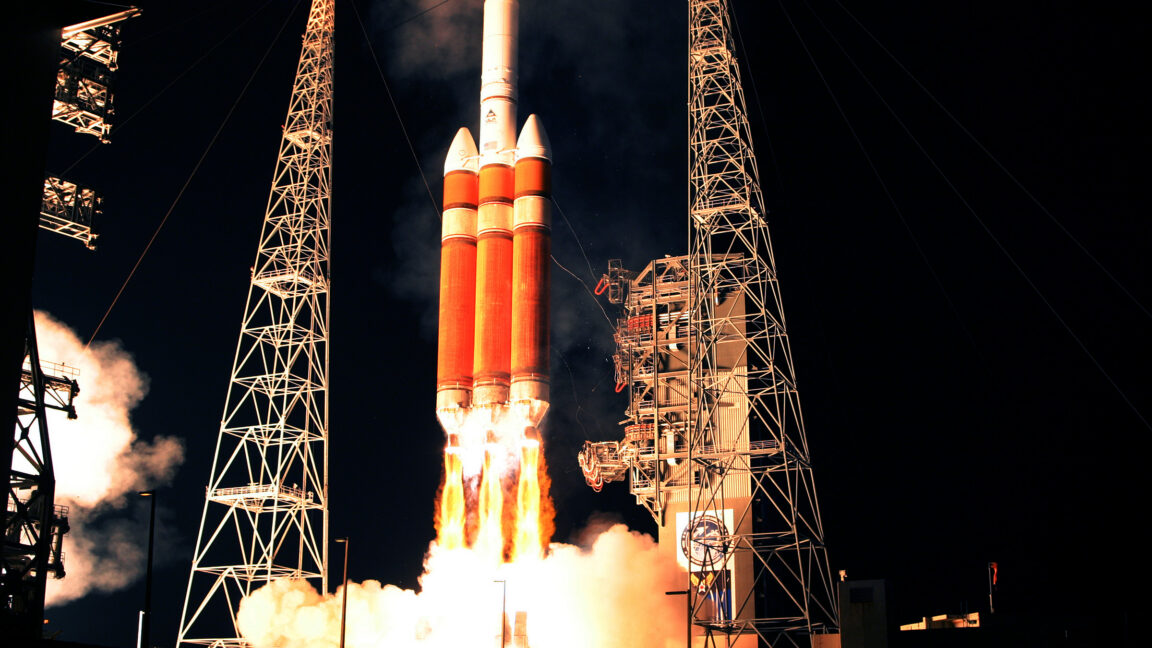
    The program had a remarkable run in longevity. It began when such observations were still experimental, and satellite manufacturing largely produced bespoke spacecraft. Their launch extended across a range of rockets from various Titan rockets to the Delta IV Heavy program and even NASA’s Space Shuttle.

    The United States is not flying blind in the absence of the Defense Support Program, of course. In 2011, the military began launching a new generation of infrared satellites, known as the Space Based Infrared System. Because these satellites have better sensors, they can generally detect dimmer events and provide a longer warning time.

    More recently, the military is developing its Next-Generation Overhead Persistent Infrared satellites. The first of these satellites could launch within the next 12 months on a Vulcan rocket.

    Photo of Eric Berger

    Eric BergerSenior Space Editor
    Eric BergerSenior Space Editor
    Eric Berger is the senior space editor at Ars Technica, covering everything from astronomy to private space to NASA policy, and author of two books: Liftoff, about the rise of SpaceX; and Reentry, on the development of the Falcon 9 rocket and Dragon. A certified meteorologist, Eric lives in Houston.

    Source: arstechnica.com

    defense support program ICBM Space space force
    Share. Facebook Twitter Pinterest LinkedIn Tumblr Telegram Email
    Peter Novak
    • Website

    Related Posts

    Review: Carrie is a triumphant remix with one major flaw

    October 22, 2026

    GM is betting compute and AI will help it compete with Chinese automakers

    October 22, 2026

    Recursive launches Flint, a laptop coding model it says was largely built by AI

    October 22, 2026

    1 Comment

    1. Pingback: Could conflict in Ethiopia expand across the region? - Warsaw.Today

    Leave A Reply Cancel Reply

    WARSAW WEATHER
    Economy News
    World

    The world is $365 trillion in debt, and the interest bill is climbing

    By Peter NovakOctober 22, 20260

    Hundreds of thousands of people have taken to the streets across Europe in recent weeks, angry at rising living costs, low wages, unaffordable housing and underfunded schools.

    Video. French police union sues French government over recent violence

    October 22, 2026

    Man United’s Carrick not worried about his job despite ‘unacceptable’ loss

    October 22, 2026
    Top Trending
    World

    Switzerland’s neutrality vote is asking the wrong question

    By Peter NovakSeptember 25, 20260

    On September 27, Switzerland votes on whether to lock a stricter definition of neutrality into its constitution. The initiative would bar Switzerland from cooperating with a military alliance unless it were under military attack or such an attack were being prepared, and prevent it from imposing sanctions on a belligerent state unless those sanctions were…

    Technology

    Apple’s hyper-pricey M5 Ultra Mac Studio made me into a vibe coder

    By Peter NovakSeptember 25, 20260

    When Apple was using Intel processors and AMD GPUs, the idea of an expandable and upgradeable tower made sense. But Apple Silicon chips bring the CPU, GPU, and memory interface all under one roof in a way that makes that sort of upgradeability not just superfluous but impossible. At least not without breaking some of…

    News

    What is working and what is holding them back

    By Peter NovakSeptember 25, 20260

    This article was authored by Jens Teutrine, DACH representative (Germany, Austria and Switzerland) at the Consumer Choice Center, and a former Member of Germany’s Federal Parliament. The views expressed in this article are those of the author and do not necessarily reflect the official policy or positions of EU Tech Loop or Euronews.

    Subscribe to News

    Subscribe to receive the latest breaking news, local updates, and top stories from Warsaw delivered to your inbox.

    Warsaw.Today is your trusted source for breaking news, local updates, business, politics, technology, sports, culture, and events from Warsaw, Poland—all in one place.

    Facebook X (Twitter) Instagram Pinterest YouTube

    The world is $365 trillion in debt, and the interest bill is climbing

    October 22, 2026

    Video. French police union sues French government over recent violence

    October 22, 2026

    Man United’s Carrick not worried about his job despite ‘unacceptable’ loss

    October 22, 2026

    Subscribe to Updates

    Subscribe to receive the latest breaking news, local updates, and top stories from Warsaw delivered to your inbox.

    © 2026 ThemeSphere. Designed by ThemeSphere.
    • About Us
    • Get In Touch
    • Disclaimer
    • Privacy Policy
    • Terms and Conditions

    Type above and press Enter to search. Press Esc to cancel.