

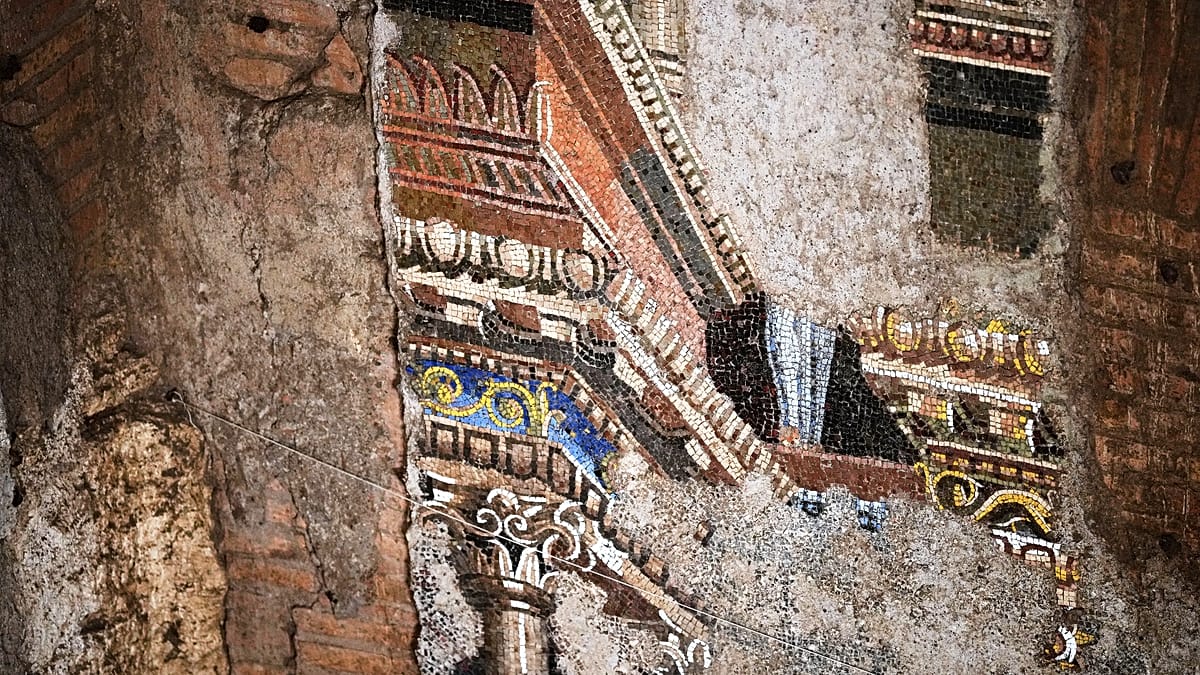
Trajan’s Baths in Oppian Hill will host a new museum where visitors to Rome can admire the Great Mosaic and the Painted City, two massive ancient artworks buried near the Colosseum that are estimated to date from the 1st century.
In a city filled with ancient treasures and relics, some are calling it the Italian capital’s biggest and best kept secret. Now, the public can finally see what’s thought to be the largest ever fresco and mosaic complex of ancient Rome.
Authorities have unveiled a first century A.D. depiction of a maritime city in what became the largest bath complex in the world – the Trajan Baths, the site of a new museum inaugurated on Wednesday.
The “Painted City” fresco and “Great Mosaic” were discovered in an underground gallery during excavations in the 1990s of the Baths of Trajan on the Oppian Hill near the Colosseum.
After being hidden underground for centuries, its blues and terracotta colors are still clear but faded.
Massive monuments
Speaking at the unveiling ceremony Rome’s mayor, Roberto Gualtieri, said: “They are truly unique in the world, both from the point of view of artistic beauty and the historic and documental importance.”
The mosaic, for its part, measures some 15 meters high and features intricately decorated columns and architectural elements and figures over four different levels. The top levels are up-close images with people that are almost like theatrical scenes, while at the bottom are views of the port city’s layout from above.
The Baths of Trajan, which were dedicated by Emperor Trajan in 109 A.D., extended over six hectares and were at the time the largest bath complex in the world. They incorporated an earlier baths complex, the Domus Aurea, and were designed on a different trajectory to take better advantage of the water temperatures to optimize the thermal experience for users.
The Painted City and the Great Mosaic
Trajan’s Baths were designed by Apollodorus of Damascus at the request of Emperor Trajan. Inaugurated on 22 June AD 109, they covered around 60,000 square metres and included bathing facilities, porticoes and spaces for physical and cultural activities and leisure time. The construction also incorporated older structures, including part of the Domus Aurea, which make it possible to trace the complex archaeological stratification.
The Painted City is a ten-square-metre fresco belonging to a building that predates Trajan’s Baths, dating from the first century AD, depicting a city seen from above.
In the monumental wall mosaic “The Muse and the Philosopher”, located in a large hall overlooking a nymphaeum, a Roman harbour is depicted in detail. It is not known whether it is real or imaginary, although some scholars have suggested it could be the final resting place of emperor Claudius.
Already partially visible after restoration, the exposed section allows visitors to admire “the philosopher and other figures of extraordinary artistic quality”, as Gualtieri put it.
However, finds made beneath the decoration have made it possible to reconstruct an original space that was much taller, with walls that must have risen to around 12 metres.
During the restoration, panoramic rest areas and new pedestrian routes were also created within the complex, along with a new tiered seating system designed to host concerts, conferences and events.
Restricted visits to preserve the artistic heritage
To assess the impact of visitor numbers on the conservation of the works, the first visits will be organised on an experimental basis for small groups at weekends only, with free guided tours by reservation, starting on 12 and 13 September.
From 2 October the site will be open to visitors from Friday to Sunday. There will be six time slots a day, with a maximum of 15 people at a time.
Source: www.euronews.com
