

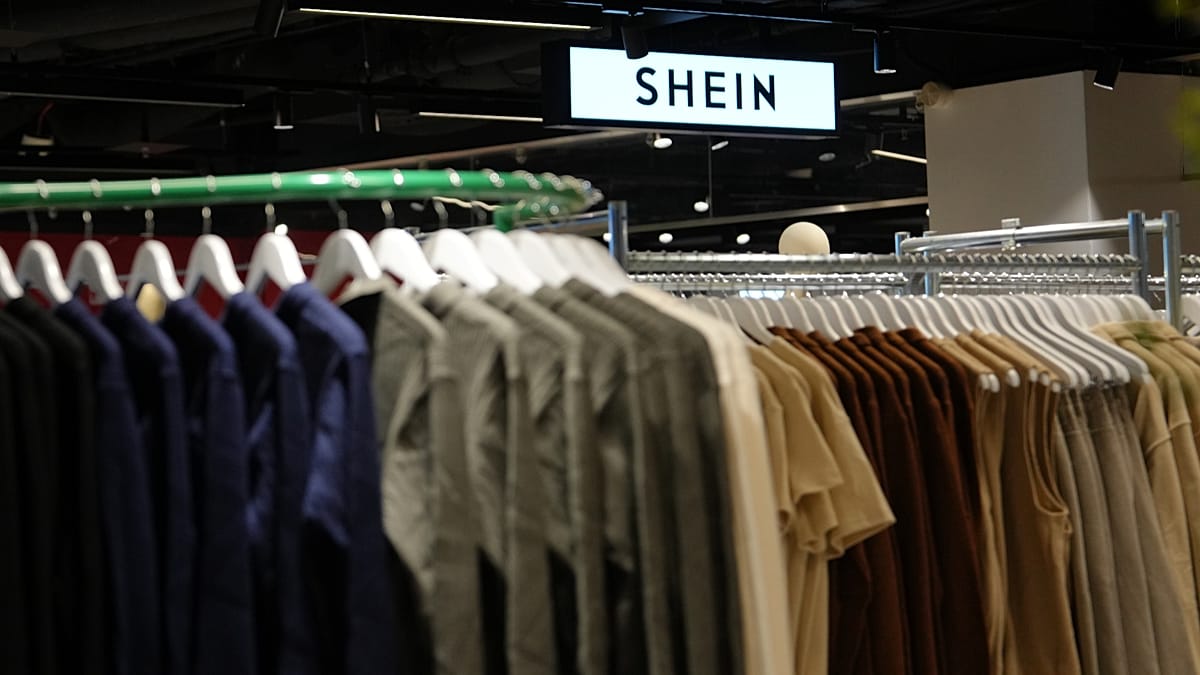
“A model that floods the market with thousands of new daily styles at single-digit price points can only exist by passing its true costs onto labour and the environment.”
Shein’s ultra-fast fashion empire has taken a dramatic fall following its post-IPO valuation collapse.
The e-commerce platform, which is headquartered in Singapore but outsources much of its manufacturing to China, failed to go public in London and New York following concerns around its supply chain and heavy criticism of its environmental impact.
Shein therefore pivoted to the Hong Kong Stock Exchange, where it was valued at around $27 billion (approximately €23.24 billion) on 1 September. It may seem like a huge financial win, but it’s 70 per cent lower than its private market peak of almost $100 billion (€86 billion) back in 2022.
Why was Shein’s IPO such a flop?
“Capital markets aren’t acting out of pure altruism: they’re reacting to material financial risk,” sustainability expert and founder of tech company E&S Solutions Ildiko Almasi Simsic tells Euronews Earth.
“Shein’s delayed public listings and severely discounted valuation prove that investors now recognise ESG issues as direct threats to terminal value.”
Simsic argues that a business model that has been exposed to multiple controversies, such as forced labour and hazardous chemicals in clothing, carries an “enormous risk profile”.
She says environmental and human rights issues have now crossed over from “ethics to equity”, signalling a watershed moment for the fast-fashion industry.
But what makes Shein so controversial in the first place, and can its super cheap garments and on-trend styles ever become sustainable?
Shein’s controversial supply chains
“For years, ultra-fast fashion grew by leveraging hyper-fragmented, outsourced supply chains that kept prices absurdly low while keeping liabilities at arm’s length,” Simsic tells Euronews Earth.
“But that model created a massive structural vulnerability. When your business relies on thousands of sub-contractors operating in grey regulatory zones, supply chain oversight isn’t just an operational headache – it becomes a central business risk.”
Shein’s supply chain has been shrouded in controversy since its conception. In 2022, an investigation by environmental NGO Greenpeace Germany found hazardous chemicals above the EU regulatory limits in seven of 47 Shein products tested.
At the time, Shein acknowledged the chemical contamination and pledged “substantial improvements” to its chemical management.
However, a 2025 investigation found that little had changed. Greenpeace purchased 56 garments from Shein across eight countries and analysed them for hazardous chemicals. They found that 18 of 56 (32 per cent) of the garments exceeded the EU limits, including children’s clothing.
Among other chemicals, the plasticizers phthalates and water- and dirt-repellent “forever chemicals” (PFAS) were detected. These are hazardous chemicals that have been linked to various health concerns, including cancer, reproductive disorders, growth disorders in children, and immunodeficiency disorders.
“Consumers are also at risk as they can be exposed to these chemicals through several ways – directly through the skin, by inhaling textile fibres in the air and, in the case of small children, through mouthing contaminated clothes.”
In 2023, Shein admitted to finding two cases of child labour in its supply chain during the first nine months of the year.
The firm introduced new rules so that any child labour or forced labour violations have become grounds for immediate termination of contracts.
“Both cases were resolved swiftly, with remediation steps including terminating contracts with underage employees, ensuring the payment of any outstanding wages, arranging medical checkups and facilitating repatriation to parents/ legal guardians as needed,” Shein said at the time.
“Following appropriate remediation, the contract manufacturers were permitted to resume business.”
Despite Shein’s clampdown on labour violations, concerns of poor working conditions remain rife. A 2025 investigation by the BBC found that workers were sitting behind sewing machines for around 75 hours a week in contravention of Chinese labour laws.
Many employers told the publication that they only have one day off each month and have to endure 12-hour shifts, which didn’t include breaks for lunch and dinner, often working until past 10pm.
A 2024 report by Swiss advocacy group Public Eye also found that excessive overtime was still common for many workers – despite Shein promising to improve conditions following previous probes.
Can Shein ever be sustainable?
As Shein geared up for going public, scrutiny on its fast-fashion model grew stronger.
The company’s draft prospectus included the slogan “We believe in doing well by doing good”. However this was removed from the final document
Shein insists that “commitment to sustainable and responsible growth is woven into the fabric” of its business model. However, the expected IPO proceeds allocate just 10 per cent to sustainability and corporate responsibility.
An investigation by global nonprofit Rest of World found that between July and December of 2021, Shein added anywhere between 2,000 and 10,000 SKUs (stock keeping units, or individual styles) to its app each day.
This is because Shein orders small batches of each garment, sometimes as low as a few dozen pieces, then waits to see how consumers respond. If a particular item seems to be selling well, Shein orders more.
“A model that floods the market with thousands of new daily styles at single-digit price points can only exist by passing its true costs onto labour and the environment,” Simsic says.
“Cheap prices are an illusion created by systemic outsourcing. When garments are produced at a fraction of a cent per stitch, it almost guarantees non-compliance with fair wages, excessive overtime, and cheap, fossil-fuel-derived synthetic fabrics.”
The expert acknowledges that while efficiency and tech-driven demand forecasting can reduce excess inventory, it cannot bypass the “physical limits of planetary resources or basic human rights”.
“Ultra-low cost and sustainability are fundamentally incompatible concepts,” she adds. “One inherently undermines the other.”
Can fast fashion survive the scrutiny?
Shein’s scrutiny has gone far beyond complaints from environmentalists and individuals. Earlier this week, France passed a law targeting companies known for selling large volumes of low-quality clothing at rock-bottom prices.
“The harmful effects of ultra-fast fashion on our environment and our economy are well known and documented,” says Mathieu Lefevre, the minister for ecological transition.
Under the bill, firms like Shein are assessed under two criteria: the volume of clothing placed on the market and the cost of repairing garments relative to their purchase price.
The per-item fee will vary on a set scale according to how each product scores on both of these standards.This year, companies will pay fines such as a 50-cent levy on underwear falling into the ultra-fast fashion category, rising to €2 for T-shirts, €9 for jeans and €12 for a jacket.
The levy could reach up to €19.50 per item by 2030, though the cap remains at 50 per cent of the product’s pre-tax price.
Beijing has bitten back, urging France to abandon the law and describing it as “clearly discriminatory” due to Shein – and sites like Temu – being located in Asia.
“Should France persist in this course of action, China will take necessary measures to safeguard the legitimate rights and interests of Chinese enterprises,” says commerce ministry spokeswoman Huang Ling. “France will bear full responsibility for all consequences arising from this.”
Simsic argues that while fast-fashion giants will still be able to survive new laws like this, it’s likely they won’t reach their historical growth model.
“Historically, labour issues or toxic chemical findings were managed by public relations or board-level sustainability committees. Today, with legislation like the EU’s Corporate Sustainability Due Diligence Directive and Extended Producer Responsibility, these are strict legal compliance matters carrying fines of up to five per cent of global turnover.”
Simsic adds that if non-compliance directly threatens a company’s bottom line through hefty regulatory penalties and import bans, growth will inevitably slow. It means sites like Shein will have no choice but to internalise these costs, by investing heavily in supply chain traceability and safer materials.
Euronews Earth has contacted Shein for comment.
Source: www.euronews.com
