

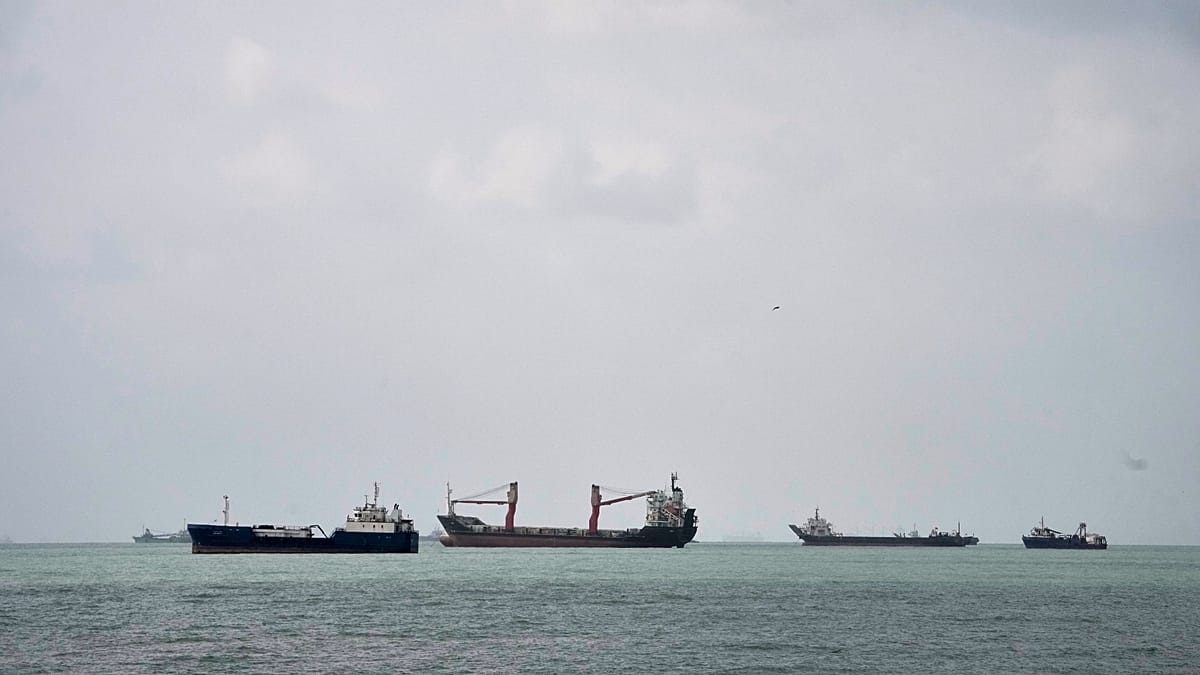
The Islamic Revolutionary Guard Corps claimed that it targeted three oil tankers and three US-affiliated vessels in the Strait of Hormuz as the cycle of violence spirals after the US military struck three Iranian oil tankers earlier on Saturday, in response to Iran targetting the US navy on Friday.
Iran’s Revolutionary Guards (IRGC) said that they had carried out attacks against three oil tankers and three US-linked vessels in the Strait of Hormuz on Saturday evening, following US strikes on Iranian tankers earlier in the day, as the cycle of violence in the key waterway keeps intensifying.
The IRGC said in a statement to the Iranian media that their naval forces “targeted three oil tankers on the unauthorised route of the Strait of Hormuz and three vessels affiliated with the child-killing America in other areas”. They also warned other vessels against attempting to use routes that Tehran had not authorised.
A spokesperson for Iran’s joint military command warned that strikes against US military ships would be more severe if the US continues to interfere with Iranian shipping, the Iranian state broadcaster reported.
Earlier on Saturday, the US military said that its forces destroyed three Iranian oil tankers after the IRGC fired ballistic missiles towards two navy warships that were patrolling the region, enforcing the US blockade of Iranian ports and thus choking Iran’s oil exports which constitutes its economic lifeline.
Iran reportedly used for the first time anti-ship ballistic missiles launched from Isfahan and Kerman towards the US navy vessels in the Strait of Hormuz on Friday, in a significant escalation of Iranian military actions against the US in the latest flare-up of violence. The Iranian media did not provide details as to the targets nor any damage inflicted in the alleged attacks.
Former head of Israel’s military intelligence research department Danny Citrinowicz said in a post on X that “yesterday attack suggests that another threshold in Iranian decision-making has been crossed,” as “it indicates that Tehran is becoming increasingly willing to accept risks it previously sought to avoid, <a href="https://warsaw.today/united-san-francisco-taipei-taiwan-795-roundtrip-including-all-taxes/” title=”United: San Francisco – Taipei, Taiwan. $795. Roundtrip, including all Taxes”>including directly threatening some of the most important U.S. military assets in the region.”
US Central Command (CENTCOM) said in a statement that a US aircraft carrier and a destroyer ship had “successfully evaded multiple unprovoked Iranian attacks” and that no American personnel were hurt.
“Following Iran’s failed attacks, CENTCOM permanently disabled the IRGC crude oil carriers M/T Downy off the coast of Kharg Island and M/T Stark 1 near Jask,” the statement continued.
“American forces also completely destroyed the unladen crude oil carrier M/T Kylo (also known as the ‘Noxen’) in the Gulf of Oman, striking the vessel in multiple critical locations to render it inoperable after the crew was directed to abandon ship,” it added.
Admiral Brad Cooper, the commander of CENTCOM, said the message to the IRGC was “clear”: “If you shoot at two of our ships, we will impose an even higher economic cost —taking out three of yours.”
“We will not hesitate to defend American forces, and if necessary, destroy Iran’s limited and exposed oil fleet,” he added.
The US statement called the tankers part of a shadow network helping to fund Iran’s Revolutionary Guard and its armed proxies in the region.
Iran’s Foreign Ministry called the attacks a war crime, and said that the consequences for continued US aggression, including “economic warfare,” would rest with Washington and its allies.
The latest cycle of violence resumed last Sunday after US forces carried out strikes on Iranian rocket launchers in the Strait of Hormuz with CENTCOM saying it had taken “limited, precise action” against IRGC minelaying forces, which it said had posed an “imminent threat” in the waterway.
The IRGC confirmed strikes had hit Larak Island and vowed to retaliate, later launching its own attacks on US bases in Jordan, Kuwait and Bahrain.
CENTCOM forces carried out another wave of strikes on Tuesday, targeting what it said were IRGC air defence sites, mine laying capabilities, radar systems, maritime assets and facilities, and communications sites.
It said the move was in response to “recent attempted attacks by the IRGC against commercial shipping in the Strait of Hormuz.”
The US military has been helping to guide ships through the strait as Tehran asserts control and targets some vessels, but overall traffic remains low.
Source: www.euronews.com
