



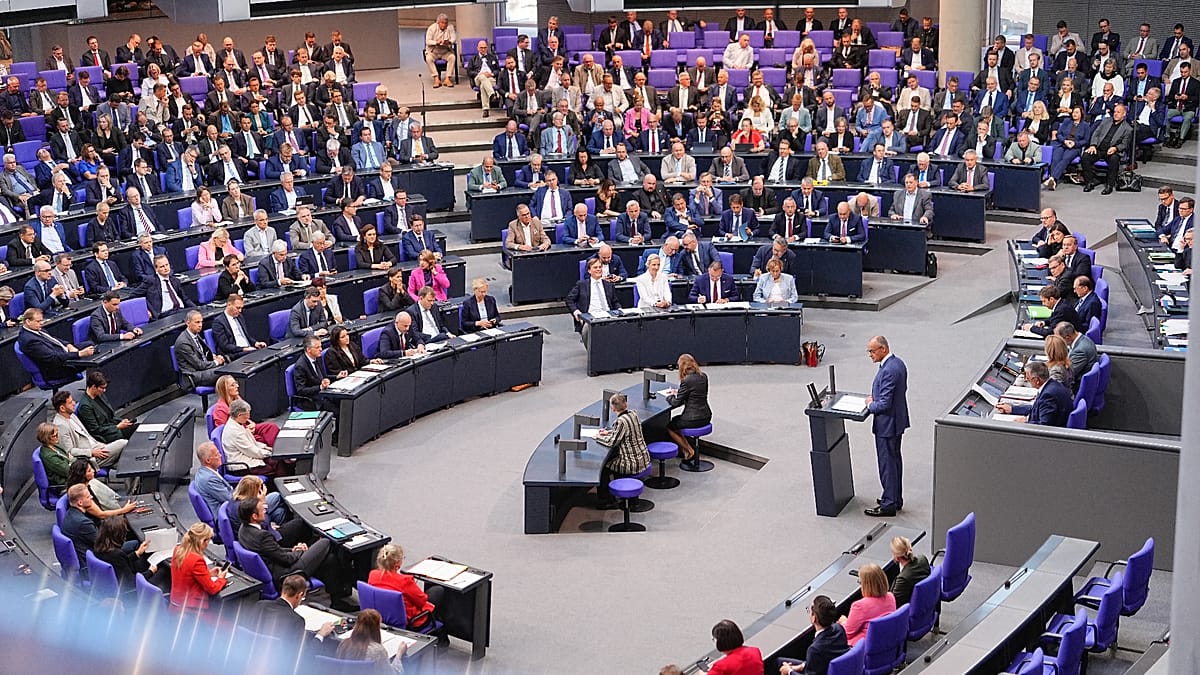
Record spending, substantial investment in defence and borrowing on a historic scale: the Bundestag has approved Germany’s 2027 federal budget. Meanwhile, the proposed pension reform envisages longer working lives, higher contributions and steeper penalties for early retirement.
The German Bundestag approved the 2027 federal budget on Friday with the backing of the governing coalition of the Christian Democratic Union (CDU), its Bavarian sister party, the Christian Social Union (CSU), and the Social Democratic Party (SPD). A total of 317 MPs voted in favour of the budget bill, while 260 voted against.
Planned expenditure under the core federal budget amounts to around €556 billion, an increase of €31.4 billion, or approximately six per cent, compared with the previous year.
Meanwhile, projected tax revenues of €391.3 billion fall short of the federal government’s original forecasts.
New borrowing set to reach highest level since the pandemic
The federal government plans to borrow around €210.4 billion in 2027, marking the second-highest level of new borrowing in the history of the Federal Republic. Only in 2021, at the height of the coronavirus pandemic, was borrowing higher, at €215.4 billion.
The planned borrowing is divided into three categories:
- Core federal budget: €123 billion
- Special fund for infrastructure and climate neutrality: €57.8 billion
- Special fund for the German armed forces (Bundeswehr): €29.6 billion
These so-called special funds do not represent accumulated financial reserves. Instead, they serve as financing mechanisms that allow the government to undertake additional debt-financed expenditure outside the core federal budget.
Defence spending rises to almost €140 billion
Defence spending accounts for a substantial share of the overall increase in federal expenditure. The regular defence budget is set to rise from around €82.7 billion in 2026 to €109.7 billion in 2027.
A further €29.6 billion will be drawn from the €100 billion special fund for the German armed forces (Bundeswehr), established in 2022 by the then coalition government of Social Democrats, Greens and Free Democrats under Chancellor Olaf Scholz. The fund is expected to be fully exhausted by the end of 2027.
An additional €11.6 billion has been earmarked for support for Ukraine.
The federal government expects military expenditure to continue rising sharply in the coming years. According to the Federal Ministry of Finance’s current financial plans, the regular defence budget alone is projected to reach €183.7 billion by 2030.
Social spending remains the largest item in the federal budget
Despite the sharp increase in defence expenditure, the Federal Ministry of Labour and Social Affairs remains the largest spending department, with an allocation of €203.3 billion, equivalent to approximately 36.6 per cent of the entire core federal budget.
A substantial proportion of this funding goes towards the statutory pension insurance scheme. However, the additional federal subsidy is set to be cut by €3 billion, placing further financial pressure on the pension system, with employees and employers facing the prospect of higher contributions.
The financial position of the Federal Employment Agency also remains strained. According to the budget figures, it requires a federal loan of €8.2 billion.
Rising debt-servicing costs weigh on the federal budget
Alongside direct public expenditure, the cost of servicing existing debt is becoming an increasingly significant burden on federal finances. In its original draft budget, the federal government earmarked €41.9 billion for interest payments in 2027, representing an increase of €11.6 billion compared with 2026.
These funds are consequently unavailable for other public priorities, such as education, infrastructure, social security or tax relief.
Meanwhile, investment under the core federal budget is set to rise to around €61.8 billion, supplemented by additional debt-financed investment through the special fund for infrastructure and climate neutrality.
Germany’s debt-to-GDP ratio rises sharply
Public debt is also increasing relative to economic output. According to the Federal Ministry of Finance’s budget projections published in October, Germany’s general government debt-to-GDP ratio could exceed 72 per cent by 2028.
Germany’s public expenditure significantly exceeds its revenues. The Federal Ministry of Finance projects a general government deficit of 5.25 per cent of GDP in 2027.
Even after accounting for the EU’s exemption for defence expenditure, the projected deficit of four per cent would remain well above the EU’s reference threshold of three per cent. Consequently, the EU could launch an excessive deficit procedure against Germany.
Klingbeil warns of sacrifices ahead
During the final budget debate, Federal Finance Minister Lars Klingbeil (SPD) made clear that the forthcoming reforms could entail sacrifices for the public.
“We will not be able to avoid asking people to make sacrifices,” said the Social Democratic Party’s co-chair. He stressed that the resulting financial burdens must be shared fairly.
Precisely what measures the public may face remains unclear.
Budget shortfall for 2028 could reach €30 billion
Even before the 2027 federal budget comes into effect, a substantial funding shortfall is emerging for the following year.
Current estimates put the funding gap for 2028 at around €25 billion. This figure already takes into account the planned postponement until 2033 of repayments on emergency loans taken out during the coronavirus pandemic and debt incurred through the Bundeswehr special fund.
Should the electricity tax reduction be extended beyond 2027, the funding shortfall could widen to around €30 billion.
Pension reform: Longer working lives and higher contributions envisaged
Alongside the adoption of the 2027 federal budget, the federal government is finalising its proposals for a comprehensive overhaul of the pension system. Federal Labour Minister Alexander Schweitzer (SPD) has presented a 287-page draft bill for consultation. Against a backdrop of rising social expenditure and an ageing population, the proposed reforms aim to place the statutory pension insurance scheme on a more sustainable financial footing over the long term.
The so-called ‘retirement at 63’ scheme is to be retained in principle, albeit subject to stricter eligibility criteria. Periods spent receiving unemployment or sickness benefits would no longer count towards the required 45 years of pension insurance. Periods devoted to raising children or providing care, however, would continue to qualify.
Early retirement would also become less financially attractive. From July 2028, the pension reduction for each month of early retirement is set to rise from 0.3 to 0.4 per cent. Anyone retiring two years early would therefore face a permanent pension reduction of 9.6 per cent, compared with 7.2 per cent under the current rules. From 2031 onwards, the statutory retirement age would also be linked to changes in life expectancy.
Further measures include compulsory pension insurance for workers in low-paid employment (so-called mini-jobs), restrictions on partial retirement arrangements and the introduction of a statutory funded pension scheme modelled on the Swedish system. Under the proposals, employees and employers would pay additional contributions from 2028, rising to a combined total of two percentage points by 2031.
Members of the Bundestag, executive board members of public limited companies and those newly entering self-employment would also be brought within the statutory pension insurance scheme.
However, the draft pension reform bill is still under discussion within the federal government, and it remains unclear which measures will ultimately be implemented.
Source: www.euronews.com
