



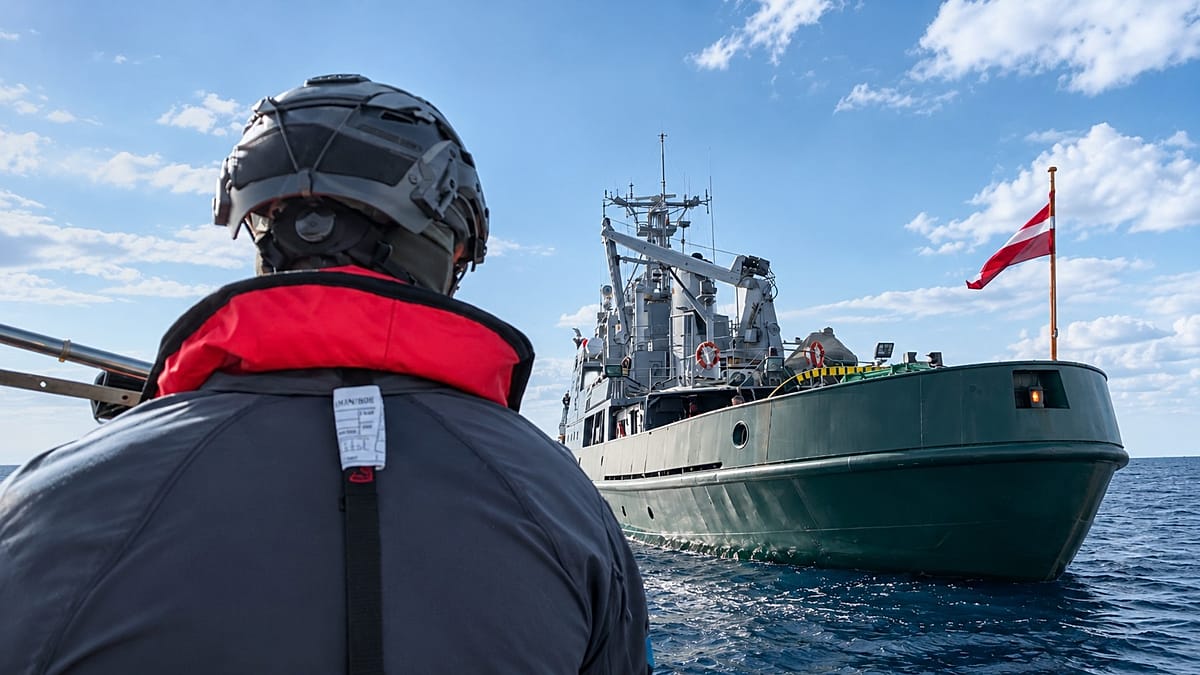
Aboard the Latvian patrol vessel Valpas, Euronews follows maritime operations and visits a Frontex drone base at Tympaki airfield. A search for missing migrants near Chrissi Island highlights the dangers of the crossing, while temporary reception facilities face growing pressure.
While irregular migration is declining along several routes into the European Union, the opposite is happening on Crete. The Greek island, better known for its beaches and tourism industry, is facing a sharp increase in arrivals from North Africa and Asia.
Around 24,000 migrants reached Crete during the first ten months of 2026, compared with approximately 17,000 throughout 2025.
Most boats depart from eastern Libya, crossing hundreds of kilometres of open sea towards Gavdos, a small island south of Crete, or the southern coastline of Crete itself.
Despite increased patrols, surveillance aircraft and sophisticated monitoring technology, the crossings continue.
To understand what is happening on Europe’s southern maritime frontier, Euronews joined a patrol of the European Border and Coast Guard Agency, Frontex, spending time with its crews at sea and visiting the facilities coordinating aerial surveillance.
A search for missing migrants
During our reporting, an incident illustrated the dangers of this increasingly busy migration route.
On the afternoon of November 4, a migrant was discovered alone on Chrissi Island, approximately 15 kilometres off Crete’s southern coast.
He claimed to have travelled with 60 other people, triggering an extensive search and rescue operation.
It is just one of dozens of incidents requiring a response from Greek and European patrol and rescue teams operating off Crete.
Local Coast Guard officials in Heraklion told Euronews that, in just 48 hours, 13 boats carrying approximately 400 migrants had arrived within their area of responsibility.
During the same period, around 20 migrants were also found dead- a stark reminder of the human cost of the increasingly dangerous crossing to Europe’s southern shores.
A Latvian ship guarding Europe’s borders
Greece hosts Frontex’s largest operational presence in the European Union, with the agency supporting Greek authorities across a wide range of activities.
The agency provides technical equipment, surveillance capabilities and support for return operations involving migrants who have no legal right to remain in the EU. All these activities are carried out in cooperation with the Greek authorities, who retain operational command.
In Crete and Gavdos -the small Greek island south of Crete and the southernmost inhabited island in Europe- alone, more than 40 officers, three aircraft, an unmanned aircraft and six patrol vessels have been deployed to support Greek authorities.
Among them is Valpas, a Latvian patrol vessel operating south of Crete for approximately 18 months. A typical patrol aboard Valpas lasts 72 hours. For its 20-member crew, the ship becomes both a workplace and a temporary home.
Leaving their families behind, crew members try to maintain a connection with Latvia, keeping familiar traditions alive even while operating far from home. Captain Ozers, a father of three, speaks to his children every evening.
Captain Ozers told Euronews that rescue operations can be extremely difficult and dangerous, both for the migrants attempting the crossing and for the crews trying to bring them to safety.
He recalled one of the most challenging moments he has faced at sea:
“Sometimes, everyone tries to stand up at once, which can cause the boat to capsize. I experienced this myself during an operation when two people fell overboard. We were fortunate that only two ended up in the water. It was nighttime, but we managed to keep them in sight throughout. We threw them lifebuoys and other flotation devices while we first secured the larger group of passengers on the boat. Once they were safe, we moved away from the boat and manoeuvred closer to the two people in the water.”
Weather conditions make these operations even more challenging. Captain Ozers explained that one of the greatest dangers arises when migrants set off in favourable weather, only to face deteriorating conditions during their journey.
“The most difficult for us is when they start their voyage with the nice weather and then the weather becomes bad. We need to plan how to pick them up and it becomes a little bit dangerous.”
Ioannis Orphanos, Commander of the Hellenic Coast Guard’s 7th Regional Command, which oversees Coast Guard operations across Crete, explained that rescue operations can be particularly challenging.
“Some incidents are extremely difficult, and unfortunately, there are times when lives are lost. We must remember that the area is vast and weather conditions are often adverse. We may be dealing with people who have never experienced the sea before, who are completely unfamiliar with the maritime environment and may not even know how to swim,” he told Euronews.
Eyes in the sky
Frontex’s operations also rely on advanced aerial surveillance. From Tympaki airfield in Crete, Frontex operates the Heron 1, a highly advanced long-endurance surveillance drone equipped with sophisticated radar, high-resolution cameras and thermal imaging technology. It can remain airborne for more than 20 hours, monitoring vast stretches of the Libyan Sea both day and night.
Its images are transmitted live to the Hellenic Coast Guard’s operations centre in Piraeus and Frontex headquarters in Warsaw, while Greek authorities retain operational command.
Evangelos Diamantis, Head of the Monitoring and Surveillance Sector at the Frontex Operation Centre, explained why early detection is crucial:
“The boats used by smuggling networks are not seaworthy. They often have faulty engines, which means there is no guarantee they will reach their destination — the European shores, in this case Greece. They are always overcrowded, making them highly vulnerable to sinking or accidents, especially when combined with bad weather. So, detecting these boats early increases the chances of rescuing the people on board and bringing them safely to shore.”
Growing tensions on Crete
Yet increased surveillance has not stopped migrants from reaching the island. Newcomers are transferred directly to four tightly controlled temporary accommodation facilities, where they await transportation to mainland Greece.
The continuing arrivals are fuelling increasingly strong opposition among residents and local authorities, who object to migrants remaining in their communities.
Crete is therefore facing pressure on two fronts: managing a growing number of arrivals while dealing with mounting local resistance.
For the European Union, the challenge extends beyond the Greek island.
As migration routes shift and surveillance capabilities expand, a fundamental question remains: how can Frontex become more effective in managing irregular migration while fulfilling its responsibility to protect human lives at sea?
Source: www.euronews.com
