


Close Menu
Warsaw.Today
    What's Hot

    Raphinha, Lamal fire Barcelona to 3-0 Champions League win over Aston Villa

    November 3, 2026

    Montenegro rejects ‘second-class’ EU membership

    November 3, 2026

    Data centers are turning to old jet engines as the wait for power grows

    November 3, 2026
    Facebook X (Twitter) Instagram
    Trending
    • Raphinha, Lamal fire Barcelona to 3-0 Champions League win over Aston Villa
    • Montenegro rejects ‘second-class’ EU membership
    • Data centers are turning to old jet engines as the wait for power grows
    • JetBlue just raised bag fees for the 2nd time this year. Will other airlines follow … again?
    • Spanish transport minister resigns after deadly train crash
    • Spain’s transport minister resigns over Urda train crash
    • Ted Schlein’s Ballistic Ventures seeks $490M for new funds amid AI-driven cybersecurity boom
    • Qatar Airways: Philadelphia – Kochi, India. $899. Roundtrip, including all Taxes
    Facebook X (Twitter) Instagram
    Warsaw.TodayWarsaw.Today
    Demo
    • Home
    • News
    • World
    • Sports
    • Business
    • Culture
    • Politics
    • Travel
    • Technology
    Warsaw.Today
    Home»World»Fossilised red blood cells found in 115m-year-old dinosaur’s bone, say scientists
    World

    Fossilised red blood cells found in 115m-year-old dinosaur’s bone, say scientists

    Peter NovakBy Peter NovakNovember 2, 2026No Comments0 Views
    Facebook Twitter Pinterest LinkedIn WhatsApp Reddit Tumblr Email
    Share
    Facebook Twitter LinkedIn Pinterest Email

    Chemical tests on Aratasaurus bone identify presence of heme, the organic compound that allows haemoglobin in blood to carry oxygen around body

    It could be the opening of a Jurassic Park rip-off: scientists examining ancient dinosaur bones find what appear to be fossilised red blood cells, and traces of the molecule that gives the beast’s blood its distinctive crimson hue.

    But that is what researchers are claiming to have discovered after analysing the hind leg bones of a small, meat-eating dinosaur called an Aratasaurus that lived and died in what is now north-eastern Brazil 115m years ago.

    Electron microscope images of the dinosaur bones revealed small, round structures that resemble red blood cells in fine channels where blood vessels once ran, while chemical tests identified the presence of heme, the organic compound that allows haemoglobin in blood to carry oxygen around the body.

    Such claims are controversial because biological tissues and molecules can break down fast, leaving little or no trace in ancient fossils. But if confirmed, it would open up entirely new avenues for scientists, allowing them to investigate dinosaur blood, metabolism and even their activity levels.

    “We are seeing a mineral and molecular echo of the dinosaur’s original biology,” said Prof Kliti Grice at Curtin University in Western Australia who led the research team. “Fossilised red blood cells with distinct chemistry related to heme have never been found in situ in any fossil, let alone a dinosaur. This is a world first.”

    The fossilised remnants of the Aratasaurus were discovered in a mine in 2008 and have since been held in the National Museum of Brazil, where researchers continue to study them. While analysing the dinosaur’s hind leg bones, Grice spotted the structures that resembled red blood cells.

    The scientists’ suspicions that they were looking at red blood cells were bolstered when chemical tests came back positive for heme and its breakdown products. Tests also found traces of the amino acid building blocks for collagen, a key protein in connective and other tissues.
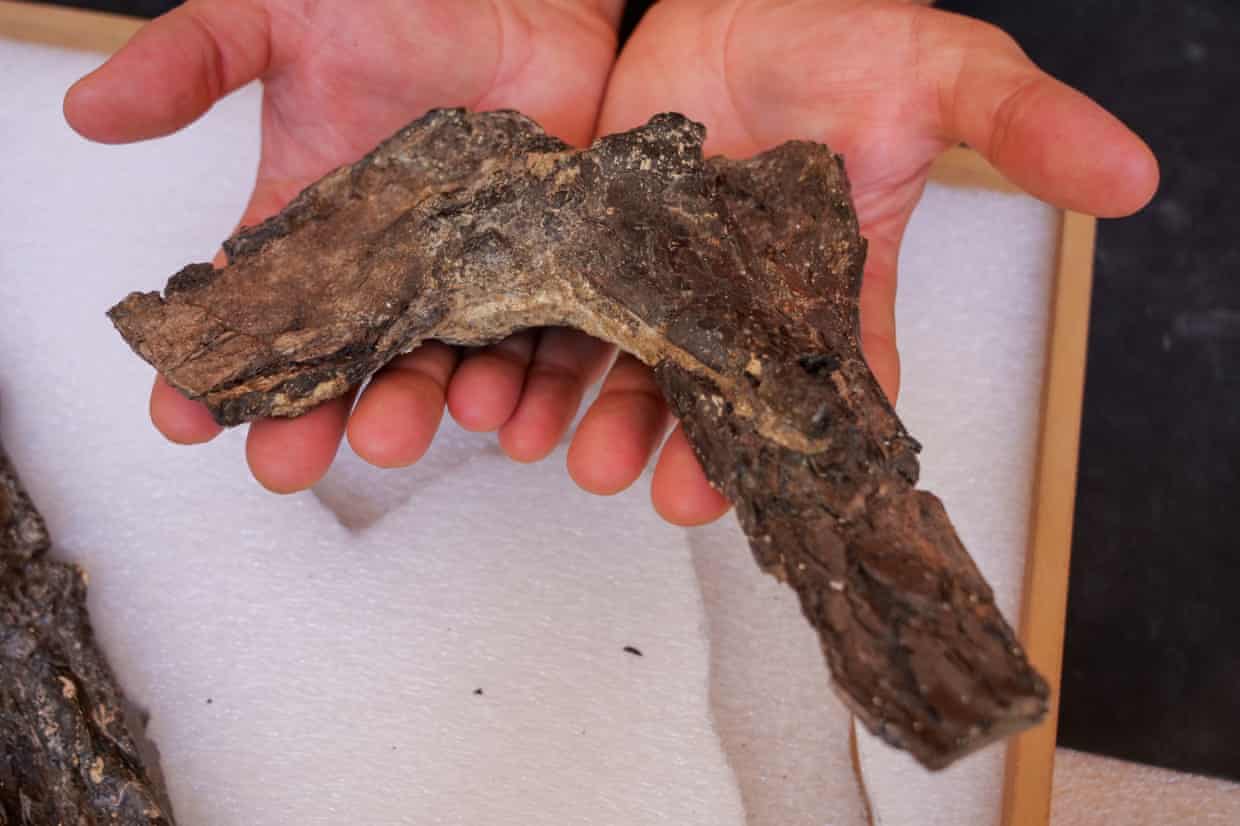
    Portion the Aratasaurus’s hind limb
    A portion the Aratasaurus’s hind limb. The remains were discovered in a mine in 2008 and have since been held in the National Museum of Brazil. Photograph: Curtin University

    If the structures really are fossilised red blood cells, as the researchers contend, it raises the question of how they were preserved. According to Grice, a manganese compound called hausmannite, which formed in and around the blood cells, may have lent a helping hand by stabilising them prior to fossilisation. The same process might have helped preserve the amino acids, she added. The study appears in Proceedings of the National Academy of Sciences.

    The work is already stoking debate. Prof Mary Schweitzer at North Carolina State University in the US, who has discovered remnants of blood vessels and soft tissues in dinosaur fossils, is not convinced Grice and her colleagues have found red blood cells. One reason for her doubt is that the dinosaur’s red blood cells should have a “nuclear bulge” making them appear dome-like on both sides. The structures Grice found are concave, suggesting they might be something else.

    Schweitzer was more persuaded by the discovery of heme and collagen amino acids in the bone and said there was so much more to learn from exceptionally well-preserved fossils. Schweitzer added: “The conventional wisdom in palaeontology that all endogenous organics would disappear in a million years or less is being routinely challenged, and will continue to be as technological approaches to palaeontological specimens are more routinely applied.”

    Another question the research raises is what other biological material might lurk in fossils collections around the world. On this, Grice urges extreme caution, adding that her work does not imply that large biological molecules such as proteins or DNA live on in ancient fossils. “Any extraordinary claim needs extraordinary analytical evidence,” she said. “The aim isn’t to find Jurassic Park DNA, it’s to determine how much genuine molecular information deep time can preserve.”

    “The really exciting implication is that extraordinary molecular information may already be sitting in museum collections around the world, waiting for us to ask new questions of old fossils,” she added.

    Explore more on these topicsReuse this content

    Source: www.theguardian.com

    Americas biology Brazil dinosaurs Evolution Fossils Palaeontology Science World news
    Share. Facebook Twitter Pinterest LinkedIn Tumblr Telegram Email
    Peter Novak
    • Website

    Related Posts

    Raphinha, Lamal fire Barcelona to 3-0 Champions League win over Aston Villa

    November 3, 2026

    Spanish transport minister resigns after deadly train crash

    November 3, 2026

    King Charles addresses summit as demands for slavery apology grow

    November 3, 2026
    Leave A Reply Cancel Reply

    WARSAW WEATHER
    Economy News
    World

    Raphinha, Lamal fire Barcelona to 3-0 Champions League win over Aston Villa

    By Peter NovakNovember 3, 20260

    Raphinha struck twice to propel Barcelona to a 3-0 Champions League win over visitors Aston Villa on Tuesday, ending the English side’s perfect start to the football competition.

    Montenegro rejects ‘second-class’ EU membership

    November 3, 2026

    Data centers are turning to old jet engines as the wait for power grows

    November 3, 2026
    Top Trending
    World

    G7 announces oil reserve release, as Trump hails Europe diesel deal

    By Peter NovakOctober 2, 20260

    Members of the Group of Seven (G7) has announced they will release up to 100 barrels of strategic oil reserves as prices continue to soar amid the US-Israel war with Iran.

    Travel

    Amazon Prime members can save 20 cents per gallon on gas every Friday through January

    By Peter NovakOctober 2, 20260

    Amazon Prime members already save at the pump with 10 cents off per gallon at over 7,500 participating Amoco, BP, Ampm and Thorntons gas stations around the U.S.

    Culture

    Myśleli, że to beton. Zakup za 300 funtów okazał się arcydziełem

    By Peter NovakOctober 2, 20260

    Pewien budowlaniec wybrał się do składu materiałów budowlanych z odzysku. W oko wpadła mu rzeźba, którą właściciele placu błędnie sklasyfikowali jako betonową. Mężczyzna zapłacił za nią 300 funtów. Po oględzinach okazało się jednak, że to barokowa perełka sprzed prawie 300 lat, wykonana z marmuru i wykonana przez znanego rzeźbiarza Pietro Bracciego.

    Subscribe to News

    Subscribe to receive the latest breaking news, local updates, and top stories from Warsaw delivered to your inbox.

    Warsaw.Today is your trusted source for breaking news, local updates, business, politics, technology, sports, culture, and events from Warsaw, Poland—all in one place.

    Facebook X (Twitter) Instagram Pinterest YouTube

    Raphinha, Lamal fire Barcelona to 3-0 Champions League win over Aston Villa

    November 3, 2026

    Montenegro rejects ‘second-class’ EU membership

    November 3, 2026

    Data centers are turning to old jet engines as the wait for power grows

    November 3, 2026

    Subscribe to Updates

    Subscribe to receive the latest breaking news, local updates, and top stories from Warsaw delivered to your inbox.

    © 2026 ThemeSphere. Designed by ThemeSphere.
    • About Us
    • Get In Touch
    • Disclaimer
    • Privacy Policy
    • Terms and Conditions

    Type above and press Enter to search. Press Esc to cancel.