



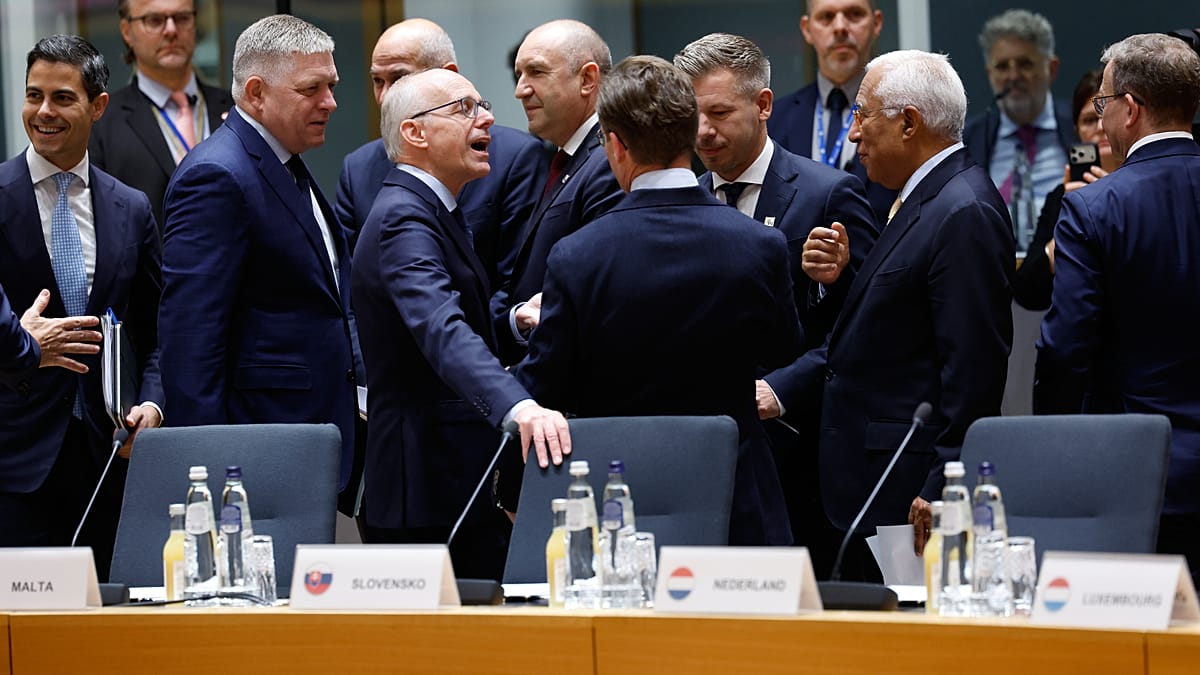
EU leaders ended their Brussels summit with no deal on the budget, a new €70bn Ukraine funding gap, open clashes over energy and migration, but fresh resolve to create new trade defence tools to battle China.
EU leaders gathered in Brussels on Thursday and Friday with a packed agenda, from the long-term budget and financial support for Ukraine to migration, energy and China.
The summit alternated between entrenched positions on the bloc’s budget, a warm welcome for Ukrainian President Volodymyr Zelenskyy, and clashes over energy and migration policies.
Here are the five highlights.
Rallying behind Ukraine
The bitter row between Zelenskyy and US President Donald Trump dominated the second day of the summit.
Leaders closed ranks behind Zelenskyy and promised to keep sanctions in place for as long as Russia pursues its full-scale invasion. They also condemned the diesel deal struck by Trump with Russian President Vladimir Putin, although the Bulgarian prime minister broke ranks to support it.
The reception gave Zelenskyy a moment of diplomatic relief as Trump doubled down, claiming Zelenskyy was “more difficult” to deal with than Putin and demanding new elections in Ukraine. Trump also called Kyiv’s strikes on Russian oil refineries, its main leverage, a “disgrace”.
“I defend the interests of Ukraine and the Ukrainian people exclusively,” Zelenskyy said in a defiant tone. “We were attacked, occupied, and our people were killed. It is only logical that we have the right to defend ourselves.”
“We will keep living, fighting, and most importantly, living with dignity,” he added.
In his address, Zelenskyy asked leaders for an additional €70bn in financial and military support next year to counter Russia’s escalation.
The request upends the bloc’s plans, which assumed last year’s €90bn loan would cover both 2026 and 2027. EU leaders tasked the Commission to come up with a proposal on how to address Kyiv’s financial needs.
Filling the gap will be anything but easy. Soaring borrowing costs make joint debt unpalatable. The immobilised Russian assets, which Zelenskyy raised again, remain politically divisive. And bilateral contributions risk leaving the burden on a handful of wealthy countries.
EU budget
On Thursday, leaders debated the next Multiannual Financial Framework (MFF) at length but, as expected, made little headway, as the “frugal” net contributors and the southern and eastern “Friends of Cohesion” dug in.
One thing is clear: the negotiating box tabled by the Irish presidency just days ago, which proposed slashing €141bn from the overall budget to appease the frugal, is now officially dead.
European Council President António Costa will take over the talks. He is due to present a new compromise in the coming weeks, which many expect to come before the special summit he has called for 26 November, just days before the Spanish elections.
Costa is expected to pursue three main lines: keep national contributions as low as possible, rework the package of EU-wide taxes, including by drawing on European Parliament proposals, and restore the flexibility instruments the Irish presidency ruthlessly cut.
That Costa would sooner or later step in was always on the cards. More worrying is that leaders on both sides now openly say they feel no pressure to close the deal by the end of the year.
Seasoned negotiators know that deadlines force concessions. Member states may be playing with fire: a no-deal in December would raise the prospect of talks slipping until after an electoral season that could reshape Europe’s political landscape.
Migration
Migration proved once again among the most contentious issues, after the last discussion, in June, descended into a shouting match between Spanish Prime Minister Pedro Sánchez on one side and Italy’s Giorgia Meloni and Denmark’s Mette Frederiksen on the other.
This time, Rome unexpectedly extended a hand to Madrid just before the dossier reached the table on Friday. Italy and Spain reached what appears to be a first steptowards ending their border dispute, after a string of tit-for-tat checks introduced in the wake of the Ceuta crisis.
Italy’s temporary border controls were due to expire on Thursday evening. They were extended by a week to align with Spain’s, which expire on 22 October. The two interior ministers are due to agree on replacement measures by then.
But while Meloni opened the summit in a conciliatory tone, Sánchez’s other main European nemesis, Frederiksen, did not spare her fellow social democrat over his plan to regularise the status of 600,000 migrants.
“I have asked the European Commission to examine what happens when a country does almost the exact opposite of what the rest of us are doing,” Frederiksen said,referring to Spain in all but name.
Meloni, Frederiksen and Dutch Prime Minister Rob Jetten hosted an informal breakfast before the discussion with 17 other EU leaders to explore “innovative solutions” on migration. Support is growing for emergency measures allowing asylum applications to be suspended during crises.
Tensions between the migration hard-liners and Spain and France came to the fore as the Italian, Danish and Polish governments pushed to rewrite the conclusions to call for avoiding “measures that could create incentives for illegal migration.”
China
On “macroeconomic imbalances”, EU jargon for avoiding naming China, leaders held their course despite the deal between the European Commission and Beijing to curb hybrid car imports.
Over lunch on Thursday, they pressed the Commission to prepare a toolbox of new trade defence instruments, including safeguards with quotas and tariffs, to shield the chemicals and machinery industries from Chinese competition.
China loomed large as the bloc faces a trade deficit of about €360bn with Beijing. Chemicals and machinery, among the sectors hardest hit by cheap Chinese imports, were singled out as the next industries needing urgent protection after the hybrid car quotas.
While the car quotas were negotiated with Beijing, leaders called on Thursday for unilateral safeguards to be introduced “without delay”, according to officials.
The Commission presented last week’s deal as the first phase of negotiations launched in June. But time is running out: the EU’s trade deficit with China keeps widening month after month, and Chinese customs data show Chinese exports to the EU up 25% over the past year.
The EU’s strategy is to keep talking as long as dialogue delivers concrete results, while strengthening its trade defences. France and Germany last week urged the Commission to develop a new instrument to respond swiftly to market disruptions caused by China, which has been accused of unfair trade practices.
“The competition must be fair. We will create instruments against leveraging capacities, against high subsidies, against undervalued currencies. And there will be a toolbox for that. The toolbox will be bigger. It will also be applied as necessary,” German Chancellor Friedrich Merz said.
Commission President Ursula von der Leyen told leaders her institution would begin work on such a tool, though it remains unclear whether it will be ready before the end of the year.
Other instruments are in the pipeline, including a diversification tool to encourage EU companies to diversify their suppliers of strategic products such as critical raw materials, and a solidarity mechanism to help member states hit by possible Chinese countermeasures.
Energy
On Thursday, leaders were dragged into an interminable discussion on energy. The Visegrád Group (V4) and Italy asked to amend the summit conclusions to call on the Commission to propose new measures to curb short-term swingsin electricity prices and to reassess the proposed Emissions Trading System (ETS).
The V4, Italy and, to a lesser extent, Greece led the push because they face some of Europe’s highest energy costs, a concern largely shared by other member states, which ultimately called for a coordinated European response to the ongoing energy crisis.
The attempt to reopen the ETS, however, triggered an ideological backlash from Finland, Denmark and Sweden. The system makes companies pay for their emissions and encourages investment in sustainability.
Czech Prime Minister Andrej Babiš, by contrast, lashed out at the carbon tax, accusing it of wrecking Europe’s competitiveness by fuelling soaring energy costs for the benefit of market speculators.
“We’ve been engaged in a drafting exercise all day at the leaders’ level about something technical,” an EU official vented at the margins of the summit. “It’s not resulting in any new measures or new policies that actually help EU member states in their problems.”
Rome and the V4 know they lack the qualified majority to reopen the EU’s carbon market rules. The aim was rather to signal to domestic audiences that they are doing what they can to contain the surge in energy prices.
Source: www.euronews.com

2 Comments
Pingback: Met police investigating row over founding of Your Party - Warsaw.Today
Pingback: Where to See the World’s Most Famous Preserved Body Parts - Warsaw.Today