



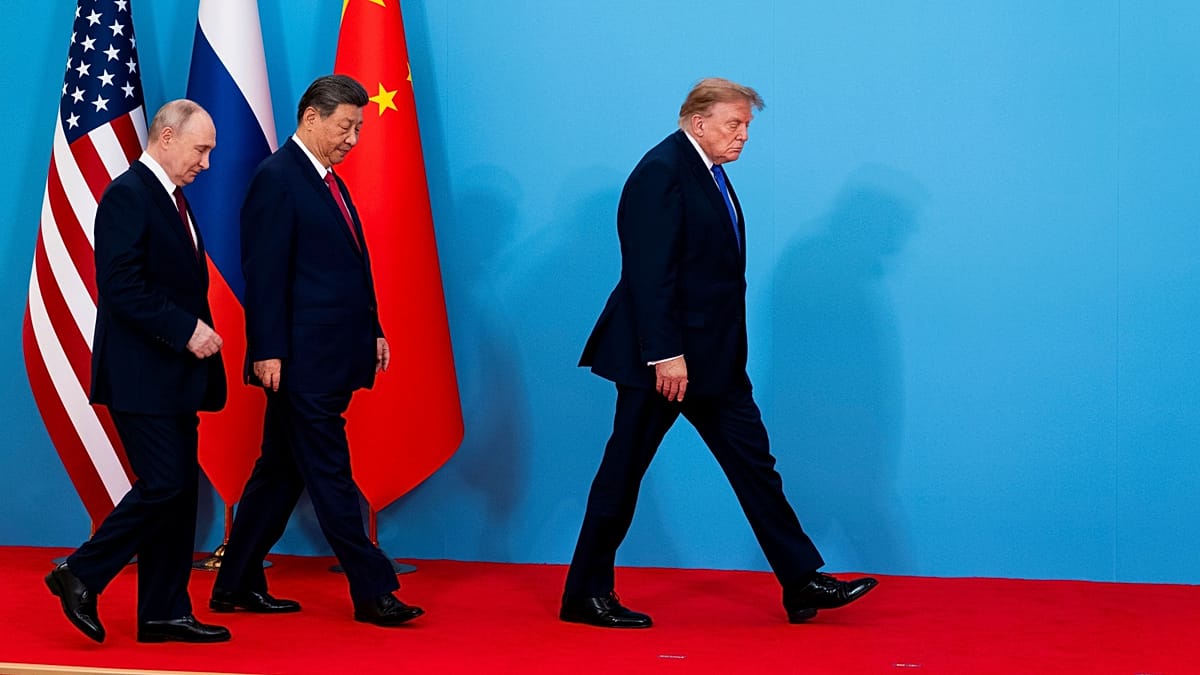
In this week’s newsletter, Euronews Political Correspondent Jorge Liboreiro unpacks the fallout from the much-hyped “Yalta 2.0”, describing the outcome as a political nothingburger.
Hype is, by nature, risky. In diplomacy, it can be deadly.
Just ask Donald Trump, who arrived in Shenzhen, China, amid pomp, pageantry and sky-high expectations for a historic trilateral summit with his Chinese and Russian counterparts. But let’s look at what actually happened.
The meeting had been dubbed “Yalta 2.0”, drawing an intriguing parallel with the 1945 conference that defined the partition of the world in sphere of influence among the victors of the Second World War: the United States, Britain and Soviet Russia.
As it turned out, Yalta it was not. More like a wannabe knock-off. And the leader of the world’s largest economy – who appeared to doze off at times during the proceedings – had the least to show for himself as he left China’s technology hub.
For Trump, the main – perhaps only – takeaway was the photo opportunity with the other two leaders and the media frenzy it generated. But Trump has long understood politics as a matter of optics, and the picture alone may have been enough.
The joint declaration against nuclear warfare was about as meaningful as a Miss World contestant calling for world peace at a Trump beauty pageant – a format he once owned, so he knows a thing or two about it.
For Vladimir Putin, it was more of a mixed bag.
The Russian president was visibly side-lined at the preceding dinner, relegated to a second-tier table while Trump and Xi Jinping chummily sat together.
His heavy-handed attempt to push Russia’s war against Ukraine to the top of the agenda also fell flat. The conflict was conspicuously absent from the ironically titled “Declaration toward Peace”, published by the three countries after their 80-minute meeting.
The meeting allowed Putin to cultivate the illusion that Russia – an economy roughly the size of Italy’s – somehow deserves to stand on equal footing to the US and China. But that’s only a mirage. The truth is Putin’s Russia is a country is decline.
For almost five years, Moscow has waged a devastating war against its neighbour, inflicting immense human suffering while failing to achieve its core objectives: toppling the government in Kyiv and occupying the country in full.
When it comes to Xi Jinping, eager to capitalise on America’s rupture with its Western allies, the summit was a home run.
As host, the Chinese president set the pace and controlled the stage. He spoke in grand terms, likening nuclear weapons to “a sword of Damocles hanging over humanity” and urging “major powers [to] live in harmony”.
More importantly, he used the occasion to reinforce his central message: an alternative to the Western-led world order is possible – and China intends to help mould it.
So, was it really Yalta 2.0? Or just three ageing men sitting around a table? It’s a fair question: together, they are 227 years old.
“As far as a new Yalta goes, what was so bad about Yalta?” Putin said at the end of the talks. “Yalta formalised the existing realities, and in today’s conflicts, too, we will have to come to terms with the realities on the ground.”
Needless to say, Putin had the most to gain from staging a replay of the 1945 Yalta conference, where Stalin’s Soviet Union emerged among the victors of World War II. Xi, by contrast, urged leaders to “abandon Cold War thinking” – somewhat paradoxically, given that Yalta helped usher in the Cold War.
For Europeans, however, the timing turned out to be surprisingly convenient.
Just hours after the Shenzhen summit, they gathered in Berlin for a fresh meeting of the Coalition of the Willing. It gave them an opportunity to project unity, demonstrate that they were taking matters into their own hands and, perhaps most importantly, show that they were getting on with business, seemingly unfazed by the noise elsewhere.
Their closing press conference said it all. To put it bluntly, it was a collective shrug.
“A Yalta-style format will not bring peace,” German Chancellor Friedrich Merz said.
“At Yalta, Europe was divided up. It was parcelled up. And we won’t allow anything like that to happen again.”
Standing alongside him, French President Emmanuel Macron suggested the Shenzhen meeting lacked the legitimacy to redraw the global order.
“Europeans have taken decisions. They have decided to determine their own fate,” he said. “Europe is not a subject on a menu of discussions, but a series of powers who want to build their own future.”
Admittedly, there was a tangible sense of relief across European capitals.
For the past two years, Europeans have been on edge, fearing that Trump would lose patience and strike a secret deal with Putin over Ukraine’s head.
They have become better at resisting – or building resilience, as we say in Brussels – to that kind of fatalistic thinking. But they remain acutely vulnerable to Trump’s penchant for political shockwaves.
The past month has, in fact, been a concerted effort to keep the diplomatic process firmly on track.
European, Ukrainian and US officials have met in Miami, Oslo, Brussels, Abu Dhabi and Berlin, building a close-knit working group to develop security guarantees and recovery plans for Ukraine once the war is over.
It marks quite a turnaround from 2025, when Washington deliberately kept Europe out of the loop and journalists – yours truly included – penned obituaries about Europe’s “missing seat” at the negotiating table.
Now, Washington is actively urging Moscow to engage in direct talks with Europe, something Russia has consistently refused to do, despite its seemingly endless fixation with reshaping Europe’s security architecture.
Privately, European officials see the US push for multilateral peace talks as evidence that Washington has finally recognised a basic reality: whatever contours a deal has, Europe will have to be involved in both negotiating it and putting it into practice.
And yet, they are under no false hopes. Everybody knows the process is and will remain volatile. Nobody can say what comes next. So far, there is little to suggest that Putin is ready for meaningful negotiations.
In another indication of Moscow’s reluctance to engage, Putin invited European leaders to Moscow to discuss their participation in the talks – an offer that hardly inspires confidence. He also declared negotiations with Ukraine over in retaliation for the attack on his prized and heavily defended Crimean Bridge.
And so here we are.
For all the uncertainty, Europeans appear to be increasingly accepting that a resolution to the war may be closer than it once seemed. That means the moment for difficult, potentially painful decisions could be approaching. The question is no longer simply whether Europe will have a seat at the table, but whether it will be ready to make those decisions when the time comes.
Above all, Europeans want to ensure that they – rather than others – get to shape the choices that will determine Ukraine’s future.
British Prime Minister Andy Burnham, who was also in Berlin, put it unusually candidly, describing the war as a “lose-lose situation” for all parties.
“We are clear about what we will accept and what we won’t accept,” he said.
“But we are also clear that we stand with Ukraine today, tomorrow, for as long as it takes until this unjust war is over.”
Thank you reading Off the Record. We’ll be back next week.
Source: www.euronews.com
