



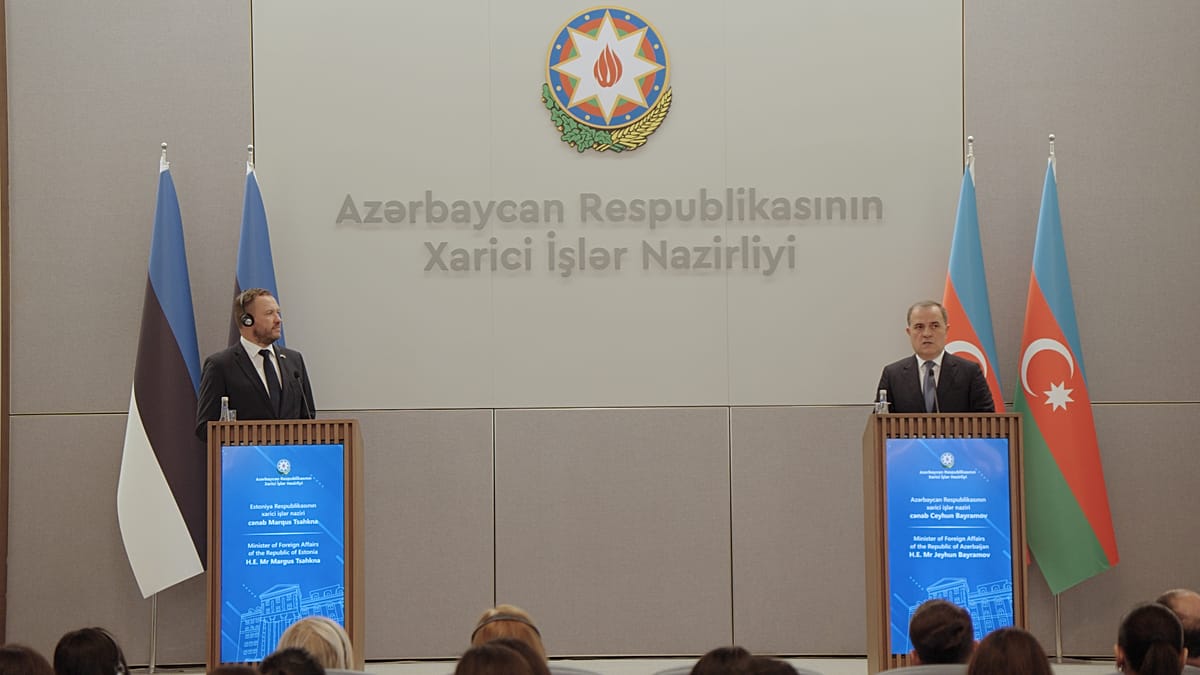
Estonia has opened its embassies in Baku and Yerevan to strengthen its strategic ties with the South Caucasus. Estonian Foreign Minister Margus Tsahkna confirmed during his visit to the Azerbaijani capital that the Baltic state will close its border with Russia on 1 December.
Estonia will close its border with Russia on 1 December, Foreign Minister Margus Tsahkna confirmed in Baku on Friday, stating that “we are not happy about that, but we need to respond and we need to secure Europe as well.”
Speaking to reporters at the official opening of the Estonian embassy in Azerbaijan’s capital, Tsahkna said his country’s decision addresses growing security concerns over Russia’s actions against European countries.
He warned that Estonia, which shares a border with Russia, has also faced an increase in Russian sabotage and attacks targeting Europe.
Tsahkna travelled to Baku as Estonia increases its diplomatic presence in the South Caucasus, describing his country’s new embassy in Baku as a long-term commitment.
“Every embassy for us has a huge value,” he said, while describing the decision to open a diplomatic mission in Azerbaijan as “well calculated”.
“Our nations, we have a long history together, the same understandings, lots of personal relations, but also the same challenges and interests to the world,” Tsahkna said.
He added that an intergovernmental commission meeting earlier this month helped move cooperation towards practical projects involving public institutions and private companies.
Trading energy and development in the Middle Corridor
Tsahkna said that Azerbaijan’s role in regional and European energy security, as well as the development of the East-West Middle Corridor connecting Asia and Europe, are among Estonia’s key interests.
“We see Azerbaijan as a huge opportunity of learning how you’re dealing with energy,” the foreign minister said.
According to the Estonian foreign minister, the historic peace process and the normalisation between Azerbaijan and Armenia open new perspectives across the South Caucasus, which until recently was dominated by Russia.
Estonia also opened an embassy in Armenia earlier this year, demonstrating its strategic interest in boosting its diplomatic presence in both countries and the wider region.
Tsahkna outlined Estonia’s interest in digitalisation, AI and other technology sectors in Azerbaijan, as well as opportunities emerging from the EU’s expanding global trade partnerships.
Following a bilateral meeting with Azerbaijan’s President Ilham Aliyev, the Estonian foreign minister said that the EU was keen to develop a more practical, long-term cooperation with Azerbaijan, particularly in trade, energy and regional connectivity.
“Estonia definitely supports the visa liberalisation process between Azerbaijan and the European Union,” Tsahkna said.
Tourism and education also featured in Tsahkna’s address as he called for stronger educational and people-to-people ties, welcoming more Azerbaijani students to Estonia and encouraging greater tourism between the two countries.
“We are very happy to host your students, your people to Estonia more and more and to see more Estonians as well coming to Azerbaijan,” he said.
Ukraine remains central to security discussions
Tsahkna said he arrived in Baku directly from Kyiv, describing how “the last night I was there, Kyiv was under heavy ballistic missiles attacks,” adding that developments in different regions were interconnected.
A staunch supporter of Ukraine, Estonia will co-host next year’s Ukraine Recovery Conference with the war-torn country.
Azerbaijan’s assistance has reportedly exceeded $50 million (€45.6 million), and its first humanitarian shipment arrived right after Russia’s full-scale invasion of Ukraine in early 2022, including food and medicine.
In addition, Azerbaijan’s State Oil Company (SOCAR) has gas stations across the country providing free fuel for emergency services vehicles.
Tsahkna stressed the importance of international assistance to help Ukraine withstand the coming winter, thanking Azerbaijan for the humanitarian support it provides to the war-torn country.
From Azerbaijan’s perspective, Foreign Minister Jeyhun Bayramov underlined the growing cooperation between the two countries.
The opening of Estonia’s embassy comes at a time of intense cooperation between the EU and the South Caucasus countries on energy diversification, transport connectivity and regional security.
For Tallinn, deeper engagement with Baku is part of a broader effort to strengthen ties with a region increasingly interconnected with Europe’s economic and geopolitical priorities.
Source: www.euronews.com
