



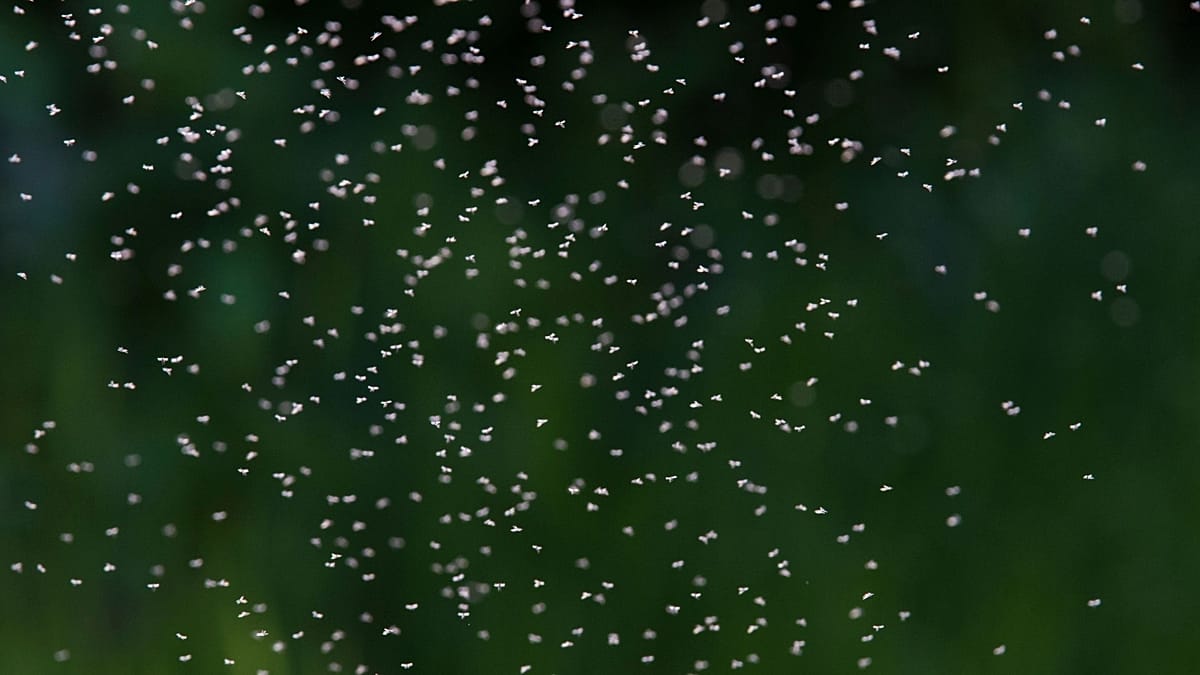
Mosquitoes that were associated with tropical regions are now established in several European countries and are moving north. Health authorities are rushing to ensure that the diseases they spread — such as dengue, chikungunya and Zika — don’t catch up with them. And citizens have an important role.
In September, Portugal has released 30,000 sterile male mosquitoes in a second attempt to curb the growing tiger mosquito population.
The mosquito, once found mainly in Southeast Asia, was introduced to Italy back in the 1990s through shipments of used tyres and has since spread to France, Spain, Germany, Switzerland and other European countries.
Concerningly, diseases that it spreads — such as dengue, chikungunya and Zika — are also making their way to Europe. While cases remain sporadic in most European countries for now, EU and national health authorities are working to ensure that the diseases do not become endemic in the bloc.
“The trajectory that we’re on doesn’t look good,” Jan Semenza, an environmental epidemiologist, told Euronews. “This is a problem that will stay with us if we don’t contain that as quickly as we can.”
Diseases spread through mosquito bites. Infected travellers returning from tropical destinations can bring the viruses back to Europe, where local mosquitoes can pick them up and pass them on.
“A lot of people are coming from their vacation back to Europe from Thailand or Brazil or places where we have these tropical diseases and they bring those viruses with them,” Semenza said. “They get bitten by a local mosquito and that local mosquito bites someone else and infects someone else and then you have a local outbreak.”
Therefore, Portugal has opted to tackle the problem by releasing male mosquitoes that had been sterilised through irradiation, meaning they could mate with females but produce no offspring.
“What we are fighting against is that we can become an endemic country,” André Peralta Santos, deputy chief of the Directorate-General of Health in Portugal, told Euronews.
Other techniques include the one Brazil used a few years ago, when mosquitoes were infected with the bacterium Wolbachia, which blocked viruses from infecting them.
But while there are ways to reduce mosquito populations and limit transmission, eliminating the insects altogether is not realistic.
“You cannot autoclave the environment,” Jan said. “Once the mosquito is established, the mosquito is here to stay; there’s nothing you can do about it.”
The only option, then, is to prepare.
And that requires “a combination of things”, ranging from population control to vaccines and antivirals. And one of the most important elements is community engagement
Getting the citizens on board
“We should not underestimate the power of citizens,” Marion Koopmans, virologist at Erasmus Medical Centre in the Netherlands, told Euronews. “In the mosquito-borne world … there’s a lot of information that you can get from people.”
Digital technology is proving useful here, with apps such as the Mosquito Alert app, being used across Europe to help track whether tiger mosquitoes are entering new areas.
“That’s new types of data that are now increasingly also being used to feed the surveillance,” she said.
Citizen reports can help authorities keep track of the mosquito’s expansion. The tiger mosquito is moving around 60 kilometres further north each year, partly by hitching a ride in cars. Disease outbreaks are spreading even faster, at around 120 kilometres a year
While citizens can help track the mosquitoes themselves, health authorities are also working to detect the viruses they carry — ideally before infections turn into local outbreaks.
Wastewater surveillance is happening at the international level, with the backing of the EU’s Health Emergency Preparedness and Response Authority (HERA).
“You can see if dengue is spreading in Europe through wastewater surveillance before the patient goes to the doctor,” Laurent Muschel, director and deputy head of HERA, told Euronews, calling this “a very powerful tool” that HERA is investing “quite a lot” in.
Monitoring is taking place at major European airports as well as at international hubs in Singapore, Africa and Latin America.
“It’s really a global network that we are trying to build to pick up early signals of what is happening in the world,” Muschel said.
Identifying an infection is crucial to preventing further spread. “We need to make sure that person is treated immediately and avoid any mosquito bites,” Semenza said. “You don’t want other mosquitoes to pick that virus up and transmit it to someone else.”
Surveillance is only one part of the response. Authorities also need to control mosquito populations — and citizens can contribute to that effort, too.
There are several ways to do so, from installing insecticide-treated screens and spraying indoors to eliminating standing water where mosquitoes breed.
Semenza pointed to examples from Nicaragua, where communities are taught to recognise mosquito larvae in standing water and understand the importance of cleaning containers around their homes.
“If you have standing water and you see a little worm in that water, that is not a worm, that’s a larva, and that larva will hatch to become a mosquito and that is a problem for public health,” Semenza said.
Getting the tools ready
But even the best surveillance systems cannot prevent every infection. As mosquito-borne diseases become established in Europe, health authorities also need to ensure that doctors can recognise them and that the right treatments are available.
“Often you get an infection even if you haven’t been abroad,” Semenza said. “And then how can [doctors] figure out that these types of weird symptoms that they have never seen before could be a potential tropical disease?”
That’s why the EU’s Health Emergency Preparedness and Response Authority (HERA) is pouring €10 million into the development of new diagnostics.
“We are also missing the right medicines to treat these new diseases that are coming to Europe,” said Muschel, adding that the agency was funding research into antivirals and new vaccines.
“There are some vaccines for dengue and chikungunya; they are not perfect,” Muschel said. “We are trying to get better generations of vaccines and we might need to vaccinate a pocket of population where the mosquitoes are present and are transmitting the disease.”
What is clear is that mosquitoes are already established in parts of Europe, and health authorities cannot afford to wait for the diseases they carry to become endemic.
“The risk is here,” Semenza said. “We need to prepare.”
Source: www.euronews.com
