



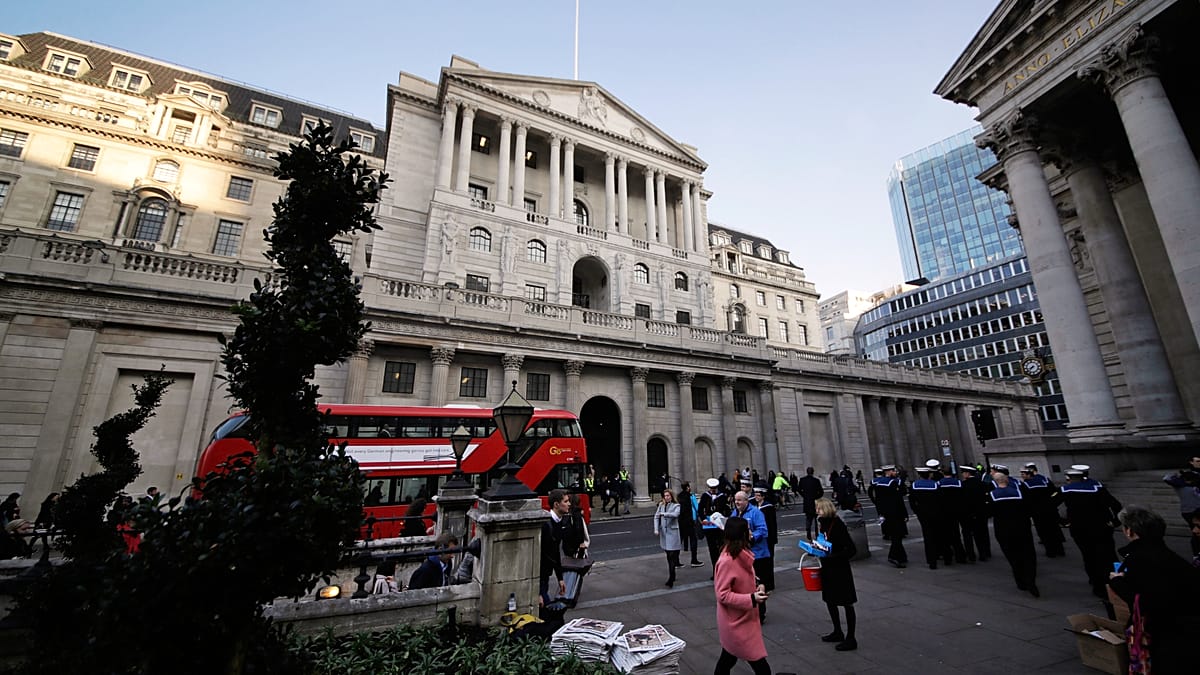
The Bank of England has raised interest rates to 4% as it tries to curb rising prices fuelled by the Iran war.
In a widely expected move, the Bank of England raised its main interest rate to 4% from 3.75% on Thursday.
The main cause of the rise in inflation this year has been down to the sharp increase in fuel costs because of the Iran war and the ensuing bottlenecks in the Strait of Hormuz, which have squeezed global oil and gas supplies.
Thursday’s increase was the first since August 2023.
Eight policymakers voted for the quarter-point increase, while one wanted a larger, half-point rise.
The pressure on the Bank of England to act has grown steadily in recent months. When inflation hit an 11-month high of 3.5% in September — well above the bank’s 2% target — it cemented market expectations of a rate rise this month, with potentially more to come in 2027.
The bank said there was still limited evidence that higher energy costs were feeding through to other prices and wages. It also said the economy had proved more resilient than expected, although growth was likely to slow in the coming quarters. However, it warned that “the degree of inflationary pressure in the pipeline is now sufficient to warrant an increase in Bank Rate”.
“We imagine that many committee members’ patience with the recent rise in inflation has worn thin,” said Ellie Henderson, an economist at Investec. “The longer energy prices remain elevated, the greater the risk that a temporary price shock becomes more permanent.”
Alongside the rate rise, the bank published its quarterly forecasts, warning that inflation could reach around 5% by the middle of 2027, up from 3.5% in September, as higher energy costs feed through to household and business bills.
The bank also raised its growth forecasts, predicting that the UK economy would expand by 1.6% this year and 1.3% in 2027, up from its July forecast of 1.1% for both years.
Bank of England governor Andrew Bailey signalled that further rate rises remained possible, but were not inevitable.
“Today’s increase shouldn’t be seen as the first in an inevitable long sequence of hikes. But, unless the conflict in the Middle East is resolved, neither does it seem likely to be the last increase. The MPC will judge the outlook at each meeting, responding as necessary to bring inflation sustainably back to our 2% target,” he said.
Market interest rates remained above their pre-conflict levels, while benchmark two-year mortgage rates had risen by nearly half a percentage point since the beginning of September. According to the bank’s latest Market Participants Survey, respondents’ median expectation was for Bank Rate to reach 4% in November and 4.25% in February.
The bank also expects the Budget to reduce inflation by a quarter of a percentage point by the second quarter of 2027, although fiscal policy is expected to weigh on growth over the medium term.
The Bank of England’s decision follows recent rate rises by the US Federal Reserve and the European Central Bank in response to inflation fuelled by the Iran war. Expectations for their next moves depend largely on energy prices.
Interest rates in the UK had been falling from a 15-year high of 5.25% before the US and Israel attacked Iran on 28 February.
Source: www.euronews.com
