



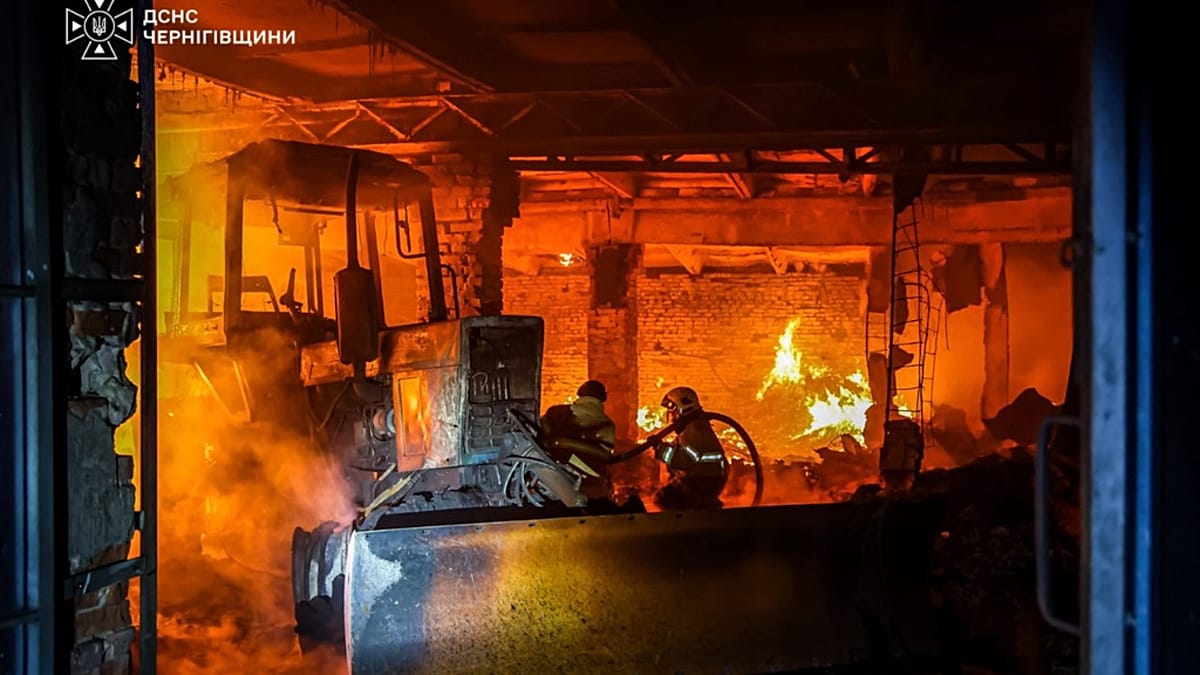
Ukraine’s air defences downed 87 Russian missiles and drones overnight on Thursday. Meanwhile, Ukrainian drones struck a chemical plant making components for military explosives and a power station in the Stavropol region.
Russian forces struck residential buildings and an educational institution in Kharkiv overnight on Thursday, killing at least three people and leaving others potentially trapped under rubble, as a wider assault combining ballistic missiles and drones caused casualties in Kyiv and several other regions.
The attack involved Iskander-M, Zircon and S-400 ballistic missiles alongside 113 Shahed, Gerbera and Parodiya decoy drones, 76 of them jet-powered.
Ukraine’s air defences shot down or neutralised 87 aerial targets.
Two people were killed when a Russian strike hit a residential building in Kharkiv on Thursday morning, while seven people were injured in a Russian missile strike on Kyiv.
A drone also struck a multi-storey building in the city’s Novobavarsky district, injuring three people. Local authorities said others may still be under the rubble.
A third person was killed and several wounded in a strike on an educational institution in the city’s Kyiv district.
One person was wounded in Dnipropetrovsk region. In Donetsk region, one person was killed and three injured in a strike on a post office in Bylbasivka on Tuesday evening.
Ukrainian strikes on Russian infrastructure continue
Ukrainian drones struck a thermal power plant and a chemical facility in Nevinnomyssk, Stavropol region overnight on Thursday.
The chemical plant, Nevinnomyssky Azot, is part of the EuroChem company and has been attacked at least six times since Russia’s full-scale invasion began in February 2022.
The plant produces around 1.42 million tonnes of ammonium nitrate, 1.16 million tonnes of ammonia and 0.17 million tonnes of acetic acid per year. The facility produces components used to make military explosives octogen and hexogen, which go into artillery shells.
The adjacent Nevinnomysskaya GRES power plant, which supplies electricity to the chemical facility among other consumers, was also struck.
Regional authorities in Stavropol said production and energy facilities had been damaged along with a school building and a university branch, and two people were wounded. Schools, universities and colleges in Nevinnomyssk switched to remote learning.
A new fire broke out at the Kuibyshev refinery in Samara region on the morning of Thursday, a day after Ukrainian forces had already struck it and the nearby Syzran plant.
Ukrainian forces also struck the Subkhankulovo pipeline station in Bashkortostan, a major hub in the Transneft trunk oil pipeline system that pumps crude oil from Western Siberia and Tatarstan.
A fire was reported at a plant in Naberezhnye Chelny in Tatarstan; monitoring sources said it may be the Altynpolymer-NCh facility, which processes plastics. Four people were injured in a drone attack in the Krasnodar region. Authorities in Rostov and Voronezh regions also reported air attacks.
Russia’s Defence Ministry said 343 Ukrainian drones had been destroyed overnight across 15 regions, over the Azov and Black Seas and over Russian-occupied Crimea. Euronews could not independently verify these claims.
Russia and Ukraine exchanged the bodies of servicemen killed in Moscow’s ongoing all-out war, returning 250 to the Ukrainian side and 22 to Russia, Russian state news agency RBC reported, citing a State Duma deputy.
The exchange was partially confirmed by Khochu Nayti, a Russian organisation that helps families locate missing, dead and captured servicemen.
“Today, 26 November 2026, with the mediation of the International Committee of the Red Cross, the bodies and remains of 22 Russian servicemen were handed over to Russia as part of repatriation,” the organisation said.
The previous such exchange took place on 22 October, when 252 bodies were returned to Ukraine and 25 to Russia.
Similar exchanges have taken place regularly since summer last year, when Russian and Ukrainian representatives reached an agreement in Istanbul.
Source: www.euronews.com
