



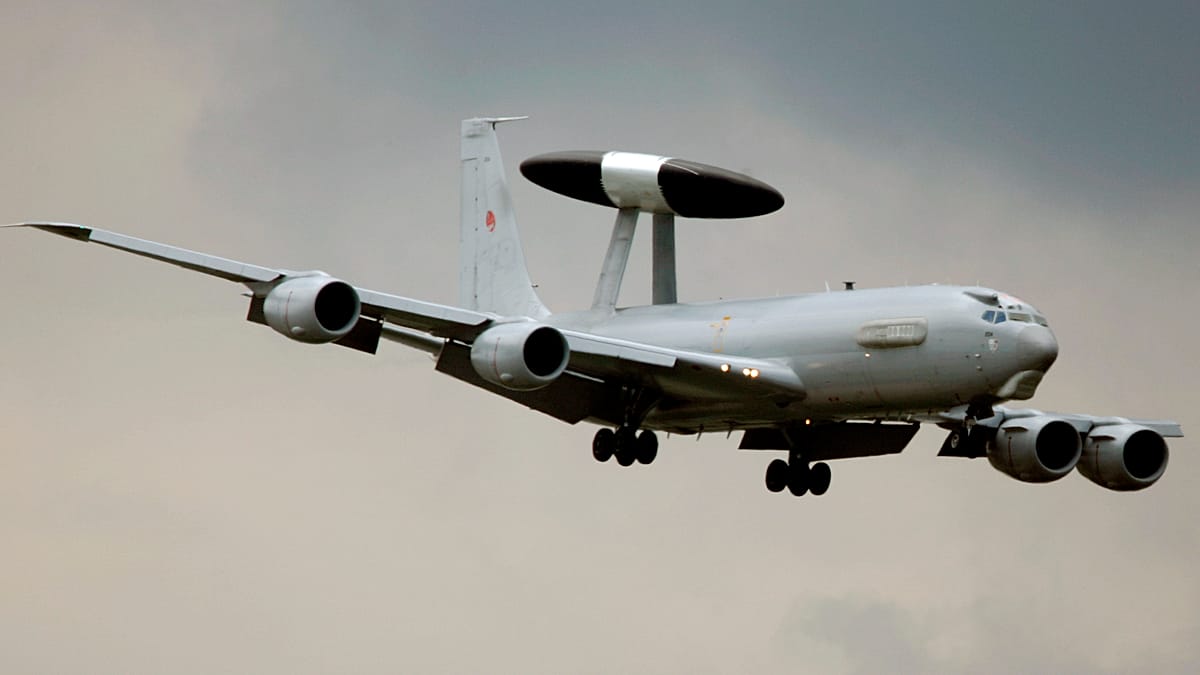
NATO has authorised deploying an AWACS reconnaissance aircraft to Poland after prosecutors said three Russian cruise missiles fell on its territory. The flying radar has served since the Cold War, in the Balkans, in Libya and after 11 September over US airspace.
A radar also has a horizon. While a ground-based radar can have low-flying aircraft or cruise missiles hidden from it by the Earth’s curvature and the terrain, viewing from higher altitude allows it to see farther. That is why NATO lifts its radar into the air, together with the soldiers who interpret the signals, relay warnings and, when needed, direct the fighter jets waiting for deployment.
According to the Polish prosecutor’s office, three Russian H-101 cruise missiles crashed in Poland on 20 November. Three days later NATO confirmed that General Alexus Grynkewich, the commander of the alliance’s <a href="https://warsaw.today/spanish-economist-to-become-new-european-central-bank-chief/” title=”Spanish economist to become new European Central Bank chief”>European forces, had authorised the forward deployment of an AWACS aircraft. The fleet based in Gelsenkirchen in Germany has played an important role since 2022 in monitoring the airspace over NATO’s eastern flank.
What makes it more than a flying radar?
AWACS is an English acronym meaning airborne early warning and control system. The most recognisable part of NATO’s Boeing E-3 Sentry aircraft is the rotating radar dome mounted above the fuselage, about nine metres in diameter. The system scans the surrounding airspace, and the crew on board cross-checks the detections with data from other sources to identify and track air traffic.
The air picture assembled on board can be passed to fighter aircraft, ships and ground control centres. That way units from several countries can follow the same air situation and coordinate their response. In a fast-changing situation this is at least as important as early detection itself.
In which crises did its capabilities become clear?
NATO’s first E-3s entered service in 1982. With them the alliance gained a jointly operated surveillance and control capability. By the end of the Cold War they were needed in another region. After Iraq invaded Kuwait in 1990, NATO deployed AWACS aircraft to eastern Turkey to reinforce the alliance’s southern flank.
In the following decade the Balkans became their main task. AWACS aircraft have monitored since 1992 the airspace of the former Yugoslavia, and later helped enforce the no-fly zone over Bosnia and Herzegovina. They were also deployed during the 1999 Kosovo crisis. In the Balkan operations continuous airspace surveillance was increasingly complemented by the coordination of multinational air operations
Why did aircraft from European bases guard US airspace?
One of the fleet’s most unusual missions began after the terrorist attacks of 11 September 2001. At Washington’s request seven NATO AWACS flew to the United States to help monitor American airspace. The Eagle Assist operation involved 830 military personnel from 13 allied countries. The aircraft flew more than 360 sorties up to May 2002. The mission was one of the measures taken after the first application of NATO’s collective defence clause, Article 5.
What role did they play in Libya and in operations against Islamic State?
In Libya in 2011 AWACS aircraft helped enforce the no-fly zone and support the alliance’s air operations. They also passed surveillance data to the warships off the coast that were enforcing the arms embargo. The final flight of NATO’s operation in Libya was carried out by an AWACS. In Afghanistan between 2011 and 2014 they performed airspace surveillance and air traffic control duties.
From 2016 the international coalition against Islamic State used them in a different role. NATO aircraft taking off from Konya in Turkey provided surveillance data to the coalition, while directing air strikes remained the responsibility of the countries taking part in the operation. The same monitoring capability has been used in peacetime as well, for example to help secure the 2004 Athens Olympics and the 2006 football World Cup in Germany.
What will replace the distinctive radar-domed Boeings?
At NATO’s summit in Ankara in July, eleven allies announced that they would jointly acquire Saab GlobalEye aircraft to replace part of the ageing E-3 fleet. The Swedish radar will be fitted to a Canadian Bombardier aircraft, which carries an elongated radar fairing above its fuselage instead of Boeing’s distinctive circular radar dome. According to NATO the new system will be able to monitor movements on land and at sea as well as airborne targets.
Technology is changing, but the incident in Poland shows why the capability introduced during the Cold War is still needed. In a border-area incident it matters how much time passes between the first detection and the alert, and whether the Polish control centre and the pilot of an allied fighter jet are seeing the same picture. A flying radar can help with both.
Source: www.euronews.com
