



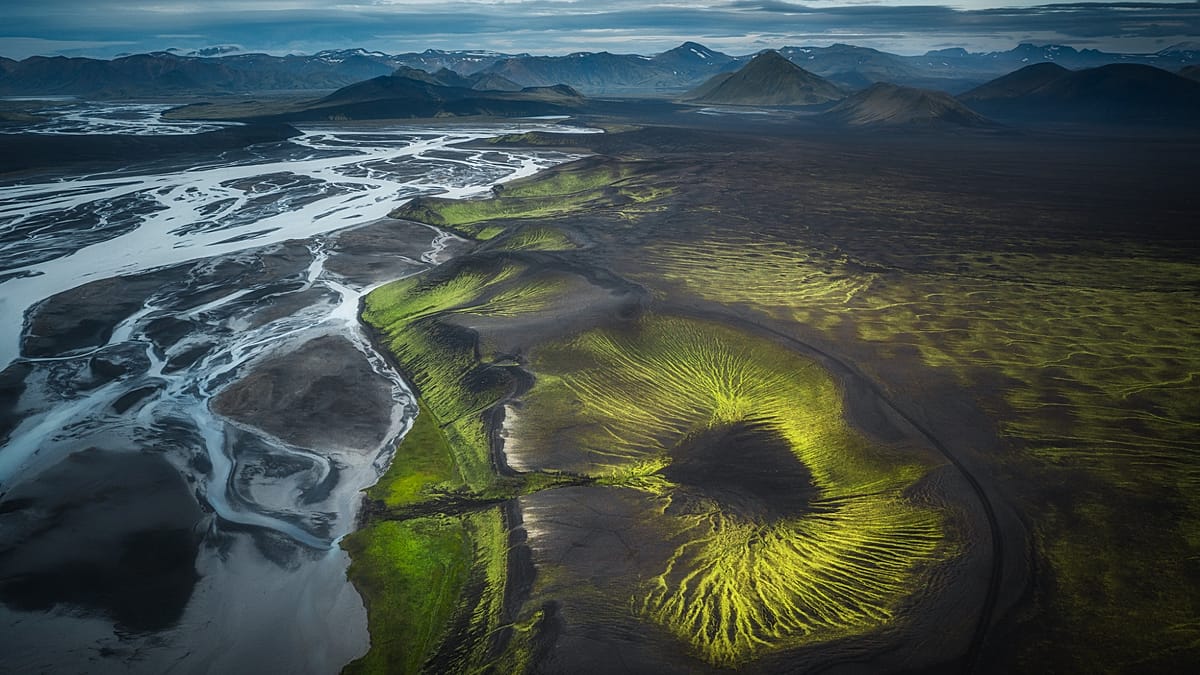
‘Tree of life’ by Radoslav Sviretsov reveals the hidden symmetry of the Icelandic Highlands.
– Copyright Radoslav Sviretsov, Resilient by Nature / EEA
Copyright Radoslav Sviretsov, Resilient by Nature / EEA
Copyright Radoslav Sviretsov, Resilient by Nature / EEA
A fragile Turkish delta and a melting Icelandic ‘snow tree’ are captured in the award-winning images.
From wildfire-scorched forests to algae-choked lakes, humans are leaving increasingly indelible marks on nature.
Carbon emissions from the burning of fossil fuels are pushing global warming towards and beyond the 1.5°C limit, resulting in ever worsening weather extremes.
Mass consumption is strewing coastlines with waste and polluting waterways with chemicals.
Europe is the world’s fastest-warming continent, and the European Environment Agency’s (EEA) latest state of the environment report found more than 80 per cent of protected habitats in poor or bad condition.
With the UN’s COP31 summit now in full swing, world leaders are coming together to get climate action back on track. Hot on the heels of the COP17 biodiversity talks, which ended on 31 October with a new roadmap but a UN report showing the world is falling behind on its 2030 nature goals, the intersection between nature and climate has been thrown into the spotlight.
It’s a relationship Europeans were invited to explore for this year’s EEA ‘Resilient by Nature’ photo competition.
Photographers from 35 countries set out to capture nature in states of harmony, disruption or renewal. From almost 2,800 entries, an external jury chose a winner in each category, as well as awarding a youth prize. The images were also put to a public online vote for the public choice award.
Harmony: Humans and nature find balance in Türkiye’s ancient delta
Türkiye’s Dalyan Delta has for decades stood strong against tourism development, with strict environmental protections helping to fight off resorts and other human activity.
Designated as a Special Environmental Protection Area in the 1980s, the ecologically vital wetland ecosystem is home to over 150 bird species and rare, endemic Turkish sweetgum forests.
Vulnerable loggerhead sea turtles nest on İztuzu Beach, where seasonal night closures and a ban on pets are in place to protect hatchlings.
Still, humans have long made their mark there: Lycian rock-cut tombs are carved into the cliffs along the delta’s labyrinthine channels, while the ruins of the ancient port city of Kaunos hark back to an era of maritime trading.
Now, eco-tourism, local fishing and wildlife preservation bring a slower pace to the delta – the delicate balance of which was captured from above by award-winning photographer Ali Aslan.
Disruption: A water rail wades through a rubbish-lined drainage pipe
Reminding us of what happens when humans neglect their duties of protection, Spanish photographer Julián Fernandez Quilez placed a remote-triggered, wide-angle setup inside a drainage pipe.
He captured a secretive wetland water rail wading through the murky, rubbish-filled pipe, probing a disposable medical face mask, bottle caps and a crushed drink can with its long red bill.
In the background, a watery habitat can be spied through the drain’s opening, putting into focus the consequences of human encroachment on natural ecosystems.
Renewal: A green shoot springs from a scorched landscape
Extreme heat and prolonged drought made 2026 among the worst years on record for wildfires, with nearly 700,000 hectares burned by August, according to the European Commission – nearly double the 20-year historical average.
The impacts are far-reaching: destroyed ecosystems and farmland, degraded soil, planet-heating emissions, health-harming air and water pollution that knows no borders.
While many of these landscapes will take decades to heal – and some will be changed irrevocably – Sofia-based photographer Elitsa Mihaylova reminds us of nature’s remarkable ability to heal.
Her image of a green shoot rising from the ashes appears “fragile, almost impossible, yet full of quiet strength”, according to the photo’s caption.
Youth Prize: Scat research and camera traps rewarded with rare sighting
Eighteen-year-old wildlife photographer Denat Lahi spends weeks mapping territories, photographing scat, and cross-referencing local wildlife databases in his home city of Lund, Sweden.
Lahi uses this intel to identify the best locations for capturing human-like emotion in mammals, he told photography news site PetaPixel.
His dedication has paid off: an image from his series following elusive pine martens in Sweden was awarded the Youth Prize by EEA.
Using nighttime camera trapping and motion-sensing, he snapped the curious creature exploring a dilapidated barn filled with industrial materials – a rare insight into the shy animals’ nocturnal forays into human environments.
Public Choice Award: Melting snow draws a ‘tree of life’ across Iceland’s highlands
Melting snow carves delicate lines in the Icelandic Highlands, with glowing green moss spreading like roots and branches. Barely perceptible from the ground, the scale and natural symmetry of the phenomenon is captured spectacularly by aerial landscape photographer Radoslav Sviretsov.
While snow in this northern wilderness naturally fades between May and June, warmer spring temperatures spurred by climate change are causing it to vanish earlier and earlier, while mild winters are hindering its ability to rebuild and disrupting water cycles.
Open to all European citizens and EEA member countries above 18 years old, the EEA photo competition is free to enter. It aims to bring light to the beauty of Europe’s nature, the environmental challenges it grapples with, and the solutions close at hand.
Source: www.euronews.com
