



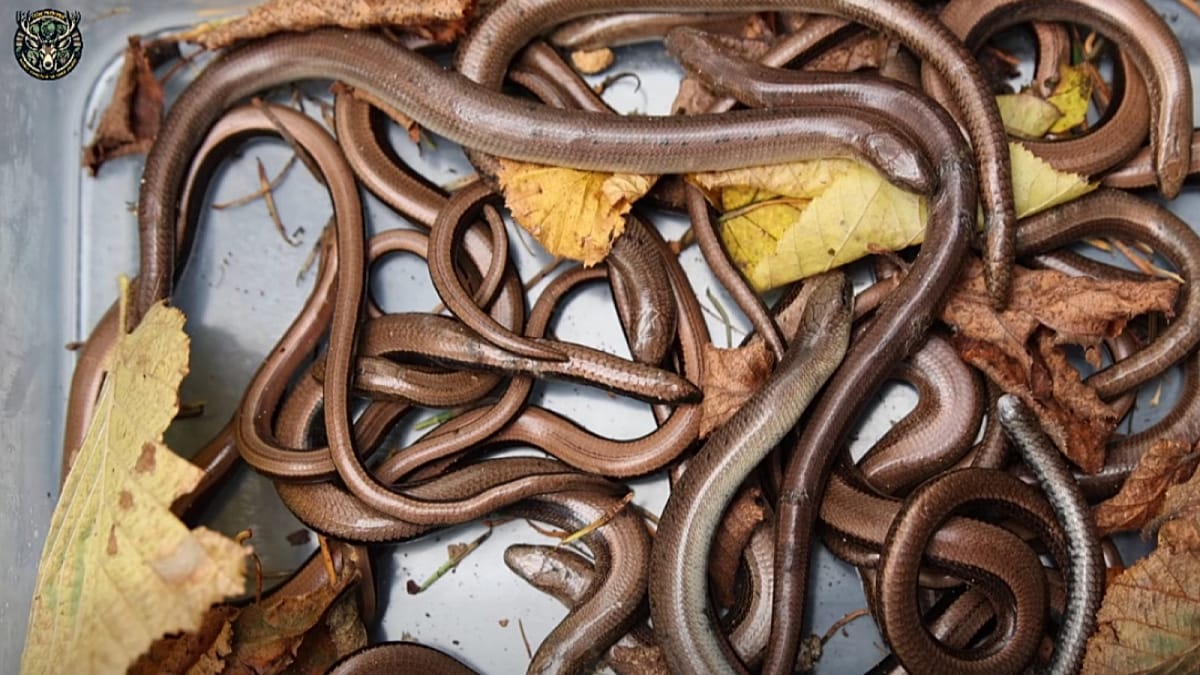
A wildlife rehabilitation centre received an unusual report of venomous vipers sheltering in a water meter chamber, these however, turned out to be harmless slow worms.
Just under two dozen slow worms, initially mistaken for venomous vipers, were found in a water meter chamber in southern Poland.
Wildlife rehabilitation centre Leśne Pogotowie received a report that venomous vipers had taken refuge in the underground chamber. However, rescuers found 19 slow worms sheltering from the cold weather instead.
The chamber provided ideal conditions, with its cool, damp environment protecting the worms’ winter torpor, and the concrete structure offering protetion from freezing temperatures.
The smooth, vertical walls of the chamber meant the slow worms easily descended down into the space, but had no way of climbing back to the surface.
After being rescued from the chamber, the slow worms could be not be released straight back into nature. Instead, they were taken to the animal rehabilitation shelter.
At this time of year, the reptiles were already in a state of winter torpor. Releasing them in cold conditions would leave them with little time to find a new shelter.
At the centre, the slow worms will be provided with the right conditions to spend the winter. A stable, low temperature allows them to remain in hibernation and reduces the risk of unnecessary waking.
The slow worms will only be returned to the wild in spring, when temperature are high enough.
What is a slow worm?
With their serpentine appearance, slow worms are often mistaken for snakes. In reality, they are actually legless lizards.
They are non-venomous and do not pose a threat to humans. In fact, the creatures are beneficial garden residents, as they feed on snails, earthworms and other small invertebrates.
Poland is home to two species of slow worms, the common slow worm and the eastern slow worm. The two species are very similar, but differ, among other things, in the structure and arrangement of their scales. Many males of the eastern slow worm have characteristic blue spots on their backs.
They can be mainly found in the south eastern region of Poland.
Source: www.euronews.com
