



Pro-datacentre officials argue scale of Australia’s buildout is smaller, more regulated and less damaging than in US
Australian politicians and business leaders are arguing that their populace’s growing resentment of AI datacentres is an inauthentic import from the United States.
Like the US, Australia is seeing community resentment grow in response to a surge in the construction of massive AI datacentres. However, pro-datacentre officials and executives argue the scale of Australia’s buildout is smaller, more regulated and therefore less damaging than that in the US. They say the burgeoning negative reaction is being tainted and inflamed by a heated US debate that has arrived down under
When the backlash began in earnest in the United States last year, it echoed slowly in Australia. In 2026, though, it has exploded into national conversation across the country, leading to calls for a national moratorium, community protests, three government inquiries, state frameworks being developed and the Australian government moving to set the rules for how the datacentres can be built, and how they consume energy and water.
Australian state governments, desperate for economic growth, have been broadly welcoming of the investment for the new centres, in some cases overriding local council approval processes, given the size of the projects being developed.
In July, Victoria’s then-minister for economic growth, Steve Dimopoulos, boasted that his state was second only to New South Wales in terms of datacentres, and was outstripping Australia’s most populous state in growth for new centres. He expressed concern that the growing resentment toward new developments was a result of US social media influence.
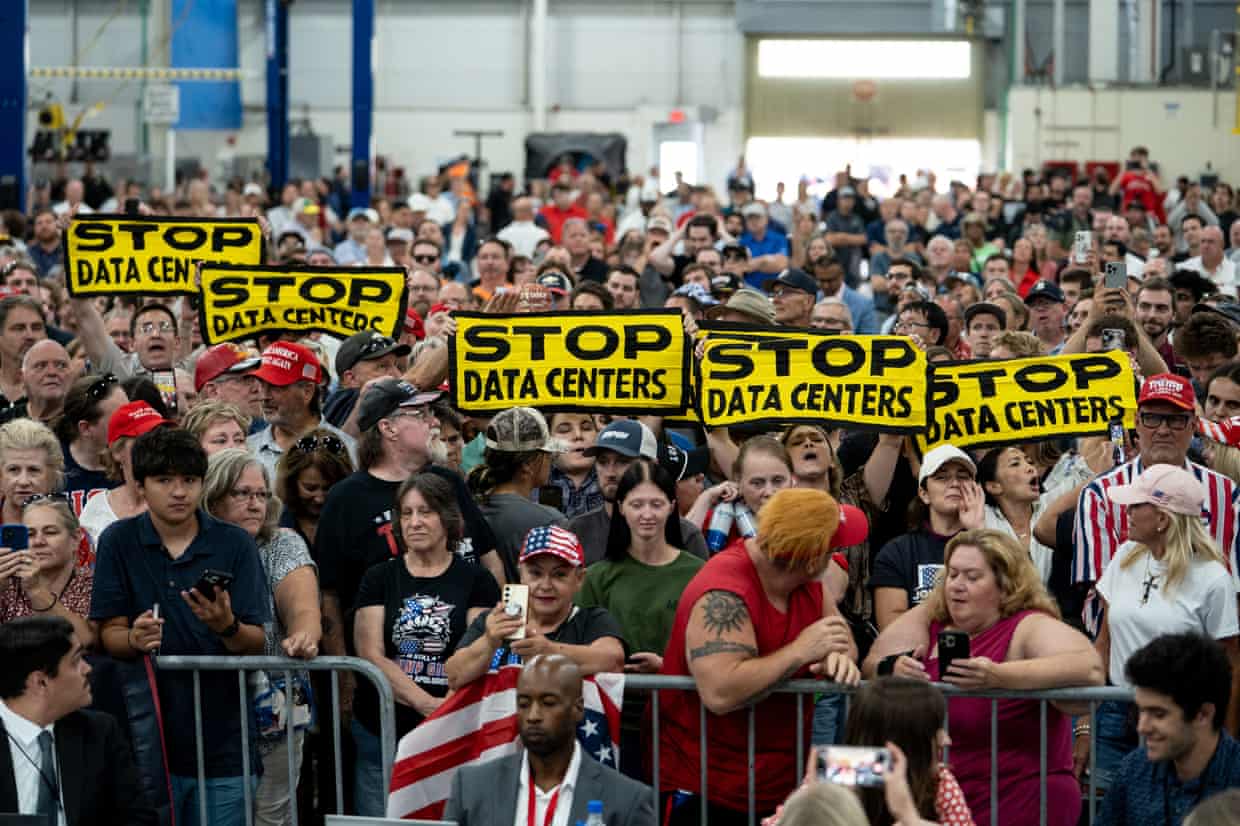
“We’re seeing some US states move to ban new large datacentres. And those campaigns and mega-developments in the US shape public opinion in Australia,” he said. “Because when it’s on your phone, you think it’s right here, or you think it might just come here.”
The minister declared: “We are not the United States. Our planning, energy and water systems are much more carefully monitored, managed and regulated.”
Leaders in the datacentre sector have also complained about the backlash, calling it misleading and disingenuous.
“Australia’s datacentre debate is being fought on America’s facts,” Belinda Dennett, the head of the peak lobby group for the sector, Data Centres Australia, declared in a speech in March.
Dennett said reactions to datacentres from everyday people range from curiosity to confusion and fear, and the news around the sector was “alarming”.
“The industry is depicted as energy vampires, water hogs and job killers,” she said. “The problem is that most of those headlines originate in the United States, where the industry is operating at a completely different scale, under completely different market rules. They are being transplanted wholesale into Australian debates as though the contexts were interchangeable.”
Dennett said the US has 5,400 datacentres, with 53.7 gigawatts of total capacity, compared with 252 in Australia with 1.4 gigawatts of capacity. Measurements of the number of US datacentres vary.
“When people read about datacentres straining the grid, driving up bills and consuming vast amounts of water, they are reading about America’s challenges, applied uncritically to an Australian market that bears almost no resemblance to it,” she said.
What Dennett omitted was that Australia, with a population of 28 million, has just under one datacentre per 100,000 people, compared with 1.5 per 100,000 people in the US, population 342.7 million.
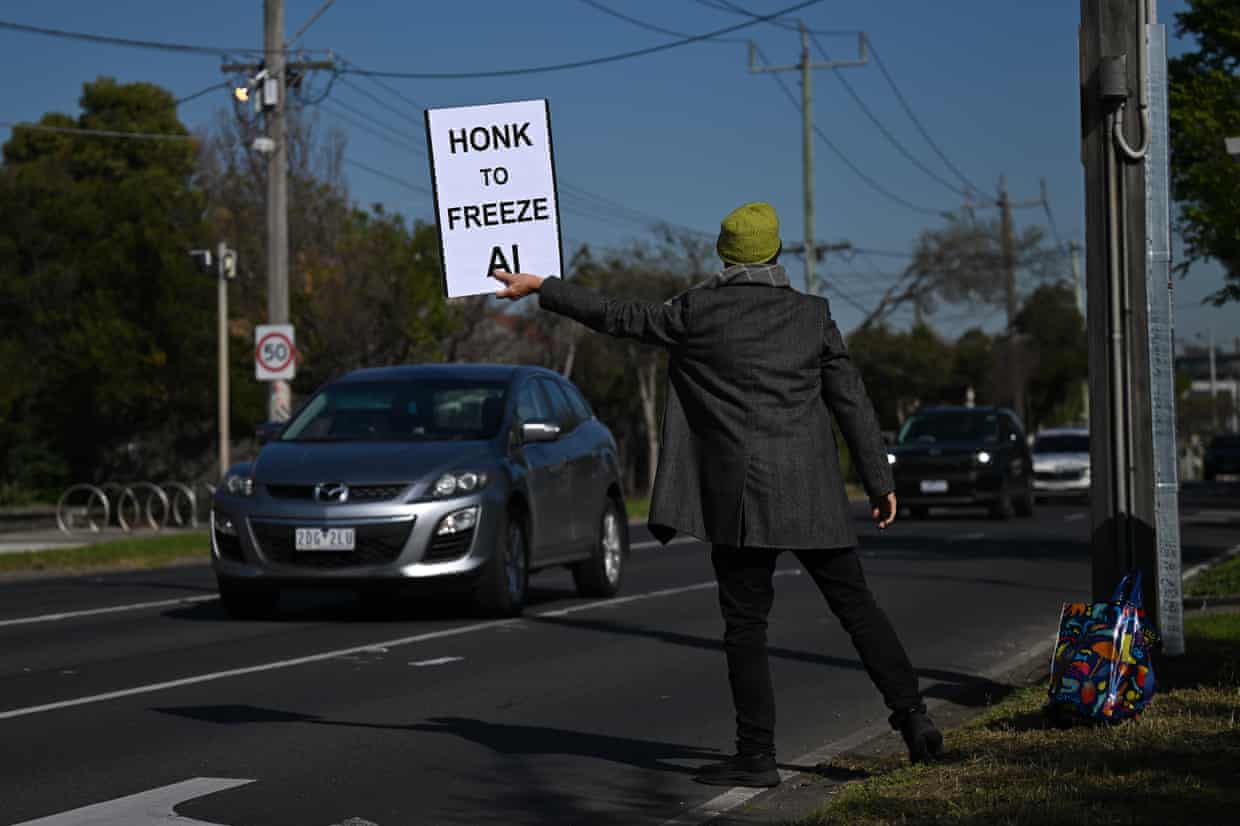
The pace of datacentre construction is increasing rapidly in Australia, with several large datacentres with 1 gigawatts or more capacity in the planning.
Trending videos on TikTok and Instagram highlight major local community concerns including a 2.4 gigawatt centre planned for outer Melbourne, and a 2 gigawatt gas-powered centre in the Northern Territory.
That is the equivalent of 2m households’ annual electricity consumption, said Rob Nicholls, professor and senior research associate in digital policy at the University of Sydney. The NT’s population is just over 265,000.
The Australian government – seeing the US gas boom fueled by datacentres’ demand for power – has planned to override states and ban gas being used to power centres. New rules would require datacentres’ operators to bring as much new renewable energy into the system as the centre would otherwise take.
Some experts find the backlash justified in following the US example.
“The social media input from the US is very vocal and rationally based: ‘It’s going to increase the cost of electricity and it’s going to increase the cost of water and I don’t get a benefit from it.’ And that’s a rational position,” said Nicholls.
Nicholls said the hurdle facing the Australian government is explaining to its constituents how the issues faced in the United States differ from local ones.
Legislation for the framework is unlikely to arrive until next year, and has led to calls for Australia to follow the lead of New York and implement a moratorium on new development until proper rules are in place.
Until then, there are now two state inquiries and one federal inquiry into the sector, along with the steady stream of new development applications leading to pushback from locals.
Many of Australia’s datacentres are US-owned. The federal assistant minister for technology, Andrew Charlton, said that Australians may be cynical about datacentres in their communities because many of the companies that operate the facilities are not Australian. Microsoft and Amazon operate several, and OpenAI and Anthropic are eyeing their own developments.
“Simply building datacentres in Australia does not necessarily mean that Australia captures the economics of AI,” he said in a speech this week. “We can supply the land, we can supply the electricity, we can host the machines, and still find that much of the value – and many of the economic rents – flow offshore.”
Charlton called for datacentre providers who want to build in Australia to enable access to compute for Australian start-ups, researchers and not-for-profits, on favourable terms, and flagged that Australia could build its own local AI capability based on open-weight models.
“We risk becoming dependent on imported intelligence itself,” Charlton said.
Explore more on these topicsReuse this content
Source: www.theguardian.com
