



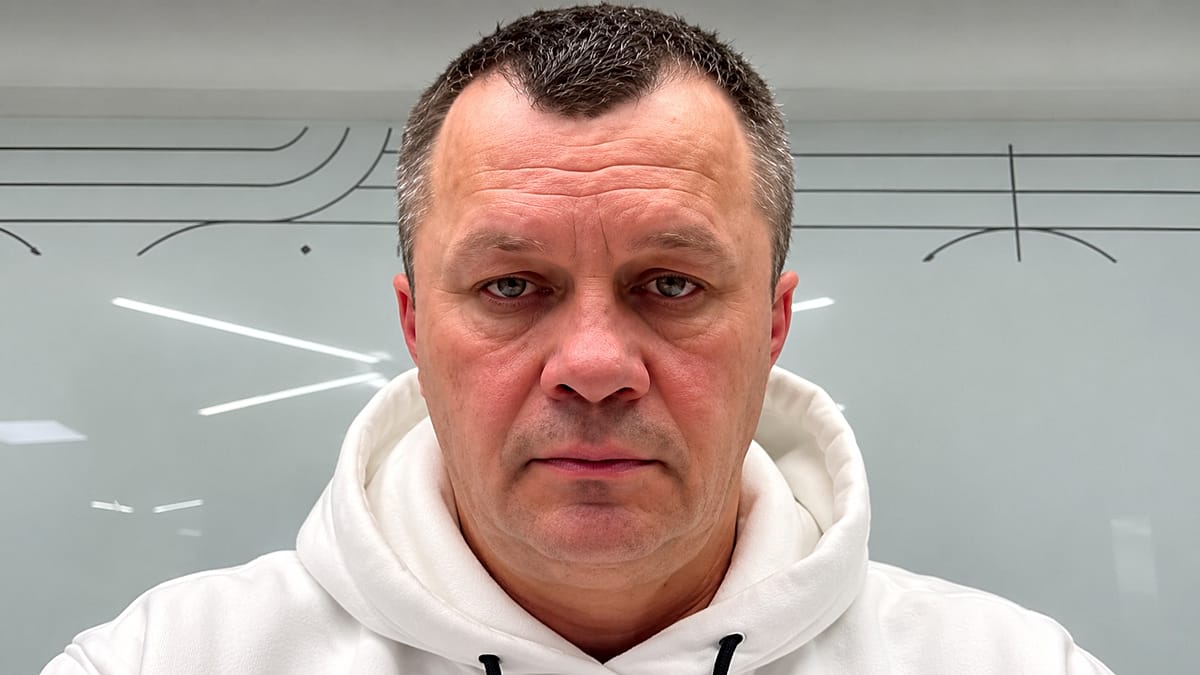
Cutting financial support for Kyiv risks emboldening Moscow and exposing Europe to further Russian aggression, Tymofiy Mylovanov told Euronews. He warned that forcing Ukraine into concessions without credible security guarantees could pave the way for another war.
Europe risks facing higher defence costs and further security threats if it withdraws financial support for Ukraine, the president of the Kyiv School of Economics Tymofiy Mylovanov told Euronews.
His comments come as financing for Kyiv emerges as a major sticking point in negotiations over the European Union’s next long-term budget, with leaders set to discuss both issues at a summit in Brussels this week.
German Chancellor Friedrich Merz has linked an agreement on the EU budget to continued financial assistance for Ukraine, while Slovakia, Hungary, Czechia and Bulgaria have signalled their reluctance to provide further funding.
Ukrainian President Volodymyr Zelenskyy has urged EU leaders to accelerate the delivery of financial assistance after the European Commission last week proposed an additional loan of up to €45 billion for 2027, aimed at covering roughly two-thirds of Ukraine’s estimated €70 billion financing shortfall.
Mylovanov said Ukraine’s mounting defence costs reflected both the increasing scale of Russian attacks and the growing sophistication of battlefield technology.
“Russia is putting more money to the war, to the tech, so we are forced to respond also with more tech,” he told Euronews.
“In practical terms, there’s more drones, more missiles. We need more interceptors.”
Drones equipped with advanced sensors, software and artificial intelligence are becoming increasingly expensive, he added.
Meanwhile, Russian attacks on energy and transport infrastructure are disrupting logistics, public transport and access to education, placing additional strain on the Ukrainian economy as winter approaches.
Ukraine’s resistance is buying Europe time, Mylovanov says
Mylovanov argued that continued assistance to Kyiv should be seen as an investment in Europe’s own security.
Weakening Ukraine, he said, would risk triggering a political or military crisis that could give Moscow greater capacity to threaten other European countries.
“As long as Ukraine is containing Russia, Europe gets a breathing space to build up its capabilities and defence,” he said.
“It’s simply cheaper to fund Ukraine and support Ukraine.”
Mylovanov pointed to the Baltic states, Poland and southern Europe as areas that could face the consequences of a withdrawal of Western assistance.
“Russia will divert resources immediately to operations in the broader European area,” he warned.
He also rejected the argument that withholding financial assistance could hasten an end to the war by forcing Kyiv to make greater concessions at the negotiating table, citing Russia’s record of violating previous agreements with Ukraine.
“So, forcing Ukraine to compromise simply means speeding up issues for Europe. Speeding up further aggression,” he said.
‘Talk is cheap, actions are costly’
Mylovanov also expressed scepticism about the renewed US-mediated diplomatic process, arguing that Moscow had yet to demonstrate any genuine willingness to end the war.
Rather than relying on assurances from the Kremlin, he said, Ukraine’s partners should create the conditions under which Russia would have no alternative but to engage in substantive negotiations.
Asked whether Moscow could agree to a ceasefire before broader political negotiations, as advocated by Kyiv and its European partners, Mylovanov drew on his background in economics.
“I’m an economist by training and we have the entire field of strategy which is called cheap talk, which means talk is cheap, actions are costly,” he said.
He suggested starting with limited, tangible agreements, including prisoner exchanges, a temporary halt to attacks on energy infrastructure, a Black Sea ceasefire or geographically limited truces.
“So we need to demonstrate something real in addition to words,” he added.
While welcoming the involvement of European negotiators in the peace process, Mylovanov questioned how a future agreement would be enforced, raising the possibility of troop deployments, joint security budgets, military training and technology sharing.
What would make a deal last?
With diplomatic pressure on Kyiv mounting, Mylovanov cautioned against judging a prospective settlement solely by the concessions it would entail.
“In the end, we’ll have a bad deal for everyone,” he said.
“What is the right question is not whether the deal should be good or bad, but how do we ensure that this deal is the final deal and there is no continuation of the war two or three years from now, five years from now.”
Achieving that, he argued, would require a clearly demarcated contact line backed by credible security arrangements, including observers and troops separating the two sides.
Source: www.euronews.com
