



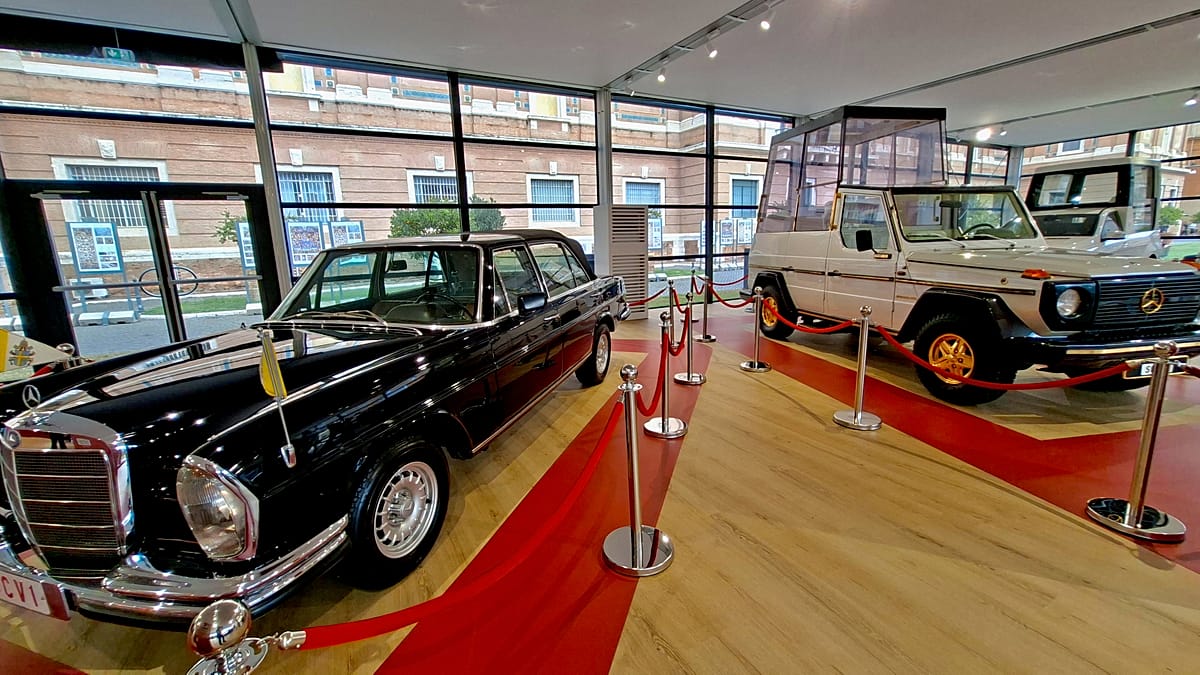
From Pius XI’s Mercedes to John Paul II’s Popemobile: eight historic cars show how Popes’ vehicles have changed. The Vatican Museums exhibition retraces a century of history, between technology, curiosities and safety.
There once was a pope who could tell his driver when to accelerate, when to slow down and even when to return to the Vatican, simply by pressing a button. Another, by contrast, had a car turned into an open-top vehicle so that he could be seen more clearly by the crowd. And then there was John Paul II, who had a barber’s chair adapted as a papal seat, so that he could greet the faithful.
The cars of popes tell a story that goes far beyond engines, bodywork and comfort. They reveal the character of the pontiffs, the way they choose to be among people and, above all, how communication of the papacy has changed – from the solemnity of limousines to the search for direct contact with the faithful, and the growing need to protect those who travel under the spotlight.
This is the journey traced by the exhibition “A century of Popemobiles”, that’s now on at the Vatican Museums . Eight historic Mercedes-Benz cars retrace almost 100 years of papal mobility. They are accompanied by a Benz Patent-Motorwagen from 1886, considered the first car in history, and a new Mercedes-Benz S-Class, broadening the view of how the automobile has evolved
Sandro Barbagallo, curator of the Vatican Museums historical collections says each vehicle has its own story: “The message is very simple: papal mobility exists so that the pope can draw close to everyone, all over the world. The use of cars is not just about moving the Pontiff around within Vatican City”.
A story in which each pontiff has, in one way or another, left his mark, including by choosing how he wished to be transported.
Pius XI, the Pope who fell in love with his car
The relationship between Mercedes-Benz and the Vatican officially begins in 1930, when Pius XI receives a Nürburg 460 (W 08), a large limousine donated by the German car manufacturer. It is the first Mercedes regularly used by a pope.
Achille Ratti, elected in 1922, was a man of culture, a scholar and lover of the mountains, with a past as a mountaineer and explorer. A Pontiff accustomed to looking far ahead, who did not shun the innovations of his time. The car also became a tool for leaving the Vatican, after the long period of the so-called imprisonment of the popes, which began with the end of the Papal States in 1870.
The Nürburg 460 is far from a standard official car: the interior is customised with a single seat for the pope, upholstered in fine silk brocade, selected woods, metallic detailing and a decorated ceiling. A kind of travelling sitting room, designed to underline the prestige of the papal figure.
But it is not just a question of luxury. Some papal cars from that era had a ‘backseat driver’ function panel, allowing the pope to instruct the chauffeur using buttons labelled “Forward”, “Slow”, “Right” and “Return to the Vatican”. A sort of remote control before its time.
John XXIII, the “good Pope” who opens the windows
The pope’s public presence also changed with John XXIII. Angelo Roncalli, a.ka. the “good Pope”, had an informal style, a cheerful manner and a natural ability to relate to people. His pontificate, shaped by the Second Vatican Council, led the Church into a period of greater dialogue and openness.
The cars began to follow this transformation as well. In 1960, the Mercedes 300 d Landaulet (W 189) arrived, with rear windows that can be completely removed to allow the pope to be seen more easily and better greet people during public outings.
The features are already those of a vehicle built around the needs of the most important passenger: an electrically adjustable central seat, controls for the air conditioning and communications within easy reach, automatic steps to make it easier to get in and out of the vehicle.
Mercedes seems to have understood that the pope’s car must not only take him to his destination: it must also allow him to meet people along the way.
Paul VI, the travelling Pope who invents the papamobile
If there is one pontiff who turned travel into a fundamental part of papal communication, it is Paul VI. Giovanni Battista Montini is the first modern pope to travel by plane and to make a series of international apostolic journeys, reaching places never before visited by a pontiff.
In 1964 he flew to the Holy Land, then to India in 1965, and in the following years to other continents. His mission was to reach the faithful in Rome and beyond by going to their countries to meet people and let them see him up close.
His Mercedes 600 Pullman Landaulet (W 100) from 1965 has a roof that opens at the rear specifically so that the pontiff can greet the crowds.
In 1967, a Mercedes 300 SEL Pullman (W 109) also arrives, another of the cars that mark the evolution of papal automobiles.
But the birth of the modern papamobile is above all linked to a practical need. As Barbagallo explains, “up until Paul VI, and then also with John Paul I, who as we all know had a very brief pontificate, the Pope went to audiences and even entered the Paul VI Audience Hall on a sedia gestatoria”.
That first vehicle was still a production car made available to the Pontiff. But it marked a decisive change: the Pope no longer simply had to be transported, he could now cross the square and be seen by all the pilgrims.
To grasp the difference between the traditional papal saloons and the papamobiles, Barbagallo retraces the evolution of these vehicles: “The way they have developed has constantly highlighted, on the one hand, the Pope’s comfort, on the other his security, and on yet another the fact that the Pope can be seen. In saloons, that is the black cars, the Pope is only seen by those on his side of the vehicle, whereas in a papamobile he can be seen equally from the right, the left, the front or the back. That, of course, is what creates the difference between the two means of transport”.
John Paul II, the Pope of the crowds and the barber’s chair
With John Paul II, the popemobile became an icon. Karol Wojtyła was a pope with a strong physical presence, used to direct contact, long international journeys and vast crowds. Before becoming Pope he was an actor, poet, sports enthusiast and lover of the mountains. It is no surprise that he was not especially drawn to the idea of remaining seated in a closed limousine.
From the beginning he refused to use the traditional sedia gestatoria, the ceremonial chair on which popes were carried during ceremonies. He preferred a motor vehicle that allowed him to move around and greet people freely.
This is where one of the most curious episodes in the history of popemobiles comes in: for some of the first open vehicles a swivelling barber’s chair was adapted, mounted on a metal base. A decidedly unusual seat for the head of the Catholic Church, but practical in allowing him to turn and greet the crowd from every side.
The Mercedes that fixed the image of the modern popemobile in the public imagination arrived in 1980, for John Paul II’s trip to Germany. It is a 230 G (W 460), based on the G-Class, with a raised seat and a large transparent dome at the rear. The Pope can be seen from every side while remaining protected from the weather.
On 13 May 1981, however, the attempted assassination in St Peter’s Square changed everything. From that moment the pope’s safety became a central concern and the popemobiles were gradually fitted with bullet-proof protection.
As Barbagallo recalls, “that first popemobile was, of course, a standard production car given for the Pope’s use; it had no comforts and no particular safety features. But from then on there was an evolution that, sadly, is also closely linked to the attack in St Peter’s Square on John Paul II, after which heavily armoured popemobiles began to be used, as they still are today”.
The G-Class became one of the most recognisable models of his pontificate. In 1997, a long-wheelbase Mercedes S 500 Landaulet (series 140) also joined the fleet, with a hydraulically operated rear soft top and a large seat for the pope.
In 2002 the Mercedes ML 430 “Popemobile” (W 163) was added to the history of papal vehicles, another off-roader adapted to the pontiff’s needs.
Benedict XVI, technology and the search for protection
With Benedict XVI the style changes again. Joseph Ratzinger, a theologian and intellectual, has a more reserved approach than his predecessor’s stage presence, but maintains the tradition of close encounters with the faithful.
In 2012, the Mercedes ML 500 “Popemobile” (W 166) arrives, with larger glass surfaces to improve visibility and reduce the sense of separation between the pope and the people.
It is a popemobile that attempts to reconcile two needs that have become inseparable: protection and proximity. The pontiff must be visible, but must also be able to travel in safety.
A car that is more than just a car
Today, the popemobile is far more than a means of transport. As Leo XIV made clear at the inauguration of the exhibition, it has become a means of bringing the pontiff closer to people.
And there is a curious detail that illustrates how special the relationship with these vehicles is: the Pope’s seat is unlike any other. Designed for him alone, every detail, from the position of the seat to the heated support bar, is suited to his needs.
Een the way a pope chooses to travel can say a great deal about how he chooses to be in the world.
The exhibition at the Vatican Museums, set up in the glass pavilion of the Giardino Quadrato, will remain open until 28 January 2027.
The papal vehicles on display
· Mercedes-Benz Nürburg 460 (W 08), 1930
· Mercedes-Benz 300 d Landaulet (W 189), 1960
· Mercedes-Benz 600 Pullman Landaulet (W 100), 1965
· Mercedes-Benz 300 SEL Pullman (W 109), 1967
· Mercedes-Benz 230 G (W 460), 1980
· Mercedes-Benz S 500 long-wheelbase Landaulet (series 140), 1997
· Mercedes-Benz ML 430 “Papamobile” (W 163), 2002
· Mercedes-Benz ML 500 “Papamobile” (W 166), 2012
Two other vehicles broaden the historical perspective of the exhibition: a Benz Patent-Motorwagen from 1886 and a new Mercedes-Benz S-Class.
Source: www.euronews.com

2 Comments
Pingback: Can the Rohingya genocide verdict deliver justice? - Warsaw.Today
Pingback: Euronews Culture's Film of the Week: 'You Can See Everything' - Is this Elizabeth Holmes doc 2026's best film? - Warsaw.Today