



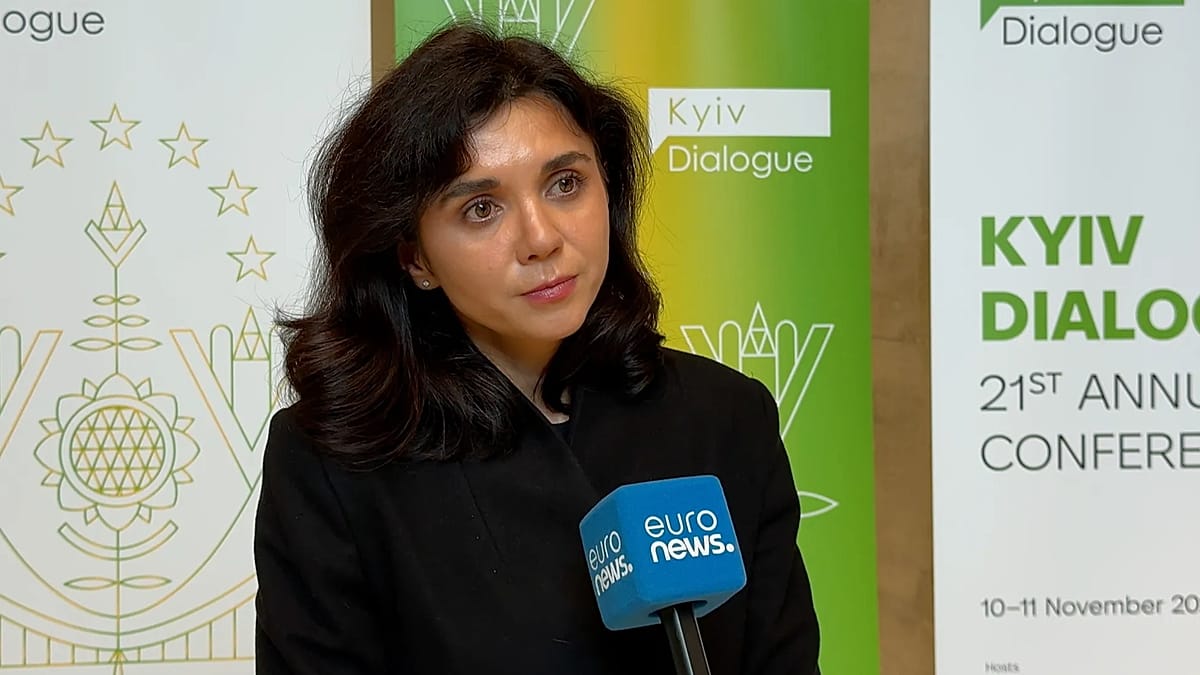
Few places in Ukraine suffer more from Russia’s invasion. Zaporizhzhia mayor Regina Kharchenko tells Euronews about winter, attacks on civilians and the Russian-held nuclear plant.
For the residents of Zaporizhzhia, Russian attacks have become a sad part of everyday life. The city lies only 20 kilometres from the front line. At the beginning of the month, several glide bombs hit an underground school in the village of Komyshuvakha in the Zaporizhzhia region. Civilians had gathered there for the distribution of humanitarian aid. At least 50 people were killed.
Time and again, Russian units attack civilian targets here. In October, a Russian drone hit a minibus at a stop in the city centre. Three people were injured, according to the independent Ukrainian outlet Ukrainska Pravda. Four people were wounded in another drone strike on a bus.
But the greatest danger lies just outside the city: the Russian-occupied Zaporizhzhia nuclear power plant. It has been in the hands of Russian forces since March 2022. So far this year, the external power supply has already failed 16 times. The most recent incident was only a few days ago. Once again, the plant had to be cooled using emergency generators.
Regina Kharchenko has been acting mayor of the city since April 2024. She was born in Crimea, which has been annexed by Russia since 2014. As a child, the lawyer moved to Zaporizhzhia. In Berlin, she represents her city at the 21st Kyiv Dialogue, a cross-party German-Ukrainian dialogue platform that brings together politics, the media and civil society.
In an interview with Euronews, the politician talks about the coming winter, Russian attacks on critical infrastructure and European aid to Ukraine.
Euronews: Almost every day, Zaporizhzhia is attacked by Russia. How does it feel for you to be so far away in Berlin right now, and what are you hoping to achieve with your visit?
Kharchenko: First of all, I consider it a great honour to be able to represent Zaporizhzhia. I can talk about real life in wartime and explain to people that this is a very difficult life experience that many Ukrainians would gladly do without. But even here, even while I am speaking on the panel, I am involved in all ongoing operations.
Just today, a residential building in our city was badly damaged; its structure is at risk of collapse, and unfortunately, one person was injured. But all municipal services and everyone tasked with helping people are already on site. Wherever I am, I coordinate what is happening in Zaporizhzhia and am of course reachable. I expect, first, that this panel will allow German and Polish municipalities to take away important information for themselves. And second, we have already received concrete offers of humanitarian aid so that people can get through this winter.
Euronews: You spoke at the Kyiv Dialogue on a forum about resilience within civil society. How have the residents of Zaporizhzhia become so resilient?
Kharchenko: Above all, society is resilient because every municipality has to prepare its area for winter. The city has to guarantee heating and water supplies and try to get the problems with the power supply under control. That is extremely important for us. In addition, socially vulnerable groups and internally displaced people need more support.
In Zaporizhzhia alone, more than 200,000 internally displaced people are living, and that, too, is a challenge for us. Resilience, therefore, has many different facets.
Euronews: Zaporizhzhia is only 20 kilometres from the front line. Russia is now even attacking city buses with drones. How has the situation in Zaporizhzhia changed in recent weeks?
Kharchenko: As far as public transport is concerned, the past week has been more or less calm. But we know that the enemy is insidious, and since the beginning of the year, we have seen systematic attacks on public transport.
Among other things, we have discussed here whether our municipal transport operator can receive vehicles as a form of humanitarian aid. We ourselves are providing additional protection: anti-drone tunnels and anti-drone nets in key locations in certain neighbourhoods, and shatterproof film on the vehicles so that people are not injured by fragments.
Everything we can do at the municipal level, we are of course doing. On this occasion, however, I would like to thank the Ukrainian defence forces, because they are doing incredible things. Countless attacks, countless drones, missiles and Shaheds are being repelled. Only thanks to their superhuman work can we lead a more or less normal life.
Euronews: Ukraine is facing its fourth winter of war. Putin wants to attack infrastructure even harder this winter, as the Financial Times has reported. How do you see the coming months?
Kharchenko: We constantly see that war is being waged by attacking critical infrastructure. These attacks are terrorism and terror against the peaceful civilian population. Perhaps this is part of the Russian strategy to break Ukraine and show that they can take everything from us, basic living conditions, amenities, and comfort.
But the city is preparing. We are actively reinforcing critical infrastructure and protecting the most important facilities: substations, heating plants and pumping stations. I would like to take this opportunity to thank all my teams who are actively working on this. But we understand that the enemy is insidious and that we do not know the scale of the attacks. That is why we do what we can and keep going.
Euronews: A few days ago, the power supply to the nuclear power plant in Zaporizhzhia was cut again. How are the residents of Zaporizhzhia coping with the constant threat posed by the plant?
Kharchenko: This is of course a tragedy. We very much hope that even in the terrorist state of Russia, there is still some remnant of common sense. Because to play with attacks on such facilities means destroying people in the 21st century and deliberately doing everything to ensure that the peaceful civilian population dies. We are very much hoping for a response from all the countries of the European Union, the United States and all responsible politicians, so that they prevent this catastrophe in Ukraine, especially as it would unfold in the immediate vicinity of Zaporizhzhia.
Euronews: Financial aid for Ukraine is currently being debated a great deal and very controversially. What do you want from the European Union and from Germany? And what do you say to people who do not want to support Ukraine?
Kharchenko: I would like to say that Ukraine is currently fighting for values that are taken for granted in Europe: human life, freedom, freedom of choice, state sovereignty. These are things that are the norm in the European Union. But unfortunately, Ukraine is now simply fighting to continue to exist on the world map. And every Ukrainian knows that their state is in great danger.
First of all, I would like to thank you for all the help that has been provided to Ukraine, to our municipalities and especially to Zaporizhzhia. And of course, I hope that this support will in no way diminish and that there will be more projects to provide military equipment for Ukraine. Because even if we achieve a just peace and, as part of negotiations and all the political processes under way, there is a ceasefire, Ukraine must remain strong and resilient, with its own effective defence forces, so that this war is never repeated.
Euronews: What would a possible ceasefire along the current front line mean for Zaporizhzhia?
Kharchenko: It is a constant life in fear. Twenty kilometres is a very short distance, and the enemy attacks incredibly often. We hope that people will simply be able to live normally again if there is an agreement on a temporary ceasefire or some kind of de-escalation. At the same time, we know that we must still remain very strong, institutionally strong and strong in terms of infrastructure. And we still have to protect our city.
Euronews: Would it be acceptable for you to cede the areas currently occupied by Russia if, in return, there were peace?
Kharchenko: To be honest, I do not have the expertise to give a well-founded answer to that. This is not really my level of responsibility; it is more at the national level. I am more concerned with life in my municipality and with what Zaporizhzhia needs.
Euronews: Is there anything else you would like to say?
Kharchenko: I would like to thank the Konrad Adenauer Foundation for giving us the opportunity to be here today, to talk about Zaporizhzhia and the actual situation, about how difficult it is to live in a war, and of course to share our experiences. I would also like to thank all the partners who are helping us, our partner cities Oberhausen and Magdeburg in Germany and especially THW (editor’s note: Federal Agency for Technical Relief) and GIZ (editor’s note: German Agency for International Cooperation), which are providing us with huge support by supplying equipment and special vehicles for our municipal services.
Source: www.euronews.com
