



Scientists are using artificial intelligence to analyse animal sounds and identify patterns in how different species communicate. But while the technology is opening up new possibilities, translating animal language remains a distant prospect.
Artificial intelligence could help scientists get closer to understanding how animals communicate, as researchers increasingly use machine learning to analyse sounds made by species ranging from birds and elephants to whales and dolphins.
One organisation working at the forefront of this research is the Earth Species Project, a US-based non-profit group developing AI models to analyse animal vocalisations and identify patterns that could help explain how different species communicate.
The organisation is using AI to decode animal communication, with the longer-term goal of understanding what animals are trying to tell one another.
It has developed NatureLM-audio, an AI model designed to recognise and classify animal sounds, identify different types of vocalisations and analyse large collections of audio recordings.
The model can also be used to investigate animal sounds through natural-language prompts, potentially making it easier for researchers to analyse recordings in minutes instead of months.
In one test using recordings from Australia’s FrogID project, a nation-wide conservation project, NatureLM-audio achieved 99% accuracy in distinguishing frog sounds from other recordings and 82% accuracy in identifying selected frog species.
But recognising animal sounds is only one part of the challenge. Researchers are also trying to establish what those sounds mean.
From recognising sounds to understanding communication
The Earth Species Project is working with researchers studying several species, including killer whales, crows and zebra finches.
In collaboration with researchers at McGill University in Canada, it has developed an AI model called ZF-AIM to study vocal interactions between zebra finches.
The model is designed to generate bird-like vocalisations in real time, allowing researchers to study how birds respond to sounds created by AI.
The experiments are particularly interesting because they move beyond simply analysing recordings to examining how animals react to AI-generated sounds.
However, this does not mean the technology can translate what birds are saying or that researchers have established a conversation between animals and machines.
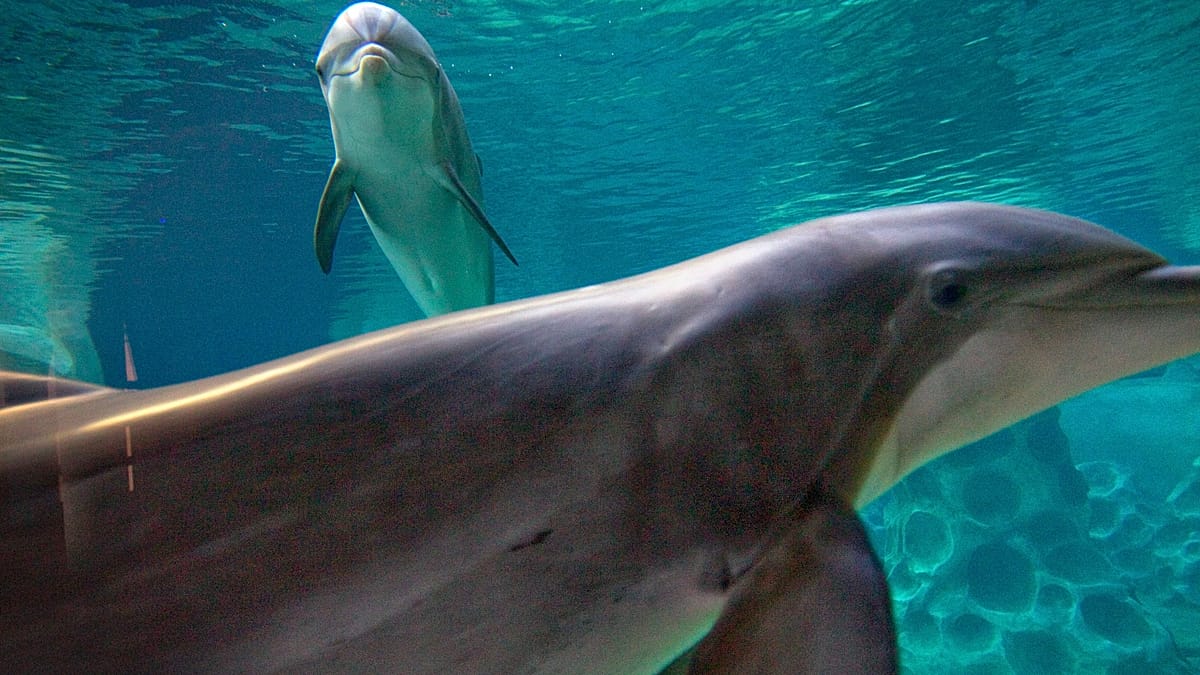
Other projects are taking a similar approach with marine mammals.
Google DeepMind has developed DolphinGemma, an AI model trained on decades of recordings of wild Atlantic spotted dolphins collected by the Wild Dolphin Project.
It analyses sequences of dolphin vocalisations to spot recurring patterns and predict which sounds are likely to follow.
Researchers hope the technology could eventually help establish a shared vocabulary between humans and dolphins, although the model is still being used to investigate how the animals communicate rather than translate their sounds into human language.
Scientists try to decode whale communication
Another major research effort is being led by Project CETI, an international initiative using AI, robotics, linguistics and underwater recording technology to study sperm whale communication.
The project focuses on sequences of clicks known as codas, which sperm whales use to communicate with one another.
Researchers have been investigating whether these sequences contain a complex structure that could provide clues about how information is exchanged between the animals.
A 2024 study published in Nature Communications analysed more than 8,700 sperm whale codas and identified several features involving rhythm, tempo and variations in the timing and arrangement of clicks.
The findings suggested that sperm whale communication is more complex than previously understood.
But identifying patterns in animal sounds does not necessarily mean scientists understand what they are communicating.
Researchers still need to establish whether particular vocalisations have specific meanings and how those meanings might change depending on the context in which they are used.
How close are we to talking to animals?
While AI is giving scientists new ways to analyse animal communication, translating it into human language remains a much bigger challenge.
Animal sounds need to be understood alongside other information, including behaviour, social relationships and environmental conditions.
A recurring sound might be associated with a particular activity, for example, but that does not automatically mean researchers know what the animal is trying to communicate.
Scientists also need to establish whether their interpretations are correct by observing how animals respond in controlled experiments.
The technology could eventually have applications beyond simply satisfying human curiosity about the animal kingdom.
However, if scientists learn to identify and reproduce animal signals associated with mating, distress or social interactions, the same technology could potentially be used to attract animals, disrupt their behaviour or make them easier to capture.
Researchers have also raised concerns about the effects of broadcasting AI-generated vocalisations into wildlife populations, particularly if the signals are misunderstood or interfere with existing communication systems.
There are also questions about the reliability of AI interpretations. Identifying patterns in animal sounds does not necessarily mean understanding their meaning, raising the risk that humans could connect intentions or emotions to animals that they have not actually expressed.
Therefore, the challenge is not simply to develop technology capable of understanding animal communication, but to ensure it is used in ways that protect the animals being studied.
Source: www.euronews.com
