



Get up to speed on the UN COP31 climate talks kicking off on 9 November, from electrification to emissions.
The UN COP31 climate summit kicks off today in Antalya, Türkiye, as the world treads dangerously close to irreversible damage.
Dozens of leaders from across Europe and further afield will attend two weeks of crucial climate talks. All will arrive with their own agenda and priorities.
They will debate the topics impacting global temperature rise: how countries produce and consume energy, how emissions cuts can get back on track, and how much funding they will give to those who have contributed least to emissions but are being hit hardest, to name just a few.
The conference will run from 9-20 November, culminating in a consensus-based package of decisions on climate action, coupled with a parallel agenda of voluntary actions.
Here’s what you need to know about who’s running this year’s talks, and what’s expected both inside and outside the negotiating room.
Who’s running COP31?
While Türkiye holds the COP31 presidency and will host the COP31 summit, the marathon negotiations will be steered by Australia in an unprecedented arrangement reached after both nations bid to host.
The presidency decides the action agenda – a mechanism for voluntary commitments made outside the formal negotiations, involving companies, cities, banks, investors, civil society, universities and others.
The UN body behind COP talks, the United Nations Framework Convention on Climate Change (UNFCCC), oversees the negotiating agenda – a different mechanism from the action agenda.
The negotiating agenda sets out what governments will debate and, where appropriate, decide on at COP31. Countries negotiate what’s on the agenda before it is formally agreed – by consensus – and adopted.
Last-minute negotiations over wording are common, with oil and gas producing countries having previously leveraged the consensus-based system to weaken commitments on transitioning away from polluting fossil fuels.
This has led to increasingly loud calls for a new majority vote system – particularly in light of the dangerously slow progress being made towards climate targets.
What’s being debated at COP31?
Electrification and the ‘35-by-35’ target
Electrification is likely to dominate the talks, with Türkiye asking countries to commit to a ‘35-by-35’ target, raising the global share of energy demand by electricity to 35 per cent, up from around 20 per cent, by 2035. We looked at the plan, and why experts aren’t convinced here.
Electrification entails replacing devices, systems or processes that rely on fossil fuels or other non-electric energy with those powered by electricity.
In a recent report, Climate Action Tracker (CAT) found that governments need to electrify much faster if they are to meet the 35-by-35 target – four times faster, in fact.
“Current policies deliver only 28 per cent by 2035, on a trajectory the IEA associates with around 2.5°C of warming by 2100,” the report says.
TAFF: The transition away from fossil fuels
Experts point out, however, that electrification is only as clean as the energy that powers it.
“Taken alone, countries could meet the [35-by-35] target by simply adding electricity to the system (e.g. data centres) or by keeping or even adding fossil fuels to electricity systems,” warns Samuel Guéret, a CAT climate and energy policy analyst with partner organisation Climate Analytics.
“Electrification only limits overshoot if the electricity is cleanly generated, which is why this target should be seen as part of a package with the renewables and efficiency targets agreed at COP28.”
The transition away from fossil fuels – or TAFF – is already a flashpoint in discussions surrounding the summit. But it will not feature on the formal negotiated agenda at COP31.
COP28 in Dubai three years ago saw countries pledge to transition away from fossil fuels for the first time. Since then, progress has stalled, with fossil fuels not even gaining a mention in the final text of COP30. Still, host country Brazil recently published a voluntary global roadmap for the transition, before handing leadership over to Türkiye.
Türkiye, where coal was the largestquired for energy security, with Energy Minister Alparslan Bayraktar advocating for a “just transition period” to shield those who work in coal mining, while also raising concerns over financing the transition
Still, this year’s energy crisis prompted by the Iran war has pushed many oil and gas importing countries to ramp up homegrown renewables in the name of security.
The International Energy Agency’s (IEA) recent ‘Renewables 2026’ report forecasts stronger growth in renewables across a wider range of countries in the coming years as governments seek to reduce their exposure to imported fuels and volatile prices.
The EU, which has set a target of cutting emissions by 90 per cent by 2040, has also argued that moving away from fossil fuels is a matter of energy security. It is pushing for faster delivery of existing pledges, including tripling renewables and doubling energy efficiency by 2030.
In Europe, Germany, France and the Netherlands have already established their own roadmaps to transition away from fossil fuels. Experts have criticised Germany’s 2045 target as being too unambitious, adding that financing of overseas fossil fuel projects is not included in the phaseout.
Methane reduction and the Global Methane Pledge
COP31 will kick off progress on the second Global Stocktake (GST2), a two-year evaluation of progress towards goals laid out in the 2015 Paris Agreement, including the commitment to keep global temperature rise well below 2°C above pre-industrial levels and ideally within 1.5°C.
The UN warned in September that the world is already set to overshoot the 1.5°C limit, as countries falter on their pledges to curb planet-heating greenhouse gas emissions.
“We will not look away, and we will not lower our ambition. The 1.5-degree target remains our compass, and our duty is to do everything in our power to return to it,” said Türkiye’s Environment Minister Murat Kurum and COP31 President-Designate, Murat Kurum, ahead of the summit.
While cleaner energy is one way to tackle this, targeting methane emissions has been hailed as an achievable win in the near term.
Although methane stays in the atmosphere for a far shorter time than CO2 before breaking down – around 10-to-12 years versus centuries – it is roughly 80 times more powerful at trapping heat in the atmosphere over a 20-year timeframe. This means even small cuts have an outsized impact on near-term temperature rise.
At COP26 in 2021, over 150 countries joined the voluntary Global Methane Pledge (GMP) to collectively reduce human-caused methane emissions by at least 30 per cent below 2020 levels by 2030, which could prevent over 0.2°C of global warming by 2050.
Methane can be tackled on a number of fronts, from reducing leaks and flaring in oil and gas operations, to improving livestock management and feed efficiency in agriculture, to managing methane emissions from landfills and wastewater.
The EU recently moved to delay a regulation requiring fossil fuel imports to meet the same standards as member states on detecting and repairing methane leaks. It said the move would help to protect energy security and ease market pressures in the oil and gas sectors.
Yet it will co-host a ministerial meeting on the Global Methane Pledge at COP31, where governments will negotiate and coordinate on the initiative. Türkiye has organised a separate Action Agenda on zero waste and methane reduction, focusing on waste-sector emissions.
In October, the US Environmental Protection Agency rolled back 2024 safeguards that limited methane pollution from the oil and gas sector.
While members of Congress and US businesses will attend COP31, there will be no official delegation from the country, which is the world’s second-biggest emitter of greenhouse gases behind China. This is because Trump withdrew the country from the Paris Agreement and has initiated a withdrawal from the UN Framework Convention on Climate Change (UNFCCC).
Climate finance: Who pays when disaster strikes?
Money is expected to be one of the most contested issues in Antalya, particularly to fund adaptation and loss and damage in countries most vulnerable to climate disasters, like developing nations and small island states.
At COP29 in Baku in 2024, developed countries agreed to mobilise at least $300 billion (€268bn) a year for developing nations by 2035, as part of a wider $1.3 trillion (€1.63tn) target from public and private sources.
At COP30 last year, governments agreed to push for at least a tripling of adaptation finance by 2035, but without settling the baseline, who pays or how the money will be delivered.
A UN Environment Programme (UNEP) report published days before the summit found even tripling current international public adaptation finance would meet just 23-29 per cent of developing countries’ needs.
Where that shortfall comes from and how it is channelled to those who need it is expected to be central to talks at COP31.
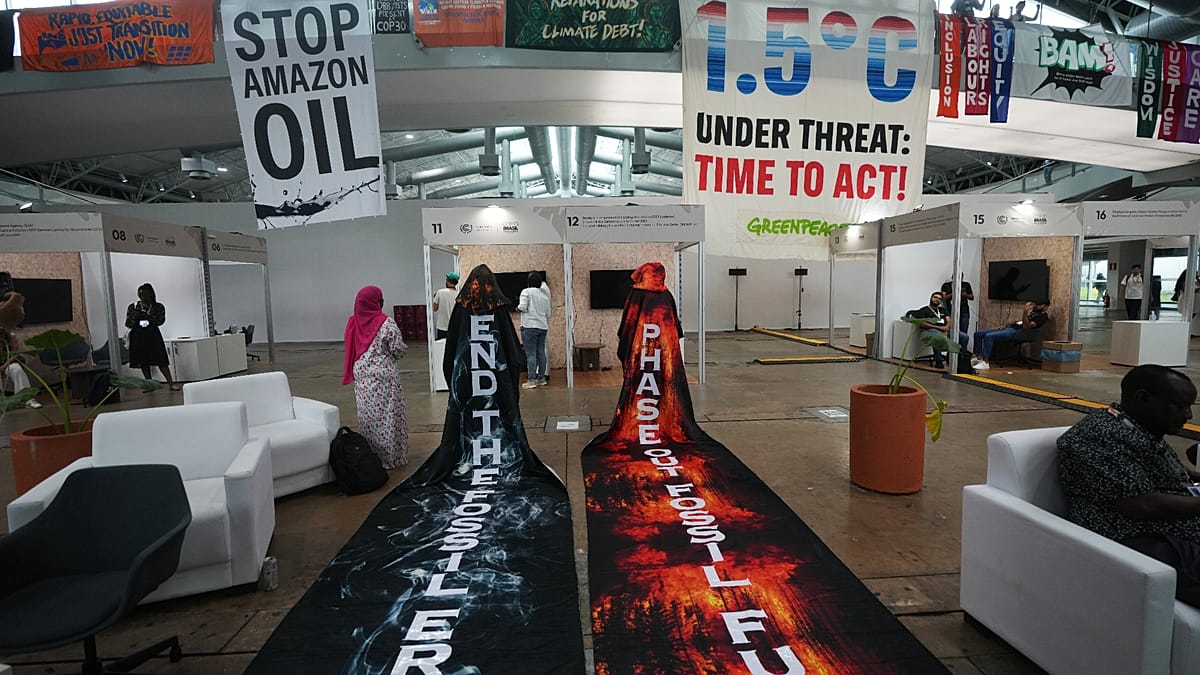
Outside the talks: Will protest be allowed at COP31?
For Turkish NGOs, COP31 could offer a rare chance to be heard in a country where, activists say, space for public protest has been steadily shrinking.
A People’s Climate Summit, a grassroots initiative of more than 100 organisations and individuals, will run alongside the talks from 9 November. Organiser Cigdem Ozbas told news agency AFP that more than 1,000 people and 300 organisations from 100 countries have signed up.
The first week will focus on making their demands visible, with forums and evening monitoring sessions in the second week examining proposals they see as greenwashing. A major rally is planned for 14 November, with unions and rights groups expected to join.
Activists are optimistic that COP, as a civil society gathering, won’t face similar crackdowns to July’s NATO summit in Ankara, where police detained more than 4,400 people on terror-related charges, including journalists, civil society leaders and over a dozen environmental volunteers.
But the episode showed how quickly space can be restricted, and Ozlem Katisoz of Climate Action Network Türkiye warned that detentions can happen at any time.
Turkish groups also want a say inside the process. Climate Network Türkiye, a coalition of 15 organisations, is seeking access to negotiators, but there is no formal consultation process. Katisoz has urged visiting delegates to check the presidency’s statements against reality at home, such as the new coal plants still under development.
Source: www.euronews.com
