



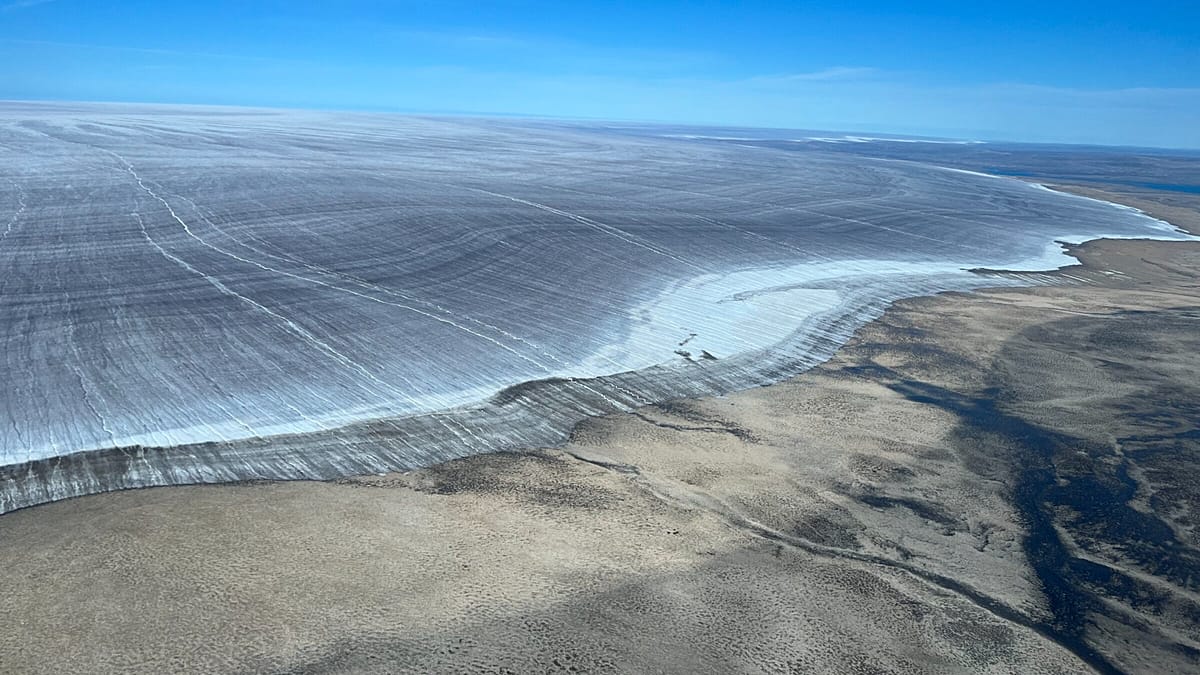
Researchers from Canada have shown that the vast Barnes Glacier was still expanding around 2,000 years ago. Their studies suggest climate change counteracted this, preventing a new ice age.
Covering around 6,000 square kilometres, the Barnes Ice Cap in north-eastern Canada is vast. Yet for several decades it has been shrinking again and has become a concrete witness to human-induced climate change. Researchers go further: thanks to new evidence they suspect that climate change may even have prevented an upcoming cold period.
Until about 1960, the icy area was actually expanding. Young, a geochemist at the Lamont-Doherty Earth Observatory of the Columbia Climate School, said it had only just begun, that everything seemed normal, that the next ice age was almost due, and then it suddenly stopped. The glaciation did not last long.
Turning point in 1961
The summer of 1961 is recorded in historical weather archives as one of the hottest of the 20th century. In terms of daily maximum temperatures, that summer was comparable to the extreme year 2021.
Since the 1960s, Canadian summers have generally warmed noticeably, as the Canadian government explained . Temperatures rose and the expansion of the Barnes ice sheet, which had begun around two thousand years ago, was reversed. The national average for summer temperatures has increased by about 2.1 degrees Celsius compared with the baseline period. The north is warming roughly three times as fast as the global average
Young said this is a very striking example of how humanity has knocked the system out of balance. Together with colleagues he has studied the Laurentide Ice Sheet. Between 95,000 and 20,000 years ago this ice sheet covered large parts of Canada and the northern United States. Today the Barnes Ice Cap, the 6,000 square kilometre glacier on Baffin Island in north-eastern Canada, is all that remains.
The team led by Young wanted to find out whether the glacier had ever been smaller than it is today and then grown again. To do this they examined vegetation around the glacier that may itself once have been covered by it.
The glacier sheet expanded again 2,000 years ago
In samples of this vegetation around the edge of the glacier ice, the researchers analysed traces of carbon-14. While organisms are alive, this isotope accumulates, and after death it decays at predictable rates. On this basis it is possible to calculate the age of organic material. Young said that if you do this often enough you can build up a timeline showing how the ice margin systematically spread across the plants, in effect tracking the advance of that ice front.
They found that the Laurentide Ice Sheet had reached its minimum size about 3,000 years ago. Around 2,000 years ago it began to expand again. The researchers conclude that the climatic conditions at the time allowed fresh ice to accumulate, so it must have been cold.
Although the researchers themselves speak of an ice age, they stress that in strict terms it is actually about the beginning of a new cold period. Humanity is currently living in the late Cenozoic Ice Age, which began 34 million years ago.
Within this overarching ice age, colder glacial phases, or cold periods, alternate with warmer interglacial phases.
Researchers find evidence for the start of a cold period
Joerg Schaefer, a climate geochemist and colleague of Young, said that through indirect measurements they already had a fairly good understanding of how this huge ice sheet grew and disappeared over thousands of years, but that capturing the start of the process through direct observations is new.
Using new measurement techniques, the scientists have been able to identify in the landscape the first steps in the growth of the vast ice sheet. Schaefer added that the approach offered them the rare opportunity to understand how renewed glaciation begins and how the Laurentide Ice Sheet forms again.
According to the researchers, the moment when the ice area started to grow again around 2,000 years ago should be regarded as the start of the Earth’s next ice age. This interpretation challenges common assumptions about how ice ages begin.
Previous model-based studies had assumed that the next glaciation would not begin for thousands or even tens of thousands of years. In Young’s view, however, the renewed growth of the ice sheet should count as the beginning, instead of waiting until huge continental ice sheets form as they did 95,000 years ago.
Some climate researchers had already claimed in the 1970s that a new ice age was imminent, although their assertions were controversial. Young now says that it did in fact begin and that they now have something like proof of this. It would have taken thousands of years before the cooling became noticeable.
Climate change is making more and more glaciers disappear
The 1960s were a turning point for the Laurentide glacier in another respect. The Earth’s climate had warmed so much that the Barnes Ice Cap lost more ice in summer than it gained in winter. The next glaciation was cut short. This phenomenon is causing more and more glaciers to shrink, <a href="https://warsaw.today/asiana-new-york-phuket-thailand-845-roundtrip-including-all-taxes/” title=”Asiana: New York – Phuket, Thailand. $845. Roundtrip, including all Taxes”>including in Germany.
Some models also predict an end for the Laurentide glacier, which at 6,000 square kilometres is still far larger than the remaining glacier fragments in Germany. Over the coming centuries it could melt away completely.
Young also says these will be the very last remnants of the Laurentide Ice Sheet, disappearing for good. The melting of such incredibly large areas could have impacts far beyond the region concerned. According to the researchers, their disappearance could alter the dynamics of future glaciations and ice ages. Some researchers even believe that a new ice age could begin in Europe.
This glacier acted as a starting point for the development of new cold periods when the Earth’s climate cooled. The vast mass of cold ice produced feedback effects that led to further ice growth. Once the glacier has disappeared, this cooling effect will also be gone.
Source: www.euronews.com
