



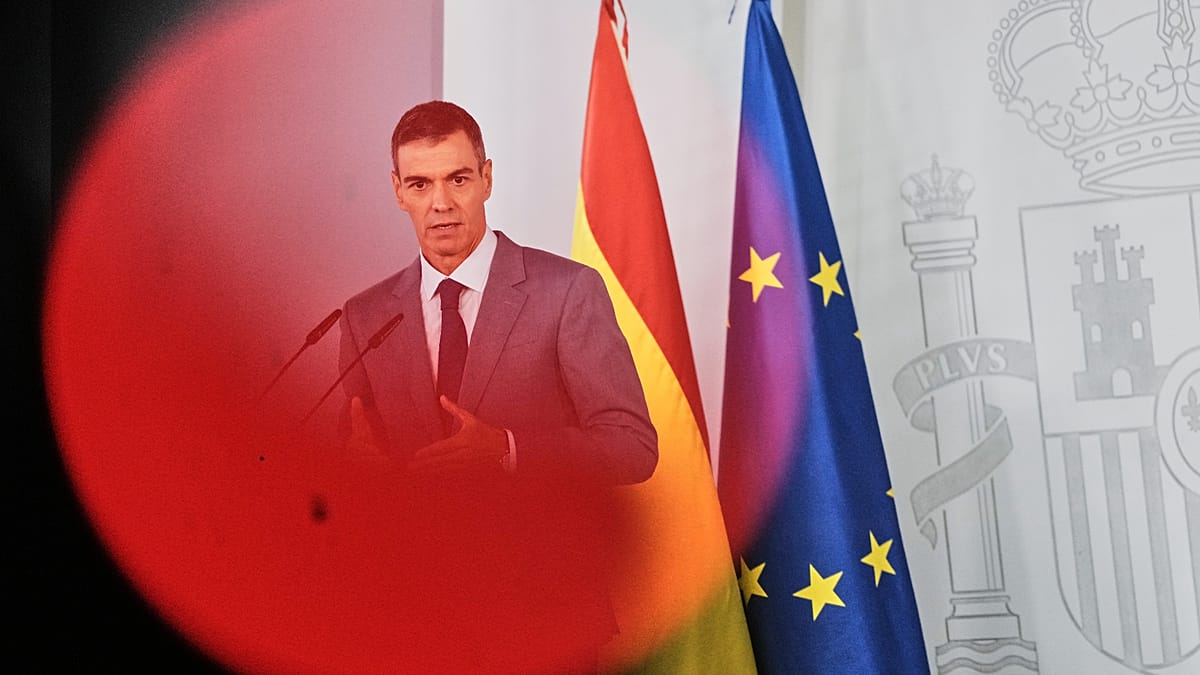
Wednesday’s accident happened in the middle of the pre-election campaign, adding pressure to Sánchez’s government. With a month to go, parties are locked in a blame battle.
Wednesday’s train crash near Toledo has added pressure on Spain’s Prime Minister Pedro Sánchez ahead of the early general election he called for next month.
His government has already faced a succession of crises this year, including another deadly rail accident in Adamuz in January and the migration crisis in Ceuta in July. The latest accident represents another political shock in the middle of the pre-election period and comes as the government’s handling of public services faces renewed scrutiny.
Although the main parties suspended their pre-campaign events after the tragedy, with the exception of Vox, political confrontation has continued.
The Partido Popular has questioned the government’s management of the rail network. Far-right Vox has filed a criminal complaint for homicide against Transport Minister Óscar Puente while Frente Amplio has demanded that he appear before parliament to explain what happened.
The investigation still has to establish what caused the collision and whether human, technical or coordination failures were involved. But the political debate is already moving faster than the investigation.
While investigators try to reconstruct the minutes leading up to the crash, the parties are already disputing the narrative of what happened and, above all, who should bear its consequences.
One crisis after another
The crash is the latest in a series of crises that have shaped public debate in Spain in recent years and are now feeding into the election campaign. These include protests over housing, migration tensions in Ceuta, the nationwide blackout, devastating floods in Valencia, the handling of the COVID-19 pandemic, and corruption cases involving figures close to Sánchez and the PSOE.
For the public, the more immediate questions are what happened, why it happened and what will be done to prevent it from happening again.
The tragedy in Urda has once again put rail safety at the centre of the national debate, barely nine months after the Adamuz accident, which killed 46 people. The two incidents have renewed questions about infrastructure oversight, safety protocols and accountability.
What were the polls saying before the Urda tragedy?
Even before this week’s train crash, polls were already pointing to a difficult electoral landscape for Pedro Sánchez, although some showed signs of recovery for the PSOE.
According to a poll published by El Mundo on 26 October, the Partido Popular was on 30.6% of the vote and between 125 and 131 seats, compared with 26.1% and between 103 and 109 seats for the Socialists. Vox was on 19.9% and between 66 and 69 seats.
Another poll published by El Español around the same time put the Partido Popular at around 32% of the vote and 135 seats, the PSOE at 27% and 108 seats, and Vox at 18.6% and 63 seats.
Both polls suggested that the PP and Vox together could secure an absolute majority.
The Centre for Sociological Research (CIS), however, has presented a very different picture, placing the PSOE well ahead of the PP in its latest barometer.
The sharp differences between polls add further uncertainty to a pre-election period already dominated by political and management crises, with the Urda rail tragedy now added to the debate barely a month before the general election.
Source: www.euronews.com

1 Comment
Pingback: Israel election result shows no overall majority as vote count complete - Warsaw.Today