



Spain begins mourning period after train crash as search continues for victims in wreckage
Emergency services, drones and dog unit continue to comb carriages as Civil Guard sets up clinics for relatives to provide DNA samples
Spain has begun three days of mourning to commemorate the 69 people who died in a high-speed rail collision as hospitals continue to treat dozens of injured passengers and relatives wait for news of their loved ones.
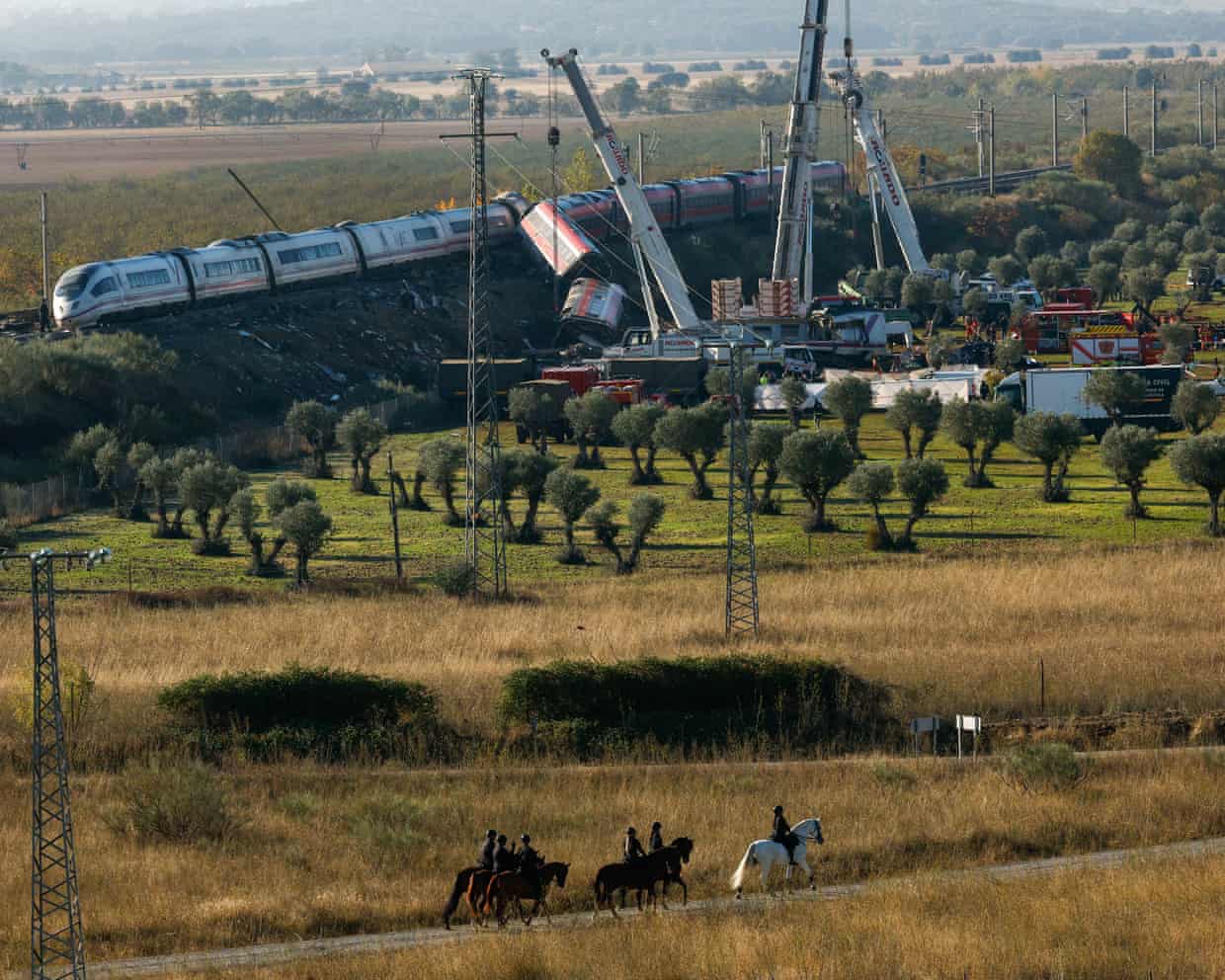
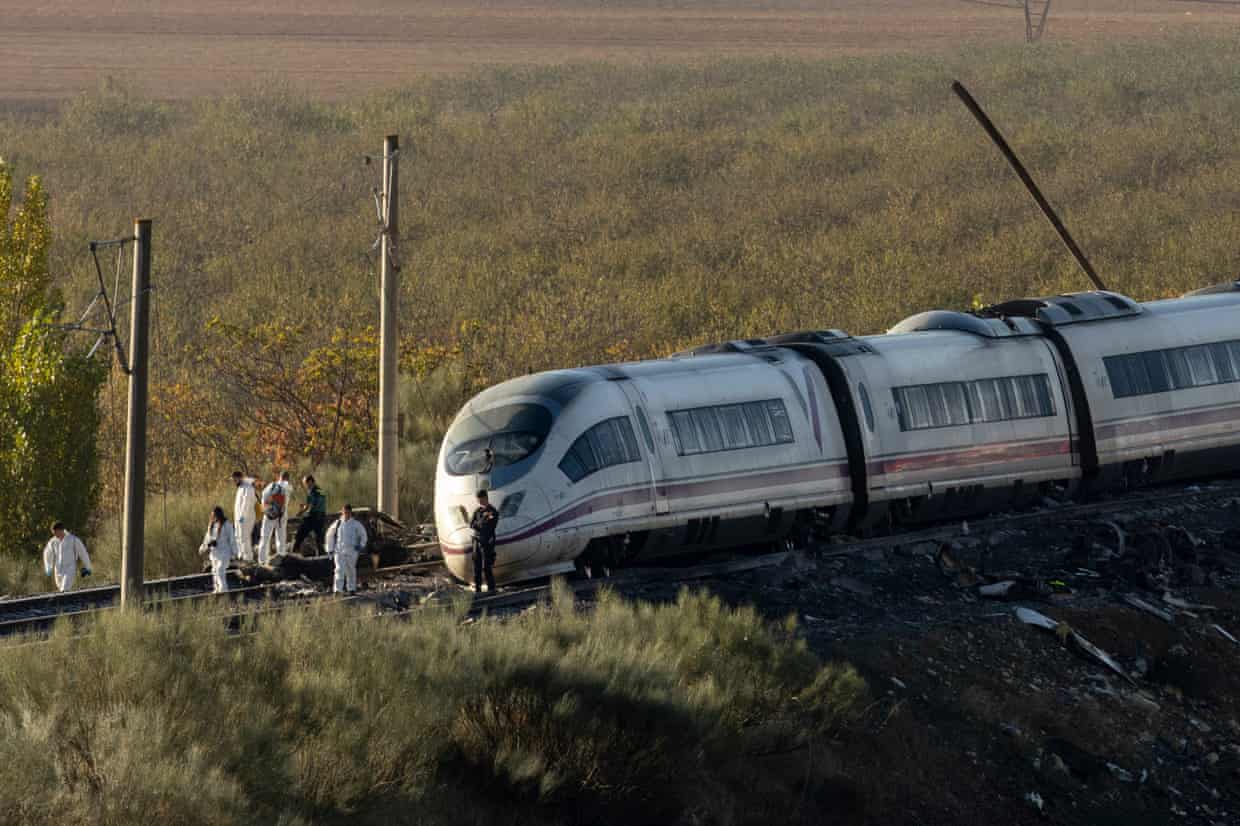
The trains – one from Spain’s state-owned Renfe and the other from the private rail company Iryo – were heading from Madrid on Wednesday to the southern region of Andalucía on the same line when they collided just before 9am. After the Iryo train came to a halt, the other slammed into its rear, knocking several carriages off the track near the town of Urda in the central region of Castilla-La Mancha.
Officials said on Wednesday another 107 people had needed medical treatment in hospital, including 15 who were in a serious condition.
The deadly crash came 10 months after 46 people were killed and dozens more injured after two trains – again, one from Renfe and one from Iryo – collided on the same line near the town of Adamuz in Andalucía.
The disaster has raised fresh questions about safety on Spain’s large, modern high-speed rail network after the transport minister, Óscar Puente, said rear-end collisions such as Wednesday’s were “highly unlikely”, and suggested the accident could have been caused by human error under “inexplicable” circumstances.
He said the LZB signalling system, which automatically halts a train if the line ahead is occupied, had gone down at about 8.30am local time owing to a computer malfunction. As a result, an estimated six trains had been halted along a stretch of about 63km of track, Puente added.
The task of monitoring the rail lines then fell to a 24-hour command centre in Madrid. Minutes after the computer malfunction, the centre instructed at least two of the trains to continue as normal, despite the fact that there was still a “stop signal” in place, the minister added.
“It was the control centre, through its operators, that made the decision to resume traffic, under circumstances that, from our point of view, are inexplicable,” he said. “Clearly, it was a wrong decision.”
Emergency services combed through the wreckage through the night to find more victims, hoisting pieces of mangled metal with cranes. At daybreak, police once again launched drones to survey the crash site. One more body was found overnight, bringing the death toll to 69.
Emiliano García-Page, the leader of the Castilla-La Mancha regional government, said on Thursday morning that rescue teams did not think they would find any more bodies in one damaged carriage that was still overturned, but added that body parts had been found that would need to be identified.
“Yesterday we experienced a catastrophe that without a doubt has left all of Spain in shock,” said García-Page. He confirmed that 50 of the 110 people who had been taken to hospitals in the region were still being treated.
The prime minister, Pedro Sánchez, speaking during a visit to the emergency command centre in the city of Toledo, said the authorities were doing all they could to establish the cause of the crash and prevent another rail tragedy.
“I’d like to let all Spaniards know that every institution that is part of the state – from the smallest municipality to the government of Spain – is working day and night, not only to provide a response to the families of the victims, but also, of course, to uncover every last detail of this tragedy and to strengthen safety measures so that something like this never happens again.”
Meanwhile, train drivers in Spain went ahead with a previously planned strike to press for more investment in railway safety after what was Europe’s deadliest train accident since a 2013 derailment in Santiago de Compostela in north-west Spain that killed 80 people.
The Guardia Civil police force has set up four offices in the cities of Madrid, Toledo, Córdoba and Seville to enable relatives to provide DNA samples and help identify victims. Blood donation points have also been set up in Castilla-La Mancha and Madrid. The force said 64 people had been reported missing by relatives by Thursday morning.
A school in Urda, which lies about 130km (80 miles) south of Madrid, has been turned into an information centre where relatives can inquire about loved ones. Teams of Red Cross workers offered support to groups of people who had arrived, some of them in tears.
Carmen García, a Red Cross psychologist, said “long and hard hours” lay ahead and that “every person will manage it in their own way”. She added: “We have people who are in shock, who haven’t taken onboard what has happened, angry people, sad, worried people. The grieving will be complicated.”
José Miguel Fernández, a parish priest in Urda, joined the emergency services in offering support to the victims’ families.
“It is important for relatives to find their loved ones, even if they have died, because the grieving process is quicker when you have been able to say goodbye at that final moment,” he told Onda Cero radio.
Survivors have spoken of being thrown from their seats by the impact of the crash, and of trying to help the injured in the immediate aftermath.
The first victim to be named included a 31-year-old Guardia civil officer, José Manuel Chacón.
The national law enforcement agency expressed its “deepest condolences” to his family, friends and colleagues. Spanish media said the missing included a former minister for the conservative People’s party (PP) and several foreigners, who were thought to be on holiday in Spain.
The PP leader, Alberto Núñez Feijóo, called for an immediate investigation into what had happened, as well as a “complete and independent review” of Spain’s entire rail network. “Spain has the right to know what is going on with its infrastructure,” he told reporters.
With Agence France-Presse and Reuters
Explore more on these topicsReuse this content
Source: www.theguardian.com
