



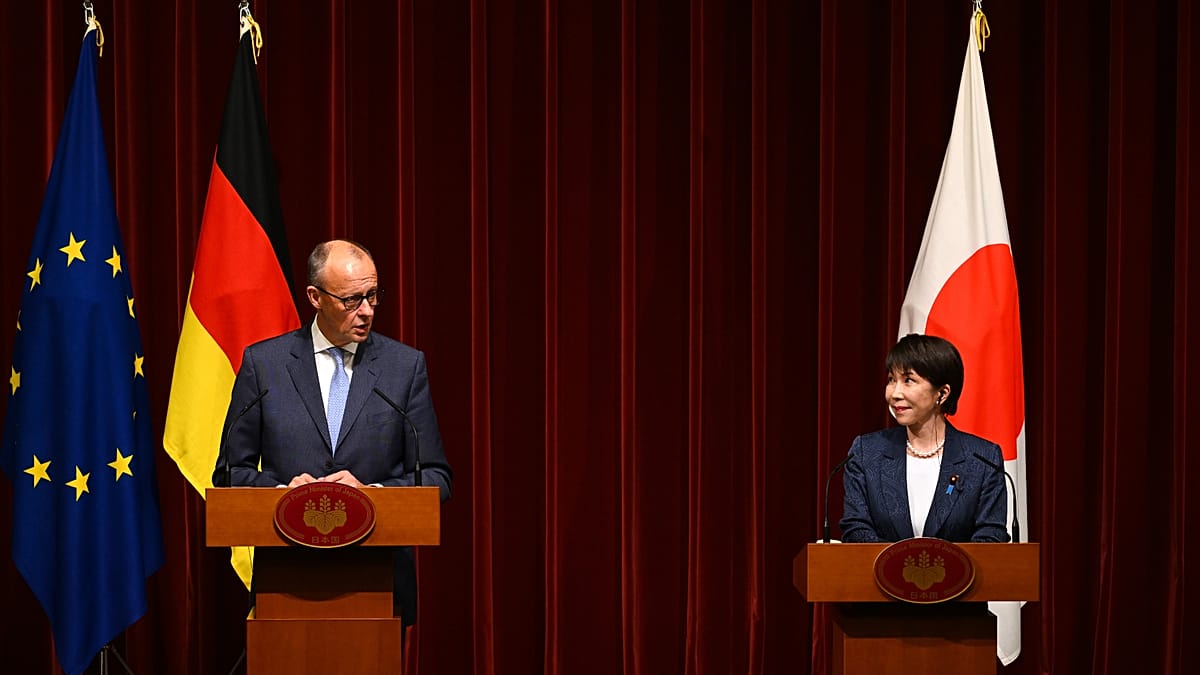
German Chancellor Friedrich Merz and Japanese PM Sanae Takaichi agreed in Tokyo on Wednesday to deepen cooperation on economic security and high tech. It is Merz’s first visit to Japan since taking office in May 2025.
It is a meeting of the leading representatives of two of the world’s largest economies. On his first visit to Japan the German chancellor Friedrich Merz has met Japanese Prime Minister Sanae Takaichi.
Takaichi and Merz issued joint statements on economic security and future technologies. These are intended to strengthen and better align cooperation between the two countries in these fields.
Side swipes at China and the US
Although China and the United States were not explicitly mentioned in the joint statement or in subsequent remarks, the message appeared to contain indirect criticism of both countries. Beijing and Washington have repeatedly used their economic policies as a means of exerting pressure on partners and rivals.
“Both heads of state and government expressed their deep concern about the growing use of economic coercion, for example through arbitrary export restrictions and retaliatory measures affecting critical raw materials. They also rejected non-market-based measures and practices that lead to overcapacity and market distortions and thereby undermine our economic security and resilience,” the joint statement said.
The two nations have said they intend to step up their cooperation in monitoring and assessing supply chains, to prevent economic dependencies from being abused as a tool of pressure. They are also examining closer collaboration in key sectors such as critical raw materials, semiconductors, batteries, electric cars, industrial AI, robotics, pharmaceuticals and wind power.
On critical raw materials, Merz and Takaichi welcomed the signing of a joint declaration of intent. At the same time, they announced plans to broaden the supply base and improve the substitutability of rare earths in the automotive industries of both countries.
Japan has faced supply bottlenecks for rare earths after China restricted exports of several important raw materials. In November Takaichi addressed Japan’s parliament, stating that Japan could intervene militarily in the event of a crisis over Taiwan. Beijing regards the democratically governed island as part of its own territory.
Takaichi and Merz also agreed to establish a high-level dialogue on artificial intelligence and to work more closely together on protection against cyberattacks. Both areas are gaining importance for the Japanese government as AI-driven cybercrime is rising sharply in the country.
In their joint statement, the two leaders both voiced concern about the situation in the East and South China Seas. They rejected unilateral attempts to change existing conditions by force or coercion – wherever in the world they may occur. They also underlined the importance of peace and stability in the Taiwan Strait and called for a peaceful resolution of the conflicts between China and Taiwan.
The shared goals of Japan and Germany
In view of rising geopolitical tensions, Germany and Japan are expected to intensify their cooperation with allies and like-minded states. Both sides reaffirmed their commitment to freedom, democracy, fair trade, the rule of law and human rights.
Military cooperation in the Indo-Pacific is also to be further expanded. One example is the first-ever participation of German armed forces in the Japanese-American military exercise “Keen Sword” this year. The drills, which run until Thursday, are taking place at several locations in Japan, particularly in the sea and airspace around Okinawa, where China has stepped up its military activities in recent years.
At an economic forum in Tokyo on Wednesday morning, Chancellor Merz called for the creation of a new political alliance to strengthen rules-based global trade. The alliance is intended to defend and further develop trade based on international agreements. At the same time, it could “provide political impetus and also respond jointly when the rules-based order comes under threat”.
Germany plans to invest two billion euros in artificial intelligence and high-tech by 2029. Japan is aiming for around 18 billion euros in private investment in these areas by 2040.
Germany only at the beginning of diversifying its partners
During his time in Japan, Merz also visited the start-up Kyoto Fusioneering. It is considered a flagship project of the German-Japanese high-tech partnership thanks to its cooperation with Siemens Energy. The goal of the collaboration is to generate electricity from nuclear fusion.
The Japanese government is promoting the strategically important semiconductor industry with extensive state subsidies.
Germany is guided by EU requirements stating that by 2030 no more than 65 percent of critical raw materials should come from China. But the diversification of partners – that is, the reduction of dependencies on Beijing, which is the declared goal of the chancellor’s Asia trip – is still in its infancy.
On Thursday, South Korea is on the agenda at the end of the chancellor’s Asia tour. At his meeting in Seoul, in addition to bilateral economic relations, security issues and cooperation on future technologies such as artificial intelligence are to be discussed.
Source: www.euronews.com
