



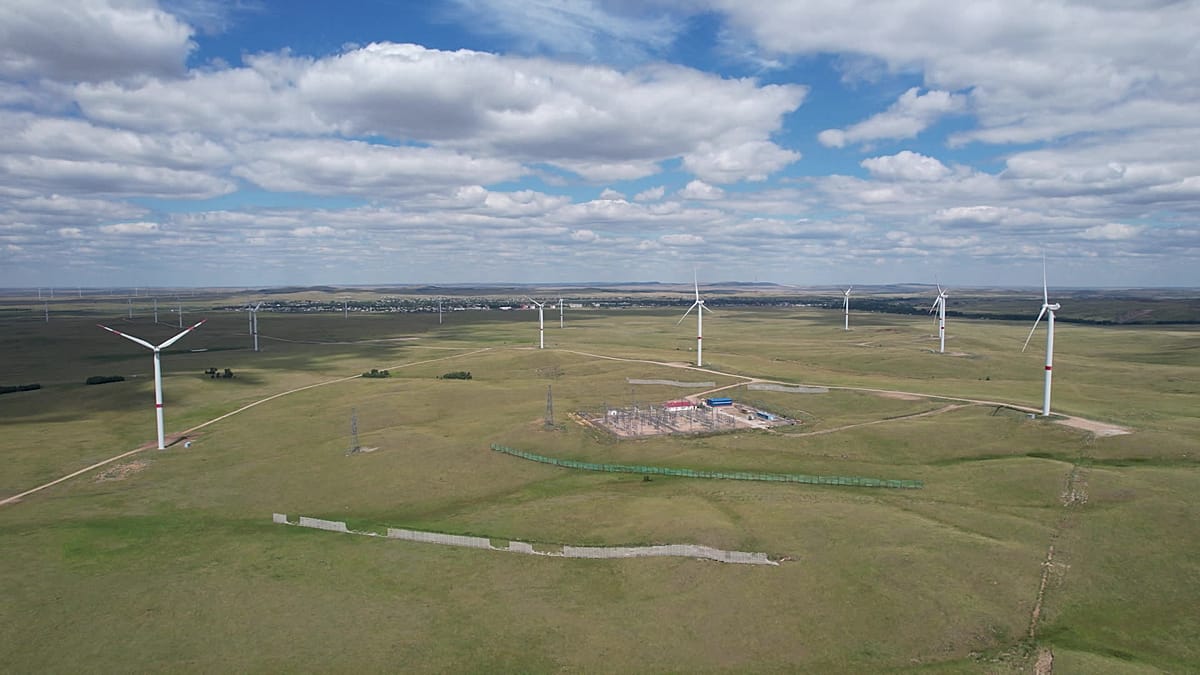
Kazakhstan aims to mobilise €18 billion in investment in cleaner energy through its just energy transition platform, QaJET, with support from the European Bank for Reconstruction and Development (EBRD).
The initiative targets renewable power and grid upgrades while addressing the impact on workers and coal-dependent communities.
Fossil fuels still supply around 85% of Kazakhstan’s electricity The country wants to expand renewable power, but that will also require upgrades to its electricity networks and support for workers in regions that depend on coal
To help finance that shift, Kazakhstan aims to attract $20bn (€17.4bn) through QaJET, its just energy transition platform. Backed by the European Bank for Reconstruction and Development (EBRD), the initiative brings together public and private investment.
The platform is already operational and is due to be officially launched at COP31 in Antalya, Türkiye, in November.
It supports Kazakhstan’s goal of carbon neutrality by 2060 and its commitment to cut net greenhouse gas emissions by up to 25% by 2030 compared with 1990 levels, subject to international support.
Kazakhstan’s Just Energy Transition platform QaJET
According to the platform’s investment breakdown, around half of the funding, approximately €8.7bn, is intended to support 10 GW of new renewable energy capacity by 2035.
A further quarter, around €4.35bn, is earmarked for integrating renewables into the power system and improving its reliability. The remaining quarter will support electrification in transport, industry and small and medium-sized enterprises, alongside upgrades to electricity networks and smart energy systems.
The platform is expected to reduce annual greenhouse gas emissions by more than 20 million tonnes, equivalent to around 7% of Kazakhstan’s energy-related emissions.
Projects already in the pipeline
QaJET already includes projects worth more than €1bn, including a major wind farm in the Zhambyl region and an electricity infrastructure upgrade in Almaty.
The Mirny wind farm, scheduled to enter operation in 2028, will have a capacity of 1 GW and include 150 turbines, alongside a battery energy storage system with a capacity of 600 MWh.
The project, developed by TotalEnergies and its Kazakh partners, is expected to generate around 4 TWh of renewable electricity annually. Its output will be sold to Kazakhstan’s state-owned Financial Settlement Centre for Renewable Energy under a 25-year agreement.
The project is expected to avoid up to 3.5 million tonnes of carbon dioxide emissions a year.
The second project focuses on modernising electricity distribution infrastructure in Almaty and the surrounding region. The EBRD is providing a loan of up to 102 bn tenge (€194m) to Alatau Zharyk Company, which serves around 50,000 commercial customers in Almaty and the surrounding region.
The funding will help the company install automated metering and remote-control equipment and upgrade its low- and medium-voltage distribution networks.
Investment opportunities
Beyond the projects already in the pipeline, Kazakhstan faces the challenge of modernising its existing energy infrastructure and preparing workers for the transition.
“We are a carbon-dependent country, with large combined heat and power plants and power stations. These facilities and the energy networks need to be modernised. Workers in the energy sector also need to be retrained as part of the energy transition,” said Saule Sabieva, Climate Policy Director at the Ministry of Ecology and Natural Resources.
The government is seeking support from international partners, including the European Union, the United Kingdom, the Green Climate Fund, the Global Environment Facility and the Climate Investment Funds.
Ensuring a just energy transition
Moving away from coal also presents social and economic challenges, particularly in regions where employment and local economies depend heavily on conventional energy production.
Before major changes are made, QaJET’s partners are expected to assess the regions most exposed to the risks of decarbonisation and identify ways to ensure people have access to new economic opportunities.
“We are expecting these findings. After that, we will be able to assess our major infrastructure projects and calculate their costs for inclusion in the project portfolio,” Sabieva said.
She identified Karaganda, North Kazakhstan and East Kazakhstan regions as likely to face some of the greatest challenges.
More broadly, she said, the difficulties would affect regions where electricity is generated by large combined heat and power plants and major power stations.
Attracting renewable energy investment
The EBRD says Kazakhstan has many of the prerequisites for expanding renewable energy, including strong natural resources and a government seeking to improve the regulatory environment.
“Kazakhstan is blessed with the natural resources needed for renewable energy projects,” said Yerlan Ramazanov, the EBRD’s Deputy Head of Kazakhstan and Regional Head of Energy.
He pointed to regulatory changes, competitive auctions and long-term power purchase agreements as factors helping to attract investors.
These agreements provide greater predictability for developers and help lenders assess the risks associated with renewable energy projects.
Referring to the electricity buyer, Ramazanov said, “Over 11 years of experience, I would say that the agreements are being honoured and the off-taker is paying in full and on time.”
Renewable energy auction tariffs have also fallen since the system was introduced in 2018. Kazakhstan is developing domestic expertise, with local companies increasingly involved in building and operating renewable energy projects.
Remaining barriers
Despite progress, several obstacles remain. Ramazanov highlighted limitations in grid capacity and stability, as well as the challenge of balancing electricity supply as more renewable energy comes online.
The EBRD is already working with officials to develop the regulatory framework for battery storage and pumped-storage projects.
For investors, stable rules and a clear long-term outlook are essential. QaJET’s target of adding 10 GW of renewable energy capacity by 2035 could help provide that direction, setting out the scale of Kazakhstan’s ambitions.
With its renewable energy ambitions, growing project pipeline under QaJET and support from the EBRD, Kazakhstan is working to create new opportunities for investors to build a cleaner, more resilient energy system.
Source: www.euronews.com
