



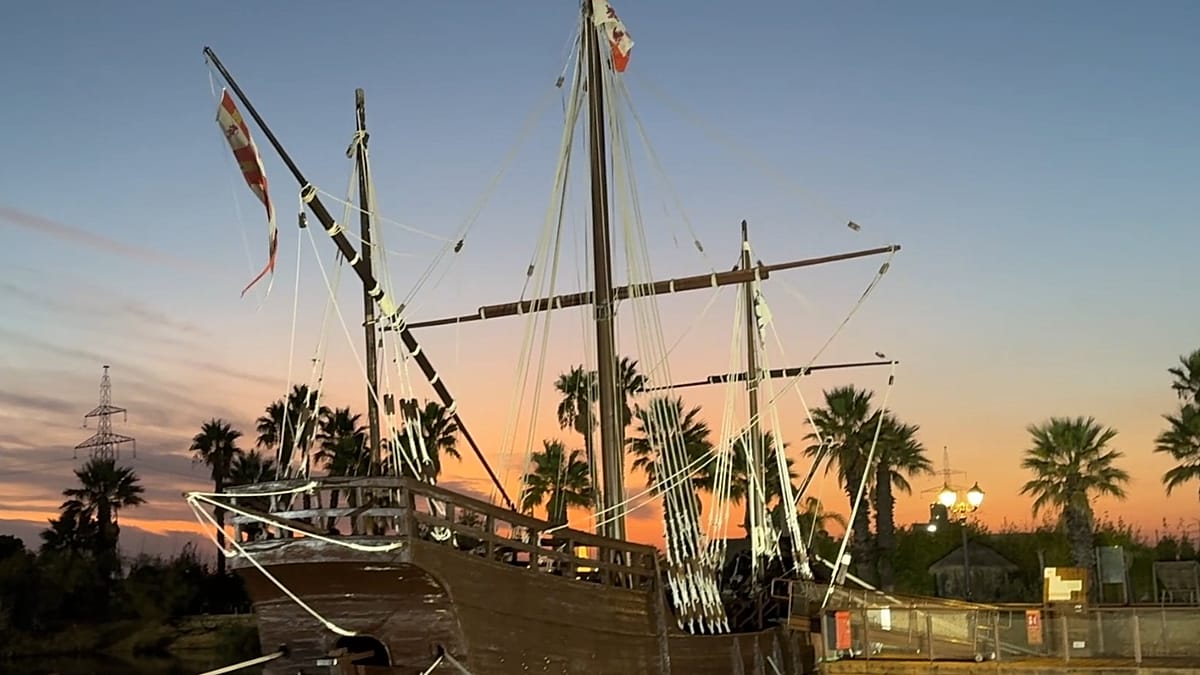
On Christmas Eve 1492 the Santa María ran aground off Haiti; Columbus used its timbers to build Fort Navidad, where 39 men died. More than five centuries later, archaeologists have yet to pinpoint the site.
Spain’s history of maritime navigation in the 15th century is full of stories and an epic quality rivalled only by the Portuguese empire. One of those stories explains the first Spanish settlement established in the Americas.
On Columbus’s first voyage to the Americas, the admiral sailed with three ships: the Pinta, the Niña and the Santa María; only two of them returned to Castile. It is widely known that on 12 October 1942 land was sighted from the Pinta: it was the discovery of the New World.
At 23:00 on a cold 24 December 1492, Christopher Columbus went to sleep. As he recorded in his logbook, he had not closed his eyes for two days. The sea was, in his own words, “like a bowl” (a handleless wooden cup), and the Santa María was making slow headway along an unknown stretch of coast in the north of Hispaniola. Around midnight, the ship ran aground on a reef.
The conqueror, far from dwelling on the loss, decided to dismantle her and, using her planks and the nails that still did their job, he built the fort of Navidad, which could house almost 40 men and lasted less than a year.
When Columbus returned, no one was left alive and now, more than five centuries later, no one has been able to prove with precision and certainty exactly where this chapter in the history of Spanish seafaring stood.
The night of the disaster
The shipwreck was the result of a chain of errors. Columbus went to bed and left the ship sailing on in a light wind. The helmsman on duty did the same: seeing the calm coast, he handed over the steering of the vessel to a cabin boy, something Columbus had expressly forbidden throughout the voyage. This led to the Santa María running aground almost silently and without guidance on a reef, near what is now the bay of Cap-Haïtien, and her hull split open.
Around midnight, currents pushed the ship onto a shoal. She touched so gently that almost no one realised what was coming. The boy felt the rudder scrape the bottom, heard the sound of the sea, began to shout and Columbus jumped out of bed.
But it was already too late, so late that the tide had already fallen. He ordered the main mast to be cut down to lighten the ship and told Juan de la Cosa, master and owner of the vessel, to take an anchor out in the skiff. De la Cosa disobeyed, another link in the chain of errors: he took the boat to the Niña, which was sailing nearby. The Santa María listed and her planks sprang apart. Columbus transferred the crew to the Niña and waited for dawn.
The day of construction
With the first light, Columbus sent messengers to Guacanagarí, one of the five Taíno chiefs on Hispaniola. According to what they told him later, the cacique wept when he heard the news. He sent all his people out in large canoes and helped to unload the ship with his brothers and relatives. He ordered the goods to be stored beside the houses, and even emptied some so they would fit. Columbus wrote to the Catholic Monarchs that he did not believe there were “better people or better land” anywhere.
Everything that could be salvaged was saved, from supplies to deck planks and hull timbers. Columbus decided to leave a garrison there. He believed that gold was abundant on the island, and the loss of the ship made it necessary to leave men behind so that the rest of the expedition could return to Spain with only the Niña.
Around 26 December he began to build a fort from the timber and nails of the ship and called it La Navidad, after the night of the wreck. Historian Carlos Martínez Shaw recalls that the log itself records that the ship was beyond repair and was broken up, and that the fort was sufficiently large to house 39 people.
The chronicles relate that Columbus had artillery fired at what remained of the hull so that the Taínos could see his power. On 30 December, Guacanagarí seated him on a platform of palm and placed his own crown on his head.
The “39 of La Navidad” were placed under the orders of Diego de Arana, constable of the expedition. Among them were the king’s pantry steward Pero Gutiérrez, Rodrigo de Escobedo, a surgeon, three craftsmen, a gunner and a tailor. Their mission was to trade with the Taínos and find out where the mine lay. Columbus set sail on the Niña in early 1493 on his return to Castile.
What happened to the first Spanish settlement in the Americas
The admiral returned on 27 November 1493, on his second voyage, with 17 ships and around 1,500 men. He found the fort burnt to the ground and the Spaniards dead, most of them disfigured. Guacanagarí blamed the attack on another chief, the lord of the mines. Historians still wonder whether the leader who had welcomed them might have had a hand in it. Columbus did not rebuild the fort but founded another settlement, La Isabela, elsewhere on the island.
The most serious find came from William Hodges, an American missionary doctor and amateur archaeologist. His patients showed him highly elaborate Taíno pottery and in 1977 he located the site of En Bas Saline, in northern Haiti. It was a major Taíno centre, very close to where the Santa María went down.
The Florida Museum of Natural History excavated there together with Haiti’s Bureau National d’Ethnologie between 1983 and 1988, and returned in 2003. In total, 276 square metres were dug. The 2003 campaign confirmed that the central mound was a large structure burned at the end of the 15th century. Researchers identified En Bas Saline as Guacanagarí’s village and as the probable site of La Navidad.
Among the animal remains, they found the first trace of the black rat from the Old World on the island. The definitive proof is still missing. Today there is no conclusive evidence fixing the exact location of the fort, and none of its timber has been identified in a way that is beyond dispute.
The wreck of the Santa María
The other piece of the puzzle is the ship. In 2014, underwater explorer Barry Clifford announced that he had found the Santa María in waters off northern Haiti. The Haitian culture minister, Monique Rocourt, said at the time that the evidence she had seen suggested it was not the ship.
The director of Haiti’s National Bureau of Ethnology, Erol Josué, pointed out that the ship could not be lying on the seabed, because its planks had been used to build the fort.
Historian María Luisa Cazorla has put forward another hypothesis. The coastline has advanced because of sediment carried by rivers, and the remains of the ship would now lie on land, under some six metres of deposits. Her thesis argues that the wreck could be located within a radius of a few hundred metres by geophysical prospecting. In August 2026, ‘History.com’ was still referring to the Haitian wreck as a purported discovery.
For the moment, neither the ship nor the fort built from her timbers have turned up conclusively. Unwittingly, Columbus had laid the foundations of an empire that would last for centuries and where the sun never set.
Source: www.euronews.com
