


Close Menu
Warsaw.Today
    What's Hot

    A 1,000-mile cloud on Mars may reveal physics never seen in nature

    October 24, 2026

    American: Miami – Las Vegas, Nevada (and vice versa). $263 (Basic Economy) / $393 (Regular Economy). Roundtrip, including all Taxes

    October 24, 2026

    Dónal Lunny, ‘colossus of Irish music’, dies aged 79

    October 24, 2026
    Facebook X (Twitter) Instagram
    Trending
    • A 1,000-mile cloud on Mars may reveal physics never seen in nature
    • American: Miami – Las Vegas, Nevada (and vice versa). $263 (Basic Economy) / $393 (Regular Economy). Roundtrip, including all Taxes
    • Dónal Lunny, ‘colossus of Irish music’, dies aged 79
    • Italy deploys hundreds of soldiers amid nationwide protests
    • Eurowizja Junior 2026 już dziś. O której początek i kiedy wystąpi Polska? Znamy kolejność
    • United: Chicago – Los Angeles (and vice versa). $161 (Basic Economy) / $281 (Regular Economy). Roundtrip, including all Taxes
    • Suspect arrested over fire at Hitler’s ‘Eagle’s Nest’ retreat in Bavaria
    • Live – Madrid joins weekend of protests across Europe
    Facebook X (Twitter) Instagram
    Warsaw.TodayWarsaw.Today
    Demo
    • Home
    • News
    • World
    • Sports
    • Business
    • Culture
    • Politics
    • Travel
    • Technology
    Warsaw.Today
    Home»Technology»The ugly economics of consumer AI
    Technology

    The ugly economics of consumer AI

    Peter NovakBy Peter NovakSeptember 30, 2026No Comments0 Views
    Facebook Twitter Pinterest LinkedIn WhatsApp Reddit Tumblr Email
    The ugly economics of consumer AI
    Share
    Facebook Twitter LinkedIn Pinterest Email

    After this week, you could argue that consumer AI is making a comeback. 

    Meta’s personal AI assistant, Muse, and its plush-like mascot Jolly, has been a surprise hit. OpenAI’s Dots, released just yesterday, appears to be chasing the same cartoony personal assistant idea. And the up-and-coming Instinct assistant reached a $10 billion valuation on the strength of its agentic errand-running, focused on booking travel, making restaurant reservations or cancelling subscriptions. 

    The bull case is easy to make. Agentic AI has finally gotten reliable enough to handle everyday tasks. Companies are increasingly pitching that service to everyday people, who are getting genuine value out of it. If you’re an investor, that looks an awful lot like the ChatGPT launch in 2022 — the raw power of AI opening up a product category that was never possible before. Who wouldn’t want a piece of the action?

    But there’s a reason frontier labs have gotten gunshy about consumer AI — and it’s not because the tech isn’t good enough. Even staggeringly popular tech products are starting to hit a ceiling on how much money consumers are willing to pay, and it’s not clear that better models are actually leading to a more profitable consumer business. The result has been an industry-wide shift toward the Anthropic model, focusing on enterprise contracts and vertical-by-vertical expansion.

    If products like Muse and Instinct are bucking that trend, it’s because they’re less concerned with monetization. But the underlying economics of consumer AI are not getting any better, and anyone getting into the business will have to grapple with them eventually.

    We got a reminder of those economics in Andreessen Horowitz’s semiannual State of Markets report, which pulled its figures from a PNC research report from this summer. In two charts, they track the slowly growing percentage of consumers paying for AI services, alongside the slowly growing amount they’re paying. As of May, 2.2% of consumers were paying for AI, at an average spend of $31 a month.
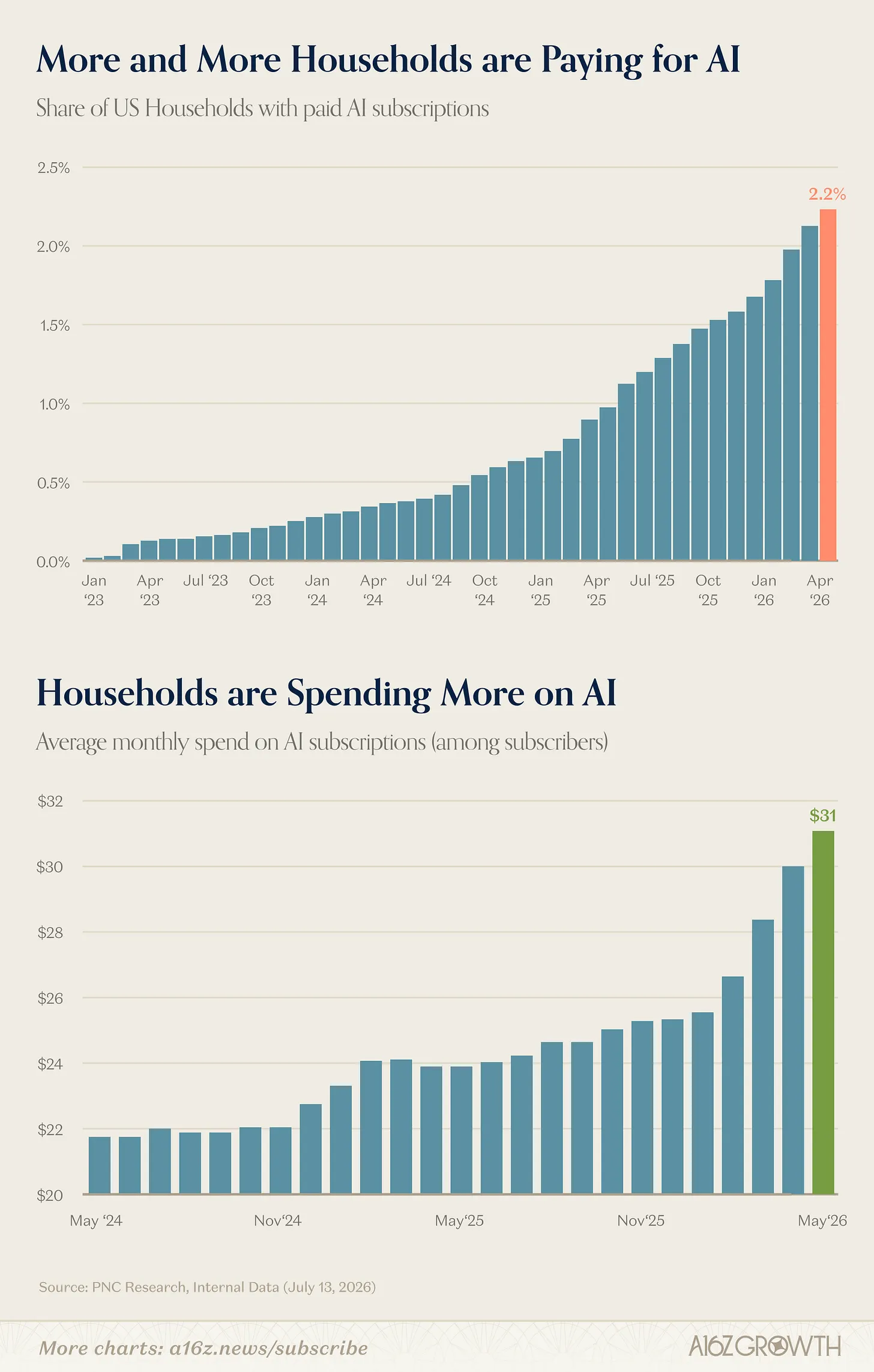

    Andreessen puts a positive spin on this, saying, “it’s still so early when it comes to mature AI adoption and utilization.” There’s a lot of room to grow! But in both charts, the pace of growth seems awfully linear. Even as models make huge improvements, there isn’t a ton of movement in the number of customers willing to pay for AI or how much they’re willing to pay for it. The enormous performance jump from GPT-5.2 to Astra, for instance, is barely visible on the chart.

    The per-consumer numbers are less striking, but still far below the standard break-even point. If you take Netflix as the standard for market-saturated online services (at 325 million subscribers), then $34 per customer only gets you to $11 billion in annual revenue, less than a third of OpenAI’s operating costs. 

    If you think PNC is underselling adoption, you can get similar numbers from Bank of America. In March, the firm found that roughly 3% of U.S. consumers paid for AI, up 40% from the previous year. A Menlo survey from September gives a slightly sunnier view, finding that a quarter of adults use AI daily and half of those users are paying for it.

    The problem with the consumer approach has less to do with revenue than with cost. AI is an unusually expensive technology to operate, particularly compared to lightweight predecessors like social networking or cloud computing. Even hundreds of millions of paying customers doesn’t guarantee you’ll break even.

    To its credit, OpenAI seems to have adapted well to these facts. The company’s widely reported pivot to enterprise has been largely successful, with enterprise bookings reportedly doubling since July. Even the Dots launch had a strong enterprise angle, showing how the new personal agent could be useful for software engineers and agency creatives. One long-standing way to make money from popular-but-cheap consumer services is to sell them to businesses at a markup, and OpenAI seems to be following the playbook.

    It’s harder to say what this means for Muse and Instinct. Muse has the juggernaut of Meta’s personalized ad targeting behind it, which gives it more options for monetization and more time before it becomes an urgent question. Notably, Meta is already exploring the enterprise angle.

    Instinct has a separate plan that involves taking a cut of purchases made through the agent, which might raise the ceiling. Presumably it’ll also be able to avoid the cost of training a frontier model, which will help a lot.

    But the ugly economics of consumer AI put a hard cap on how large the company can plausibly grow without tapping into enterprise revenue. It’s a lesson the major labs have already learned, and it’s one of the few things about the industry that doesn’t seem to be changing.

    Source: techcrunch.com

    AI chatbots consumer AI instinct ugly
    Share. Facebook Twitter Pinterest LinkedIn Tumblr Telegram Email
    Peter Novak
    • Website

    Related Posts

    A 1,000-mile cloud on Mars may reveal physics never seen in nature

    October 24, 2026

    Rocket Report: SpaceX says no thanks to military launches; Spanish rocket nearly ready

    October 24, 2026

    Everybody panic: A Valve developer said “HLX” in public

    October 24, 2026
    Leave A Reply Cancel Reply

    WARSAW WEATHER
    Economy News
    Technology

    A 1,000-mile cloud on Mars may reveal physics never seen in nature

    By Peter NovakOctober 24, 20260

    Every morning during the Martian spring and summer, a thin and extremely long cloud emerges, only to disappear again. The wispy formation appears near the volcano Arsia Mons and gradually elongates until it reaches over 1,000 miles—about the distance from New York to Kansas City as the crow flies—before dissipating. This cycle then repeats for…

    American: Miami – Las Vegas, Nevada (and vice versa). $263 (Basic Economy) / $393 (Regular Economy). Roundtrip, including all Taxes

    October 24, 2026

    Dónal Lunny, ‘colossus of Irish music’, dies aged 79

    October 24, 2026
    Top Trending
    Technology

    Your uncle’s frozen Mac says it’s infected after viewing a Google ad. Now what?

    By Peter NovakSeptember 26, 20260

    Researchers say they recently found Google ads delivering a sophisticated tech support scam that freezes the screens of both Windows and Mac devices and displays messages urgently instructing them to phone a bogus call center.

    News

    We can’t stop the ‘Godzilla’ El Niño

    By Peter NovakSeptember 26, 20260

    The ‘Godzilla’ El Niño is here, and it is already breaking records the world would rather have left unbroken.

    World

    Why are India’s elections under unprecedented scrutiny?

    By Peter NovakSeptember 26, 20260

    New Delhi, India – Indian democracy has been shaken by new revelations showing divisions within the body that is in charge of conducting its elections over controversial policies that critics say have disenfranchised tens of millions of people.

    Subscribe to News

    Subscribe to receive the latest breaking news, local updates, and top stories from Warsaw delivered to your inbox.

    Warsaw.Today is your trusted source for breaking news, local updates, business, politics, technology, sports, culture, and events from Warsaw, Poland—all in one place.

    Facebook X (Twitter) Instagram Pinterest YouTube

    A 1,000-mile cloud on Mars may reveal physics never seen in nature

    October 24, 2026

    American: Miami – Las Vegas, Nevada (and vice versa). $263 (Basic Economy) / $393 (Regular Economy). Roundtrip, including all Taxes

    October 24, 2026

    Dónal Lunny, ‘colossus of Irish music’, dies aged 79

    October 24, 2026

    Subscribe to Updates

    Subscribe to receive the latest breaking news, local updates, and top stories from Warsaw delivered to your inbox.

    © 2026 ThemeSphere. Designed by ThemeSphere.
    • About Us
    • Get In Touch
    • Disclaimer
    • Privacy Policy
    • Terms and Conditions

    Type above and press Enter to search. Press Esc to cancel.