

Ulf Kristersson has stood down from his post, paving way for Social Democrats leader to form a government
Sweden’s centre-right prime minister, Ulf Kristersson, has stood down, clearing the way for Magdalena Andersson, the Social Democrats leader, to attempt to form a government.
In a victory speech on Thursday, Andersson said the Swedish people had “voted for a new direction for our country, voted for unity and against division”.
She added: “The Swedish people have voted to take Sweden forward and I will realise the new direction that you have voted for.”
Among the priorities she named were the climate crisis, schools, healthcare, elderly care and immigration policy.
Andersson spoke as the preliminary count for Sunday’s election was finally completed, with 176 seats for the left-leaning opposition parties – a narrow three-seat majority over the right-leaning ruling Tidö coalition supported by the far-right Sweden Democrats (SD). There were 50,359 votes between the two blocs.
Earlier on Thursday, Andersson, who was Kristersson’s predecessor as prime minister, sent an invitation to the other left-leaning parties – Left, Centre and Green – for initial coalition talks.
Soon after, Kristersson, the Moderates leader, announced his resignation after four years as prime minister.
Before the election, some had feared that the vote would mark a turning point for the far right after Kristersson promised key ministerial posts for the SD if his coalition took power. Instead, the SD lost support for the first time in a general election since its foundation, falling from Sweden’s second biggest party to third.
In his resignation letter, Kristersson wrote: “Now it is the speaker who will lead the next steps towards forming a new government. In order for that work to begin immediately, I hereby request to be relieved of my duties as prime minister.”
The speaker, Andreas Norlén, will now start working on proposals for a new prime minister after talks with representatives of each of the parties.
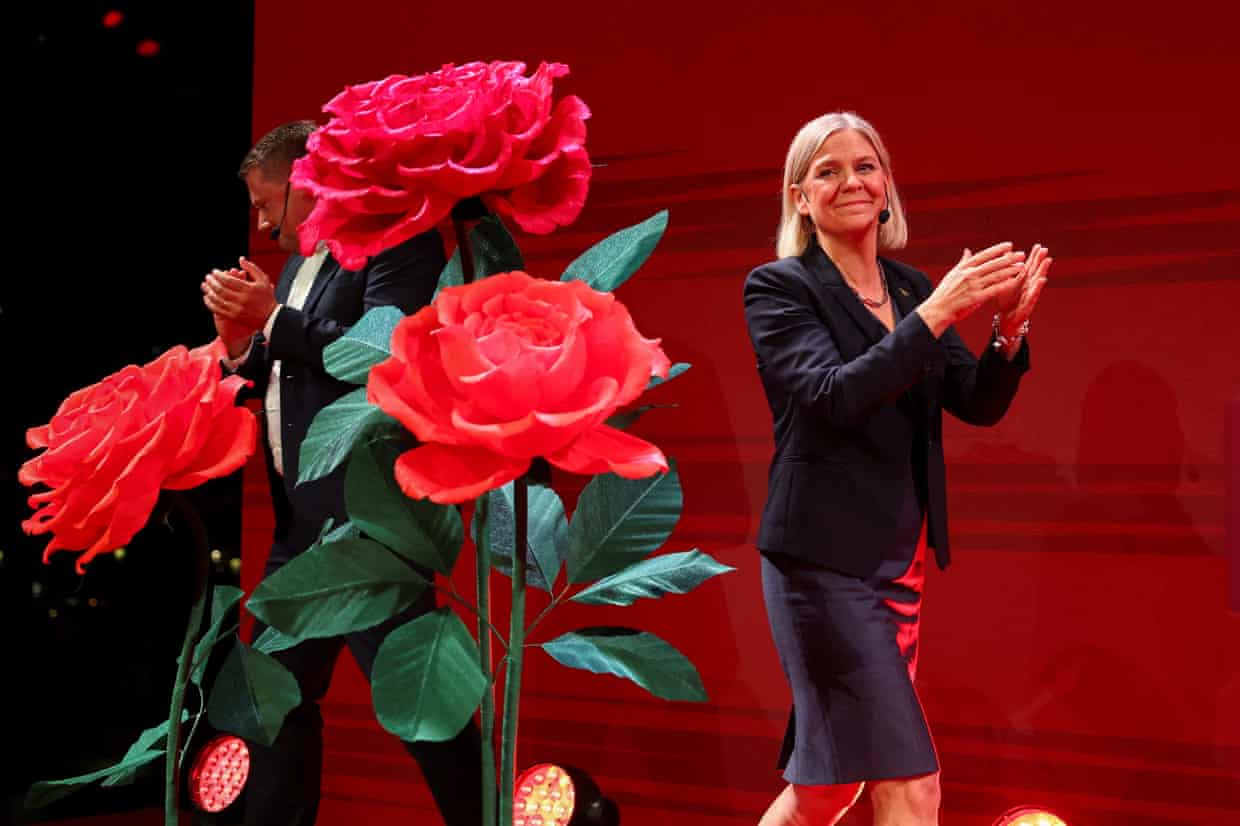
Four celebration cakes decorated with red roses were brought into the Social Democrats’ headquarters amid cheers from inside.
The result will be a considerable relief among Social Democrats, who remain Sweden’s biggest party but received record low support. However, the result marks only the beginning for Andersson of what is expected to be weeks of complicated coalition talks.
One of the trickiest negotiations is expected to be between the Centre and Left parties. The Centre party has ruled out being in government with the Left, while the Left has demanded a place in government in return for its cooperation.
Other difficult areas are expected to be the Left’s support for a billionaire tax, the Green party’s opposition to nuclear energy and differences of opinion on taxation. The Greens, Social Democrats and the Left are all in favour of tax increases, but the Centre party wants to cut taxes.
Nooshi Dadgostar, the leader of the Left party, said: “The Swedish people have voted away Tidö and given us a clear mandate for change.” She added: “This is one of the proudest days of my life.”
Elisabeth Thand Ringqvist, the Centre party leader, thanked Kristersson for his work as prime minister but said Sweden was now “entering a new political phase”. She added: “The Centre party will be a constructive force for Sweden to have a functioning government, with policies anchored in the middle.”
Andersson, who was prime minister between November 2021 and October 2022, is understood to be reaching out to all the opposition parties, with the exception of the SD. The Liberals and the Christian Democrats have ruled out working with the left, but in his resignation letter Kristersson appeared to leave the door open. However, given Swedish tradition, it is extremely unlikely the Moderates and the Social Democrats would form a coalition.
Kristersson wrote that the election had left a “complicated situation” for building a government and called for “constructive openness” from all parties to find a way to form a stable government.
In the nervous days since the election, the Social Democrats are understood to have been using the time to prepare for coalition negotiations, where they are understood to be seeking broad cooperation with one or multiple parties.
Minority-run governments are common within Swedish politics and it is commonplace for governments to form agreements outside of coalitions. In the last government, the SD were not officially in government, but they held considerable sway over the budget and policies.
The Social Democrats are understood to be planning to prioritise making changes to the immigration, integration and climate policies of the last government. But with their policies having moved to the right in recent years, particularly on immigration and crime, much of the legacy of the previous government is likely to remain.
Explore more on these topicsReuse this content
Source: www.theguardian.com
