

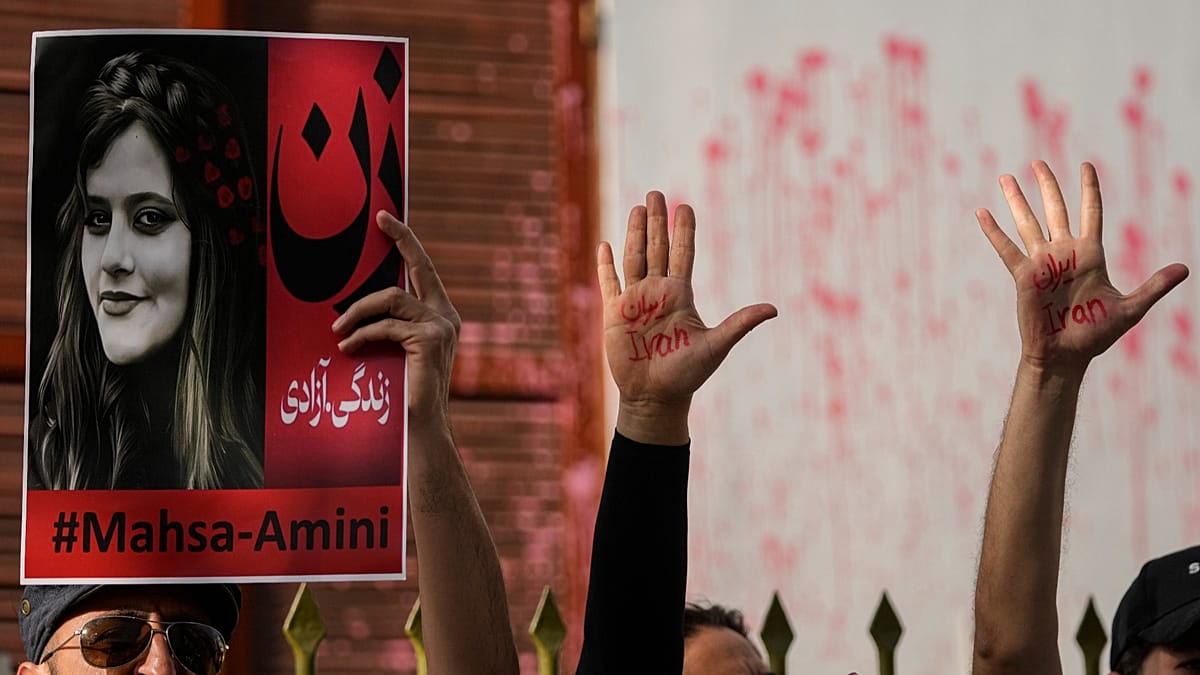
Human rights groups said those who directed the violent suppression of the 2022 protests still control Iran’s security apparatus, as Kurdish businesses shuttered across her home region and the UN Special Rapporteur said four years of state violence had failed to extinguish the resistance.
Four years after the death of Mahsa Amini in Iranian police custody, Kurdish businesses across her home region staged a general strike on Wednesday while international human rights organisations warned that those responsible for crushing the 2022 protests remain in power and continue to use the same methods.
Shopkeepers and businesses in Saqqez, Sanandaj, Mahabad, Marivan, Baneh and Bokan shut their doors following a call by Kurdish political coalitions. Video circulating on social media showed empty bazaars across the region.
Amnesty International, in a report marking the fourth anniversary, said those who directed the violent suppression of the 2022 protests still control Iran’s security apparatus.
<a href="https://warsaw.today/we-need-ai-for-health-done-in-a-european-way-von-der-leyen-says/” title=”‘We need AI for health’ done in a European way, von der Leyen says”>European Parliament President Roberta Metsola (Malta/EPP) said on X that the Parliament would continue to support young Iranians facing execution or imprisonment, singling out the case of twin sisters Taraneh and Romina Rahimi, sentenced by Tehran’s Revolutionary Court after recent protests.
The European Parliament “will keep their light shining until it breaks through the darkness.”, Metsola wrote on X.
UN Special Rapporteur on Human Rights in Iran Mai Sato said that four years of brutal state violence — including lethal force deployed during nationwide protests in late 2025 and early 2026 — have failed to extinguish the resistance.
“Four years on, the resistance Jina’s death gave rise to has not been extinguished,” Sato said in a statement on X.
“The women and girls who took to the streets in her name still insist on the right to decide what they wear, where they work and how they live… Those rights will not stay deniable forever.”
Sato also noted that despite the Law on Protecting the Family through the Promotion of the Culture of Chastity and Hijab being formally suspended since December 2024, cafes, restaurants and shops have continued to be closed for hijab violations, with arrests reported in some cases.
What happened to Mahsa Amini?
Amini, 22, was detained by Tehran’s morality police on 13 September 2022 over compulsory hijab rules and died three days later after being brutally beaten in custody.
The UN Independent International Fact-Finding Mission on Iran concluded she had been subjected to physical violence in custody and that Iranian authorities were responsible for her death. Iranian officials rejected the findings and denied she had been physically assaulted.
Protests spread nationwide in the days after her death. While compulsory hijab and women’s rights were central, the movement drew together demands for political freedoms, minority rights, economic justice and changes to the political system.
The UN fact-finding mission documented up to 551 deaths across 26 provinces, including at least 49 women and 68 children, and said some violations — including killings, torture, rape and sexual violence — reached the threshold of crimes against humanity.
Tehran acknowledged detaining more than 22,000 people which also documented enforced disappearances, unfair trials and death sentences
Tehran pivots to hi-tech
Compulsory hijab remains law, the political structure is intact, and many participants in the protests are in prison, in exile or under sentence.
The regime has shifted enforcement away from morality-police patrols toward cameras, facial recognition, drones and digital tools. Iran’s police announced in 2023 that public cameras would be used to identify women not wearing hijab.
The UN fact-finding mission’s 2025 report cited facial recognition being used to monitor students’ dress at the entrance to Amirkabir University in Tehran.
A 2025 study published in the journal Iranian Studies at the University of Cambridge described the movement as producing a “cultural revolution” alongside a political one, arguing it weakened the state’s ideological hold over public and cultural life.
For instance, images of morality police vans detaining women on the streets were among the most potent symbols of the 2022 protests, prompting Tehran to avoid public confrontation methods.
The growing presence of women without headscarves in public spaces and the central place women’s rights and freedoms take in political debate show that the situation has not reverted to where it stood before September 2022 — a direct result of the movement’s actions.
Source: www.euronews.com
