

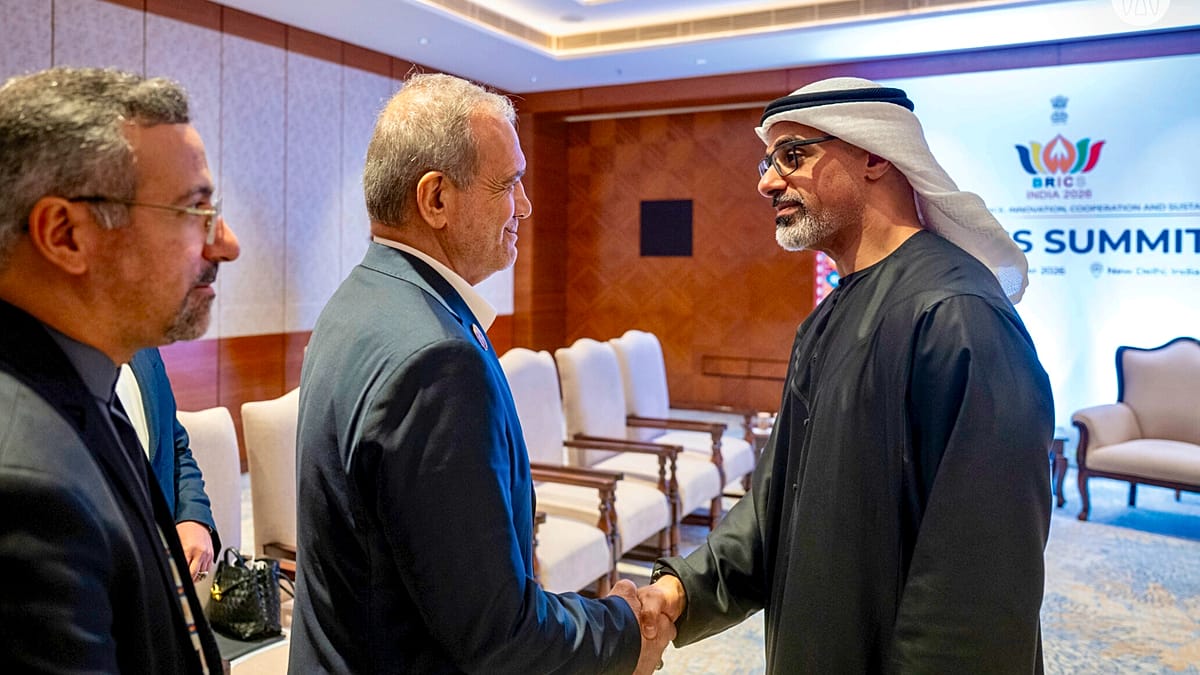
The talks follow the UAE’s suspension of trade and financial dealings with Iran in August and follow UAE’s firm position that trust with Iran “is a mountain to climb” after Iran’s attacks on the Gulf countries.
Abu Dhabi Crown Prince Sheikh Khaled bin Mohamed bin Zayed Al Nahyan met Iranian president Masoud Pezeshkian on Sunday during the BRICS summit in India, weeks after the UAE announced a suspension of trade and financial dealings with Tehran.
The talks mark the countries’ highest-level meeting since the start of the US-Israel war with Iran, as the UAE has been making it clear through presidential diplomatic adviser Anwar Gargash that “trust is the mountain we will have to climb,” as “geography leaves us no alternative to engagement,” but that those relations will need to be judged by actions and not words to rebuild the shattered trust.
The Abu Dhabi Media Office said the two leaders stressed the importance of supporting efforts to reduce tensions and strengthen regional stability.
On 19 August, the UAE’s foreign ministry announced that it had halted all trade and financial transactions with Iran until further notice, citing regional escalation.
The same statement reaffirmed the UAE’s commitment to dialogue and regional cooperation. Saturday’s account of the meeting did not announce a change to the trade restrictions or a specific agreement between the two countries.
Former head of Israel’s military intelligence research department Danny Citrinowicz explained in a post on X that “despite all the bad blood between Abu Dhabi and Tehran, the emerging Gulf approach, and particularly the UAE’s, is increasingly clear: manage the Iranian risk rather than push Tehran into a corner.”
“This does not mean trust. Rebuilding even a basic level of confidence between the two sides will take years. But from Abu Dhabi’s perspective, maintaining channels with Tehran is itself a form of strategic hedging. The UAE has little interest in becoming a frontline state in another regional war,” the Israeli security analyst said.
Calls to protect trade and energy
Both countries are members of BRICS, the group of emerging economies that includes Brazil, Russia, India, China and South Africa.
They backed the summit’s New Delhi Declaration, adopted on Saturday, which expressed concern over escalating tensions in the Middle East and called for “maximum restraint”.
The declaration urged the protection of civilians and civilian infrastructure, respect for national sovereignty and a lasting settlement through diplomacy. Leaders also called for cooperation to keep global trade, supply chains and energy moving, in line with international law.
Chinese President Xi Jinping urged BRICS to help bring peace to the region, saying China would work with other members towards that goal.
The declaration also criticised unilateral tariffs and sanctions and supported further work on international payments and trade using members’ own currencies.
Speaking on Sunday at the BRICS Plus outreach session, which brings members together with other invited countries, Pezeshkian said attacks on a country’s economic and energy infrastructure had consequences beyond its borders.
He said unilateral sanctions affected food security and people’s welfare, and called for greater use of national currencies and a stronger role for the New Development Bank, the lender established by BRICS countries.
Hormuz talks planned in Oman
Separately, Pezeshkian said Arab foreign ministers were due to meet in Muscat on Monday to sign an agreement establishing a joint Iran-Oman shipping route through the Strait of Hormuz, disregarding the Gulf countries’ united position that the strait must be open to free international navigation.
The UAE president’s diplomatic advisor Anwar Gargash underlined days ago the country’s firm position that it would not accept a single state’s control of the strategic Strait of Hormuz and that it was unacceptable for oil tankers to be threatened and attacked while attempting to transit the key waterway.
“Our energy exports will not be held hostage, nor will our trade and economic activity,” Gargash said.
In an interview published on Saturday, Pezeshkian said the International Maritime Organisation would then be informed of the agreement.
Iran had already announced on 5 August that it had agreed the location of a proposed shipping route with Oman.
At the time, Iranian foreign ministry spokesman Esmaeil Baghaei said the arrangement alone could not guarantee safe navigation while the US naval blockade and other actions against Iran continued.
Pezeshkian also said in Saturday’s interview that Iran would reopen the strait when the United States ended its blockade and attacks. His remarks did not set a date for reopening the waterway.
On Sunday, Qeshm governor Amir Teymouri said one person had been killed after a merchant vessel was struck near Iran’s Hengam and Qeshm islands. He did not identify the
Source: www.euronews.com

2 Comments
Pingback: The Iran war reveals the limits of BRICS - Warsaw.Today
Pingback: Sports travel is having its 'Eras Tour' moment. Airlines have noticed - Warsaw.Today